Your trees may look like the problem. A low limb over the driveway, a canopy scraping the roof, deadwood hanging above the patio. In Dallas, that's usually why people start looking for a tree trimming service.
But the bigger issue often sits below the canopy.
On North Texas properties, neglected limbs and poorly managed canopy growth can redirect runoff, choke swales with debris, overload irrigation patterns, and push water toward beds, hardscape edges, and foundations. Tree work isn't just cleanup. Done correctly, it's part of how you protect the whole site.
What Professional Tree Trimming Really Means
'Tree trimming' is often considered to be cutting off whatever looks overgrown. Professional arboriculture is narrower than that and more deliberate. The goal isn't to make a tree smaller at any cost. The goal is to improve structure, manage risk, and keep the tree compatible with the site around it.
A good way to think about it is this. A trained arborist prunes with a plan. A hack cuts until the complaint goes away.
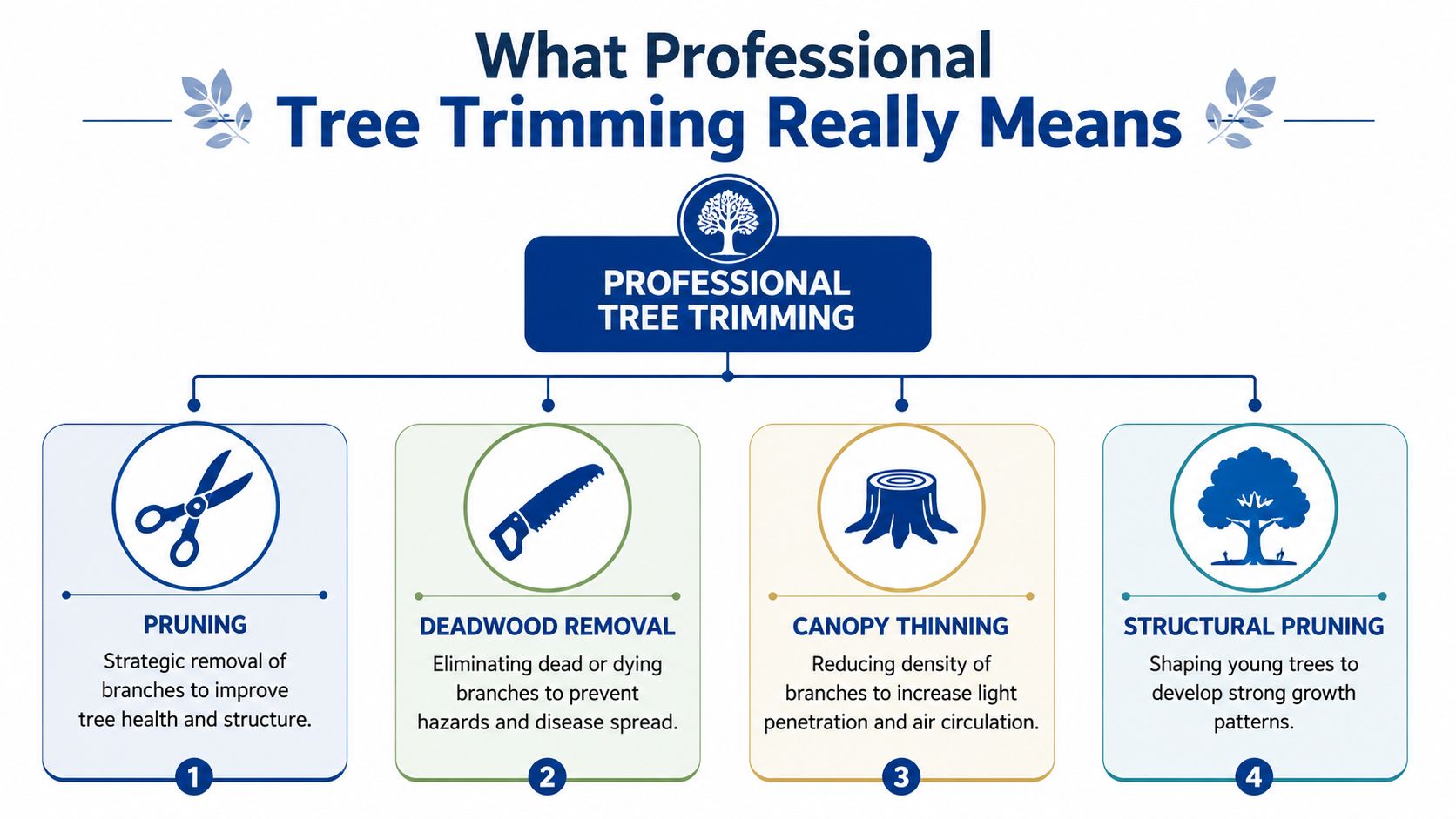
Four types of work that get called trimming
Professional trimming usually falls into a few different categories, and each one solves a different problem.
- Crown thinning removes selected interior branches so light and air can move through the canopy. This isn't stripping the tree out. It's controlled reduction of density.
- Crown raising removes lower limbs to create clearance over drives, sidewalks, turf areas, fences, and structures.
- Crown reduction shortens portions of the canopy to reduce end weight and overall spread while preserving a natural form.
- Hazard removal targets dead, cracked, hanging, or structurally weak limbs that can fail over people, roofs, vehicles, or service lines.
Those categories matter because the wrong cut creates the next problem. Over-thinning can trigger stress growth. Topping can destroy structure. Random lion-tailing can shift weight to branch ends and make failure more likely in storm season.
Practical rule: If a crew can't explain which pruning objective they're using and why, they're probably just cutting for appearance.
What works and what doesn't
Good pruning starts with branch unions, load distribution, species habit, and the tree's age. On a mature live oak, for example, the work often focuses on weight management, canopy balance, and selective deadwood removal. On a young cedar elm, structural pruning may matter more than appearance because you're setting the scaffold for the next decade.
Bad tree work usually has a familiar look:
- Stub cuts that don't heal cleanly
- Flush cuts that remove protective tissue at the branch collar
- Topping cuts that invite weak regrowth
- One-sided canopy reduction that leaves the tree imbalanced
- Too much interior clearing that exposes bark and shifts wind load
That last point matters more than homeowners realize. When the canopy changes, the site changes with it. Shade patterns shift. Understory plants dry out faster. Surface runoff behaves differently. Areas that stayed stable start eroding.
For Dallas properties with grading issues, I look at trees as part of the drainage system, not separate from it. Limb structure affects light, leaf drop, root zone competition, and the way water moves through the site. That's one reason tree selection and placement matter as much as pruning technique on North Texas sites. For homeowners planning bigger improvements, this guide to choosing the right trees for North Texas landscapes helps connect the planting decision to long-term maintenance.
The Best Times for Tree Trimming in North Texas
Timing changes how a tree responds to pruning. In Dallas, the calendar isn't just a scheduling issue. It's a biological one.
For most species, late winter is the preferred window. Trees are dormant, sap bleeding is minimal, and pruning wounds heal faster as spring growth begins. Arborists in regions like Dallas widely recommend that timing, and the broader tree trimming services industry in the United States grew by an average of 6.1% per year from 2020 to 2025, according to IBISWorld's tree trimming services industry data.
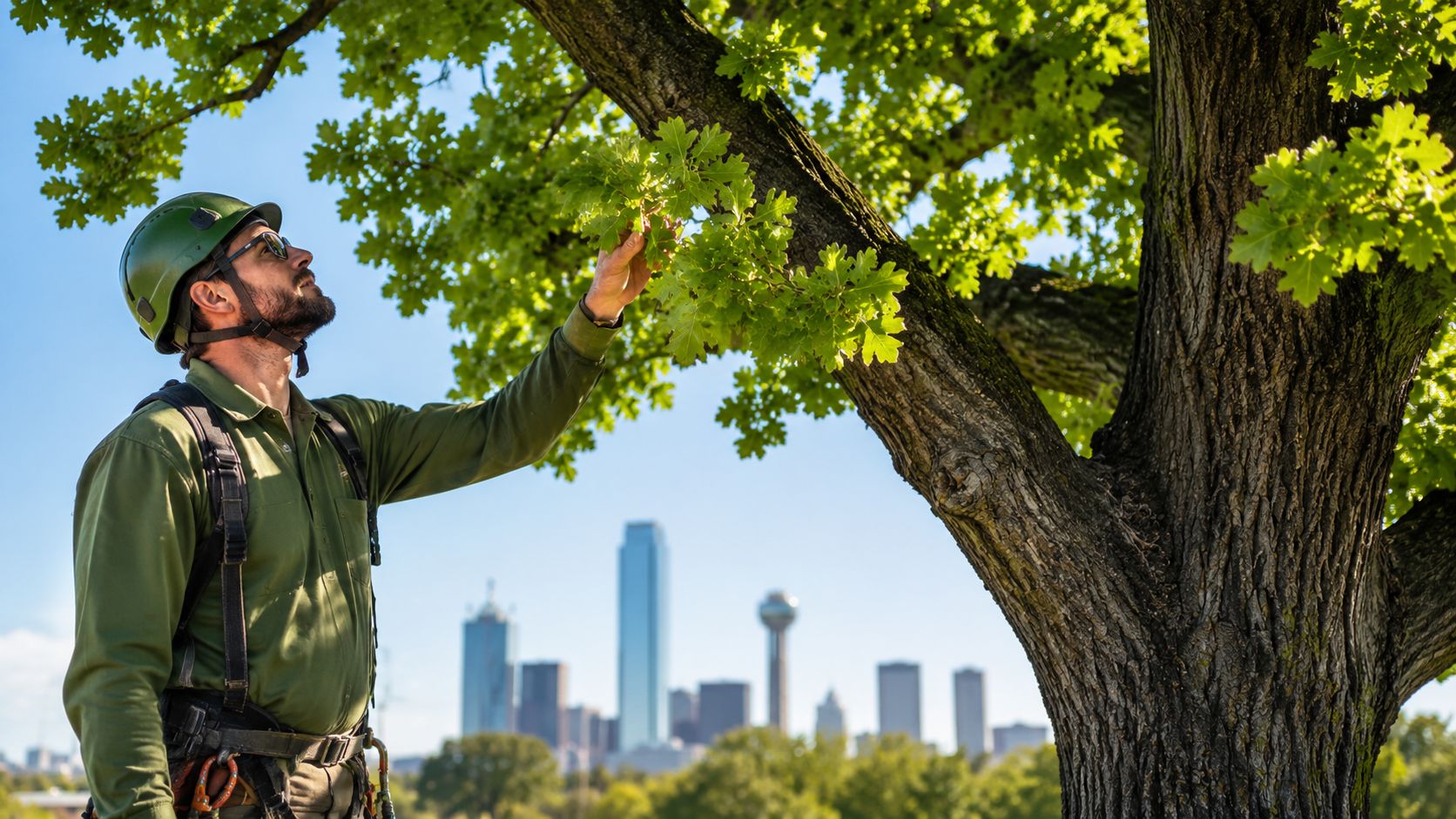
Why late winter works
Dormant-season pruning gives you better visibility into branch structure. Without full leaf cover, it's easier to spot crossing limbs, weak unions, deadwood, and poor architecture. That improves cut selection.
It also reduces avoidable stress. A tree that's already managing summer heat, reflected pavement heat, and inconsistent rainfall doesn't need unnecessary pruning at the wrong time. In North Texas, the combination of heat and storm exposure makes restraint as important as action.
Timing by site condition
That doesn't mean every tree should wait for late winter. The right answer depends on the problem in front of you.
If a limb is cracked over a play area, dragging across shingles, blocking vehicle clearance, or interfering with service access, you address the hazard when you find it. If canopy density is contributing to gutter overflow, poor turf vigor, or drainage choke points, selective work may be justified sooner.
A practical schedule often looks like this:
- Dormant-season structural pruning for overall canopy management
- Pre-storm cleanup for dead, rubbing, or overextended limbs
- As-needed hazard response after wind events or visible failure signs
Trees don't care about your calendar, but they do respond to your timing. Trim with the growth cycle, not just the HOA notice.
What homeowners often miss
The most common mistake isn't pruning too late. It's waiting until the tree announces the problem with broken limbs, blocked drainage, or a sudden clearance issue.
A proactive tree trimming service in Dallas should look at more than canopy shape. It should account for rooflines, irrigation overspray, bed drainage, turf competition, and how debris moves across the property during heavy rain. That's where timing and technique start working together. You aren't just pruning the tree. You're reducing pressure on the entire property system.
Understanding Dallas Tree Trimming Costs
A Dallas homeowner usually calls about price after a problem shows up. Limbs are scraping the roof, gutters are packing with leaves, and water is spilling out of downspouts into already saturated beds near the foundation. At that point, trimming is no longer just about appearance. It is part of preventing runoff problems that can cost far more than the pruning itself.
Dallas pricing starts with tree size, then shifts based on risk, access, and the amount of control the crew needs during the work. According to Angi's Dallas tree service cost guide, the average cost of trimming a small tree under 25 feet is $132, a medium tree between 25 and 60 feet is $412, and a large tree over 60 feet is $824.
2026 average tree trimming costs in Dallas, TX
| Tree Size (Height) | Average Cost Range |
|---|---|
| Under 25 feet | $100 to $350 |
| 25 to 60 feet | Average $412 |
| 60+ feet | Average $824 |
Those numbers help with budgeting. They do not tell you whether the quote solves the actual property issue.
What changes the final price
Two trees of similar height can land at very different prices. A live oak in an open front yard is one job. The same size canopy hanging over a tile roof, drainage swale, and irrigation zone is another, because every cut has to be planned around what sits below it and where debris will go if a storm hits next week.
The variables that move a quote up or down usually include:
- Access limits. A backyard tree behind a narrow gate takes more labor than one with clear equipment access.
- Targets below the canopy. Pools, fences, glass, lighting, roofs, and utility service lines require slower rigging and more controlled lowering.
- Tree condition. Deadwood, included bark, decay, cracks, and storm damage change how a climber or bucket crew approaches the work.
- Pruning objective. Crown raising for clearance prices differently than selective reduction to reduce end weight over a structure or drainage path.
- Debris handling and site protection. Haul-off, chipping, plywood paths, and protecting turf, hardscape, and garden beds all add time.
Low bids often skip the expensive part. That is usually debris control, protection of beds and irrigation, or the careful reduction cuts that keep limbs from shedding into drainage routes during heavy rain.
Trimming versus removal
Homeowners sometimes compare trimming to removal as if they are close substitutes. They are not. As noted earlier from the same Dallas cost source, removal runs much higher than trimming, and stump grinding adds another line item. If the tree can be preserved, pruning is often the better investment because it reduces failure risk, keeps shade on the house, and helps prevent the leaf load and branch drop that clog inlets, gutters, and shallow yard drains.
That last point gets missed a lot in Dallas. Overgrown canopies can dump a surprising amount of organic debris into swales, area drains, and mulch beds during a single storm. Once that flow path slows down, water starts backing up where you do not want it, around paving, turf edges, and foundations.
How to read a quote like a property owner
A useful proposal should explain the objective of the pruning, not just promise to "trim trees." Good tree work is specific. The crew should be able to tell you whether they are removing deadwood, reducing end weight, raising clearance, correcting storm damage, or thinning only where it improves airflow without overstressing the tree.
Ask for these details if they are missing:
- Which limbs or canopy sections are included
- Whether deadwood removal is part of the scope
- Whether roof, driveway, or service-line clearance is included
- How the crew will protect lawn, irrigation, garden beds, and hardscape
- Whether haul-off and cleanup are included
- Whether the pruning plan considers runoff paths, gutters, or low spots that collect debris
That level of detail tells you whether you are paying for real tree care or just paying for cuts. On North Texas properties, the difference shows up later in tree health, storm performance, and how well the rest of the yard handles water.
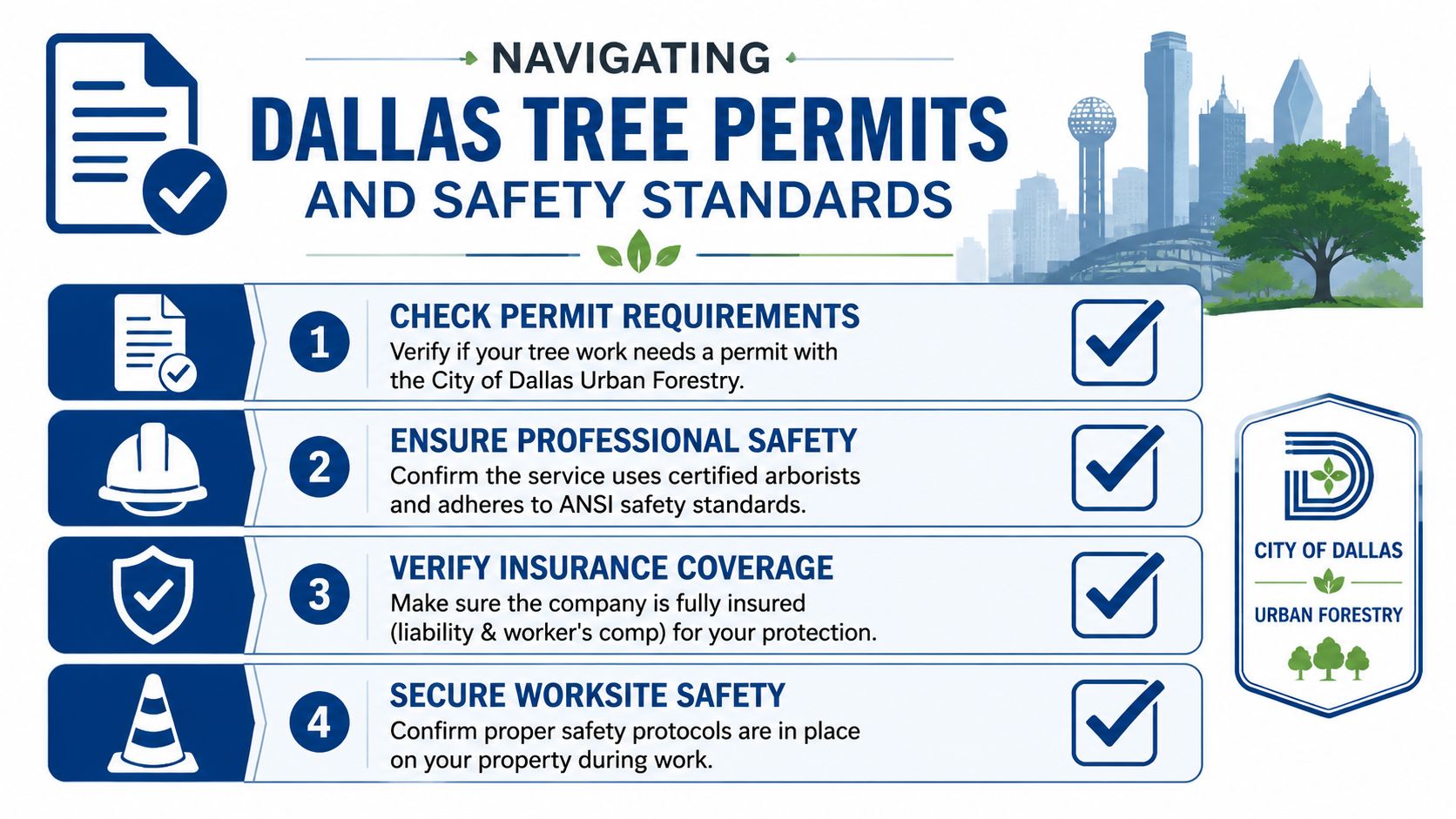
Navigating Dallas Tree Permits and Safety Standards
Tree work can create legal exposure for the homeowner long before the first cut is made. In Dallas, that matters most when the tree may qualify as protected or when the work happens near power lines, streets, or structures.
Homeowners often assume permits are only for full removals on commercial sites. That's a mistake. On many residential properties, tree size, lot conditions, and species identification affect what the city requires.
Protected trees and mitigation
In Dallas, removing a protected tree often requires mitigation under city code. A protected tree is typically one with a diameter of 6 inches or greater measured 12 inches above ground, and removal can trigger an inch-per-inch replacement requirement or payment into the city's Reforestation Fund. Non-compliance can lead to fines of up to $2,000 per tree, according to this summary of Dallas protected tree permit requirements.
That same guidance notes an arborist survey is essential because species and diameter determine whether mitigation applies. Some non-protected species are exempt, but you don't want to guess. Guessing is how property owners end up with a violation after the crew is gone.
Safety isn't optional on tree crews
The second issue is worksite safety. Professional tree trimming near energized lines, steep grades, traffic areas, or confined backyards isn't casual labor. It requires procedures.
The Texas Department of Insurance resource covering tree trimming safety references OSHA standards 29 CFR 1910.268, 29 CFR 1910.269, and 29 CFR 1910 Subpart S, along with requirements for hazard assessment, drop zones, inspected climbing gear, and maintaining a minimum 10-foot clearance from power lines unless specialized insulated equipment is used. Those details appear in this Texas tree trimming safety guidance.
A competent crew should already be doing the following:
- Hazard assessment first before anyone climbs or cuts
- Drop zone control with cones, barriers, and clear communication
- Utility coordination when limbs are near energized conductors
- Equipment inspection at the start of the shift
- Emergency planning for aerial rescue or injury response
What to ask before approving the job
Don't overcomplicate the interview. Ask direct questions.
- Is any permit review needed for this tree?
- Did you verify whether the tree is protected?
- How will you handle work near service lines or public areas?
- What site protection measures are included?
- Will an arborist evaluate structure, species, and risk before cutting?
If a contractor shrugs off permits or treats line clearance like routine yard work, move on. The homeowner carries real risk when the crew doesn't know the code or the safety rules.
How Integrated Tree Care Protects Your Property's Drainage
A common Dallas call goes like this. The owner wants limbs trimmed off the roof and driveway, but the bigger expense is already taking shape below the canopy. Water is backing up in a swale, mulch keeps washing out, and the soil near the slab stays wet after every hard rain. In many cases, the pruning issue and the drainage issue are part of the same problem.
Unchecked canopy growth changes how water moves across a North Texas property. Low limbs catch leaves before they reach collection points. Heavy shade slows dry-out in turf and bed areas. Debris piles up along edges and shallow drainage routes, then runoff jumps the path it was supposed to follow. What starts as overdue pruning can turn into erosion, soggy planting areas, and foundation-side moisture.

Tree work and drainage affect each other
Crews that treat tree trimming as a stand-alone task often miss the site conditions that are driving repeat problems.
A dense canopy over a drainage route can create several issues at once:
- Leaf and twig buildup slows runoff in swales, drains, and bed edges
- Persistent shade keeps soil wet longer and thins turf that would otherwise hold grade
- Overflow and erosion start when water spills past a blocked edge or low spot
- Irrigation mismatch develops as light levels change but spray patterns and run times do not
Homeowners usually notice the branches first. The expensive repair shows up later in the ground plane.
What a good site review checks before cutting
Proper tree care on a Dallas property should include more than canopy measurements. The arborist needs to read the whole site. That means checking where debris collects, how water exits the lot, whether roots are heaving hard surfaces, and how irrigation, grading, and canopy density are interacting.
The right pruning plan depends on the failure point. Sometimes selective thinning reduces debris load and improves air movement. Sometimes crown raising keeps a swale open and prevents repeated clogging. If root stress or compaction is part of the decline, follow-up care may include deep root fertilization for stressed North Texas trees.
I see this on older Dallas lots all the time. A tree can be structurally sound and still contribute to water problems because nobody adjusted the canopy, irrigation coverage, or surface drainage as the site matured.
Why coordinated work protects the property better
Rosewood's approach matters because tree care decisions affect grading, irrigation, and long-term site performance. If one crew removes weight from the canopy but nobody addresses the flattened swale below it, the property is still exposed to the same runoff problem. If lower limbs are lifted without accounting for heat and sun exposure, turf and understory plantings may need changes too.
That coordination saves money in the long run. It reduces repeat cleanup, limits erosion repairs, and helps protect foundations, paving, planting beds, and mature trees at the same time.
Single-service trimming can make a tree look cleaner for the moment. Integrated tree care does more. It helps keep water moving where it should, which is one of the most overlooked ways to protect a North Texas property.
Your Tree Care Process with Rosewood from Start to Finish
Most homeowners don't need more jargon. They need to know what happens after they make the call.
A professional process should feel organized from the first visit through the last cleanup pass. That reduces surprises, helps the crew work safely, and gives you a clear record of what was done on the property.
Step one through site review and diagnosis
The job starts on site, not over text messages and a blurry tree photo. The evaluator needs to see branch structure, site access, targets beneath the canopy, and any signs that the tree issue is tied to irrigation, decline, or drainage.
If the tree shows stress, decline, or abnormal leaf and bark symptoms, that should be addressed before anyone starts removing canopy volume. Some situations call for pruning. Others need a health-focused plan first, such as targeted tree disease treatment.
Step two through written scope and scheduling
After the inspection, the proposal should describe the work in plain language. Not just "trim oak in front yard." It should identify the pruning objective, the cleanup expectations, and any access or safety constraints that affect the schedule.
Good scheduling also accounts for weather, utility conflicts, and property use. If the crew needs clear access to a side yard, locked gates, pet coordination, or protection around outdoor features, that should be settled before arrival day.
Step three through execution and cleanup
On work day, a trained crew should control the site before cutting begins. That includes equipment placement, drop-zone management, and a clear debris path that doesn't destroy beds, turf, or irrigation heads.
The final pass matters. A professional finish includes:
- Debris removal from lawn, beds, and hard surfaces
- Rake and blow cleanup so small material isn't left in drains or mulch
- Cut review to confirm the pruning objective was met
- Owner walkthrough when needed, especially on larger or more technical jobs
That process gives you something many tree jobs don't. Clarity.
When you're evaluating a tree trimming service in Dallas, that clarity is part of the value. You're not hiring someone to wave a saw at the canopy. You're hiring a crew to make the tree safer, keep the property functioning, and avoid creating the next problem in the process.
If your property has overgrown canopies, drainage choke points, or trees crowding structures and hardscape, Rosewood Landscape Group can evaluate the site and outline a practical scope for tree care, drainage, and property protection.
Related posts
8 Best Shrubs for North Texas Landscapes in 2026
Permeable Paver Installation: A DFW Homeowner’s Guide

Zoysia Grass Fungus: Identify, Treat & Prevent in 2026
How to Improve Soil Quality: Easy Ways to Improve Soil
Take All Root Rot: Diagnose & Treat Your Lawn