A lot of DFW homeowners notice the problem the same way. One week the Live Oak looks full and steady. Then a stretch of hard heat, a burst of rain, or a sharp pruning cut later, the canopy starts thinning, leaves discolor, or a branch suddenly dies back. If it's a Magnolia, the leaves may look scorched or spotted. If it's a Red Oak, the decline can feel alarmingly fast.
That's the moment when people often start searching for tree disease treatment and hoping there's a spray, a fertilizer, or a one-time fix.
Sometimes there is a useful treatment. Often there isn't a cure in the way homeowners mean it. The practical path is to diagnose the problem correctly, reduce stress on the tree, use sanitation and pruning where they help, and bring in professional treatment when the disease and the species call for it. In North Texas, that matters because the same symptom can point to very different causes on Live Oaks, Red Oaks, and Magnolias.
Is Your DFW Tree Sick or Just Stressed
A stressed tree and a diseased tree can look surprisingly similar in North Texas. Yellowing leaves in summer, thin canopy sections, marginal leaf burn, and branch dieback can come from disease, but they can also come from drought, overwatering, compacted soil, planting depth issues, or construction damage around the root zone.
That confusion is common in DFW environments because our trees deal with abrupt swings. A Magnolia may struggle in reflected heat near pavement. A Live Oak may hold on through dry weather and then show stress after root disturbance. A Red Oak may look fine until it doesn't.
What stress often looks like
Stress tends to show up in patterns tied to the site.
- Heat exposure: Leaves scorch on the outer canopy or on the side facing hot pavement or masonry.
- Water imbalance: You see general decline, limp foliage, or uneven leaf drop after erratic irrigation.
- Root problems: The tree looks weak overall, not just in one limb or one section.
- Recent site work: Symptoms begin after trenching, grade changes, or traffic over the root area.
A disease pattern is often more specific. You may see distinct lesions, cankers, blackened shoots, unusual fungal growth, or one branch dying in a way that doesn't match the rest of the canopy.
Practical rule: Don't treat the symptom before you understand the cause. A fungicide won't fix buried root flare, compacted soil, or summer water stress.
Why DFW homeowners misread tree decline
Live Oaks and Red Oaks don't respond the same way to disease pressure. Magnolias also react differently than either oak. A homeowner may see leaf drop and assume infection, when the bigger issue is soil oxygen, drainage, or a root system that's been stressed for months.
That's why sound tree disease treatment always starts with a simple question: is the tree under abiotic stress or dealing with a biotic disease?
A useful way to think about it is this. Stress weakens the tree first. Disease often takes advantage of that weakness second. If you skip the first part, treatment usually disappoints.
Diagnosing Common Tree Problems in North Texas
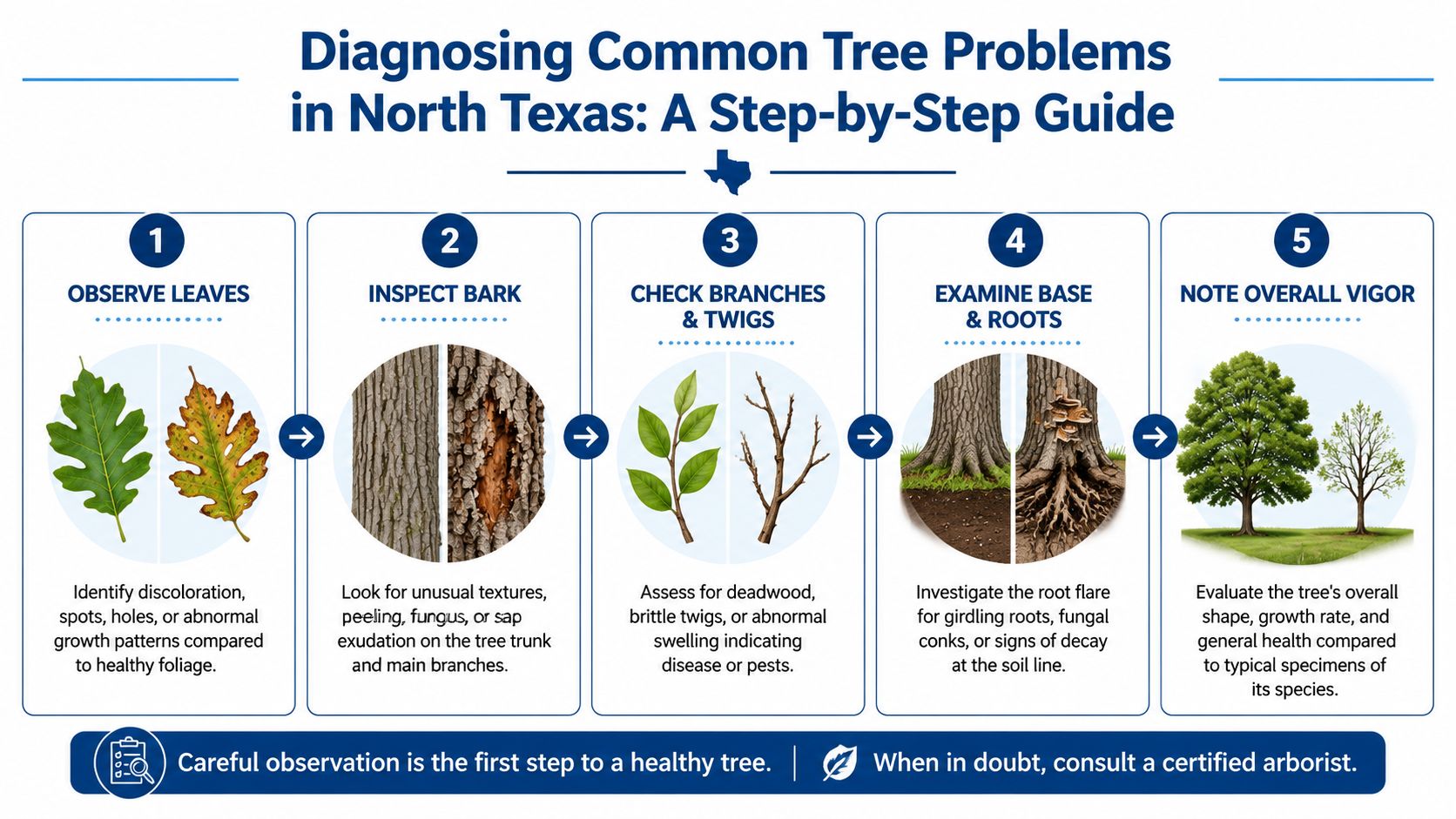
The right diagnosis starts with observation, not products. A professional workflow begins by inspecting the canopy, trunk, roots, and soil, then separating abiotic stress from biotic disease. For valuable trees or unclear cases, lab confirmation can make sense. One-time sprays without a clear target are a common failure point, as noted in this guidance on diagnosis-first tree disease management.
Start at the top and work down
Don't walk straight to the trunk and guess. Stand back first and look at the entire silhouette.
Check the canopy shape
Is the thinning uniform, or is one side failing first? Uniform stress often points to root or irrigation issues. Isolated flagging can suggest disease, branch injury, or vascular disruption.Inspect leaves and shoots
Look for spotting, scorching, curling, blackened tips, or wilted leaves that remain attached. On Magnolias and ornamentals related to pears or apples in gardens, blackened shoot tips can raise concern for fire blight.Examine bark and branch unions
Cankers, cracking, sloughing bark, sap flow, and dead patches matter. On weakened oaks, Hypoxylon can show up after stress has already reduced the tree's defenses.Look at the root flare and soil line
If the trunk goes straight into the ground like a telephone pole, the tree may be planted too deep. Also watch for mulch piled on the trunk, fungal growth near the base, girdling roots, and soggy or rock-hard soil.Review the recent history
Has the tree been pruned recently? Was there trenching, new sod, drainage work, or grade change? Has irrigation changed? The timeline often solves the mystery.
Common DFW tree disease identification
The table below isn't a lab test, but it's a practical field guide for the trees homeowners in North Texas ask about most.
| Disease | Common DFW Host Trees | Key Symptoms |
|---|---|---|
| Oak Wilt | Red Oaks, Live Oaks | Sudden wilting, leaf discoloration, canopy decline. Red Oaks often decline fast. Live Oaks may show more gradual branch and canopy loss. |
| Hypoxylon Canker | Live Oaks, Red Oaks and other stressed hardwoods | Thinning canopy, branch dieback, bark sloughing, exposed fungal crust on trunk or large limbs after stress. |
| Fire Blight | Ornamental pears and related hosts, sometimes confused with other shoot blights in mixed landscapes | Blackened or scorched-looking shoots, wilted tips, dead blossoms or twig ends that appear burned. |
| Anthracnose | Oaks and other shade trees in wet periods | Irregular brown blotches, distorted leaves, early leaf drop, patchy thinning. |
| Leaf spot and foliar fungal issues | Magnolia and many ornamentals | Spotted leaves, cosmetic decline, premature drop, repeated issues during wet weather. |
What homeowners get wrong most often
The most common mistake is treating all decline as a leaf problem. It isn't. The leaves are often just reporting what the roots, trunk, or vascular system are already dealing with.
Another mistake is assuming every discolored oak has Oak Wilt. In practice, many trees in DFW are stressed first and diseased second. That's one reason a broader plant health care approach for trees and shrubs is often more useful than chasing symptoms one by one.
A good diagnosis answers two questions at the same time. What is hurting the tree, and what made the tree vulnerable in the first place?
Immediate Triage and First Aid for Your Trees
When a tree starts declining, the first response shouldn't be panic pruning or blanket spraying. It should be stabilization. Good first aid gives the tree a better chance while you sort out the cause.
Safe actions you can take right away
These steps are low-risk and useful in many DFW situations:
- Water thoroughly, not constantly: Trees handle deep soak cycles better than shallow daily watering. The goal is moisture in the root zone, not a wet surface every evening.
- Refresh mulch correctly: Keep mulch over the root area, but pull it away from direct trunk contact. Mulch helps moderate soil temperature and moisture when applied correctly.
- Clean up fallen material: Remove diseased-looking leaves, twigs, and small branch debris so pathogens have less material to overwinter or spread from.
- Pause unnecessary pruning: Don't start cutting major limbs until you know what you're dealing with.
- Protect the root zone: Keep vehicles, heavy foot traffic, and stacked materials off the area under the canopy.
What not to do
Some well-meant responses make tree disease treatment harder.
- Don't overfertilize a declining tree: Pushing growth on a stressed root system can backfire.
- Don't top the tree or thin it aggressively: Large cuts add stress and create more entry points.
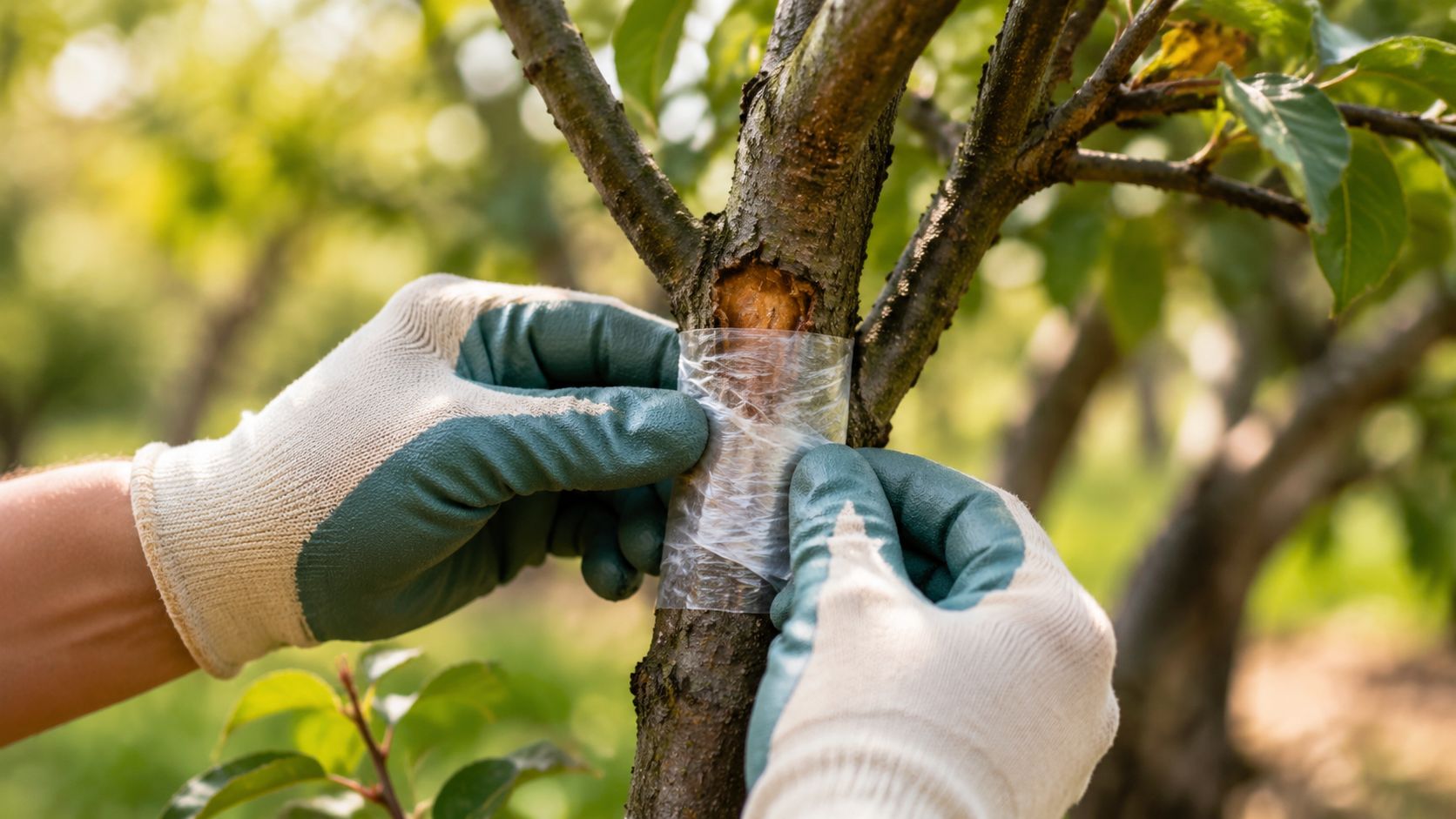
- Don't wrap the trunk with random materials for long-term “healing”: Trees don't heal like skin. Proper wound response depends on tree biology, not sealing everything over.
- Don't assume more water is always better: Saturated soil can be just as damaging as drought.
If you don't know whether the issue is fungal, bacterial, environmental, or structural, your first job is support and sanitation.
Why sanitation matters
Many common foliar problems are managed, not cured. Practical guidance for tree disease treatment notes that infected leaves are often removed and destroyed in the fall, and that some fungal branch issues require pruning or fungicide use matched to the pathogen and timing. The same guidance notes that cuts for black knot should be made at least 10 cm below visible symptoms, and that some fungicide leaf treatments or trunk injections work best before bud burst according to this timing-based treatment reference.
Even if your exact problem isn't black knot, the principle holds. Clean up infection sources. Reduce stress. Don't guess with chemicals.
Choosing the Right Tree Disease Treatment Method
Once you have a likely diagnosis, treatment becomes a matter of fit. The right tool depends on the host tree, the disease, the stage of the problem, and whether the issue is in foliage, branches, trunk tissue, or the vascular system.
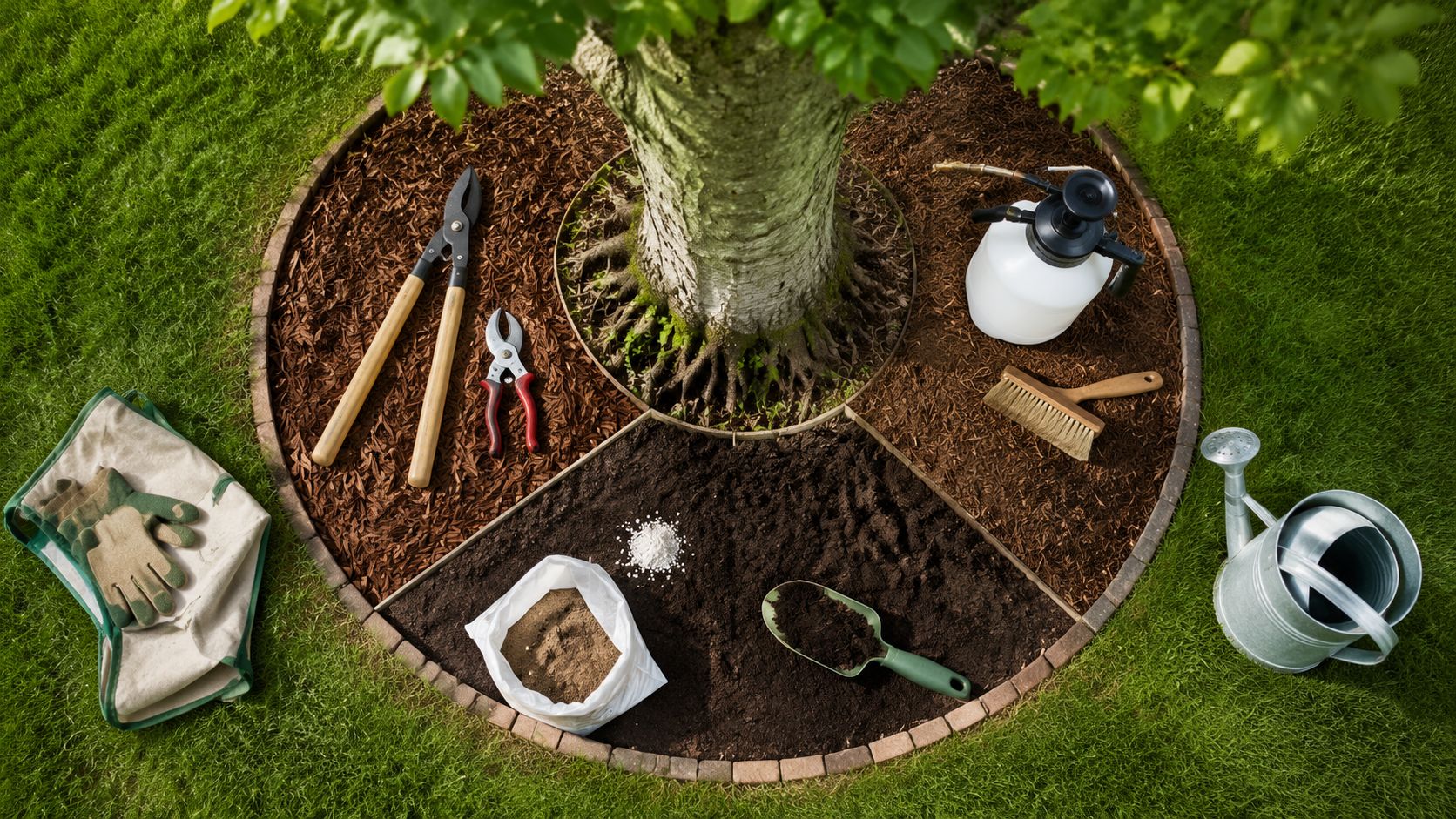
Sanitation pruning
This is often the first true intervention, and sometimes the most useful one.
For branch diseases, cankers on secondary limbs, and dead infected wood, pruning removes inoculum and stops some problems from advancing further into the canopy. It also improves airflow in dense crowns, which can help with recurring foliar issues.
The trade-off is that pruning is only helpful when the infection is still confined to removable tissue. If the trunk is involved, or if the disease is moving through the vascular system, cutting alone won't solve it.
When pruning makes sense
- Dead branch tips and localized dieback
- Visible cankered limbs
- Recurring foliar issues worsened by poor airflow
- Storm-damaged wood that can become an entry point
When pruning isn't enough
- Trunk infection
- Root disease
- Systemic vascular disease
- Widespread canopy collapse
A practical note from the field. Homeowners often undercut infected wood because they stop where the branch “looks better.” That's not enough. Some diseases extend beyond what you can see.
Soil and foliar treatments
Sprays and soil-applied products have a place, but only when they match the disease and its timing.
Foliar treatments may help protect new growth in repeat-problem situations. Soil care can reduce stress, improve vigor, and make the tree less vulnerable to secondary decline. On Magnolias and ornamental trees with repeated leaf diseases, better air circulation, irrigation correction, and sanitation usually matter as much as any product.
Here's the trade-off. Chemical treatment without diagnosis wastes time and often misses the biological window when treatment has any value. A homeowner may spray after symptoms are obvious, when the useful prevention window has already passed.
Field judgment: Products don't replace diagnosis. They only work when the disease, timing, and host line up.
Systemic injections
For high-value trees facing serious disease pressure, trunk injection can be the right tool. This isn't a homeowner treatment. It requires training, proper equipment, and a clear target.
In DFW, this conversation often comes up around Oak Wilt, especially for oaks that are still in a stage where intervention is part of the management plan. Injections can place material directly into the vascular system, which is why they're considered for select cases where foliar or soil approaches won't do the job.
The trade-offs are straightforward:
| Method | Best use | Strengths | Limits |
|---|---|---|---|
| Sanitation pruning | Localized branch problems | Removes infected tissue, improves structure and airflow | Won't solve systemic disease |
| Soil and foliar treatment | Preventive or timing-specific disease management | Useful when matched to disease cycle and site stress | Easy to mistime or misuse |
| Systemic injection | Serious high-value tree cases such as vascular disease scenarios | Direct delivery for select problems | Professional-only, not suitable for every case |
One practical option for homeowners who want diagnosis tied to treatment planning is working with an arborist or a company that provides plant health care rather than only reactive pruning. That can include services like those offered by Rosewood Group, but the key is the workflow, not the label.
Proactive Plant Health Care for a Resilient Landscape
The strongest tree disease treatment plan is the one that prevents the next problem. That's where a year-round plant health care mindset pays off in DFW. North Texas trees don't just face pathogens. They deal with heat load, compacted soils, irrigation mistakes, and storm damage. A resilient tree handles disease pressure better because it isn't already using all its energy to survive the site.
Modern management has moved away from the old idea that reactive sprays are the answer. A historical review of major disease losses shows why. Ash dieback, introduced to Europe from Asia via imported timber, is expected to cause about 70% mortality in affected ash populations, and in the UK it is projected to kill 70 to 90% of native ash trees, more than 100 million trees, over the next 20 years according to this review of tree disease management and biosecurity. The lesson for urban areas is simple. Prevention, sanitation, and limiting spread matter more than hoping every disease has a curative fix.
A DFW maintenance rhythm that works
A practical calendar is more useful than a stack of products.
Winter and dormant season
Use this time for inspection, structural pruning, and root-zone review. You can see branch architecture clearly, spot deadwood, and correct problems before spring growth starts.
Spring growth period
Watch new leaves and shoot growth closely. This is when recurring foliar issues tend to reveal themselves, and when irrigation needs often shift faster than homeowners expect.
Summer stress season
This is when many North Texas trees slide from manageable stress into visible decline. Deep watering, mulch management, and avoiding root-zone disturbance matter most here.
Fall cleanup
Remove diseased leaves and small debris. Fall sanitation reduces carryover for many recurring leaf problems and keeps the site cleaner going into dormancy.
Build health from the soil up
Healthy trees resist problems better. That doesn't mean dumping fertilizer on everything. It means paying attention to aeration, drainage, watering patterns, mulch, and root flare visibility.
For trees that need nutritional support as part of a broader care plan, a targeted service such as deep root fertilization for North Texas trees can fit, especially where compacted urban soils limit root performance. It works best when paired with diagnosis and site correction, not as a stand-alone rescue attempt.
Prevention beats repeated rescue
A homeowner who waits until canopy loss is obvious usually has fewer options. A homeowner who notices site stress early, keeps the root zone healthy, and cleans up seasonal disease debris often avoids the worst outcomes.
That's the practical truth in tree care. The trees that “suddenly” fail usually gave quiet warnings first.
When to Call a Professional from Rosewood Landscape Group
There's a clear point where DIY observation stops being enough. If the tree is large, valuable, near a structure, or declining fast, professional help isn't a luxury. It's risk management.

Call when the diagnosis is uncertain
If you can't tell whether you're looking at Oak Wilt, Hypoxylon Canker, fire blight, root stress, or construction damage, guessing can cost you time the tree doesn't have. This is especially true when multiple trees begin showing similar symptoms or when one tree's decline could threaten nearby plantings.
A professional can inspect the canopy, trunk, roots, and site conditions as one system. That matters because homeowners often focus on the visible symptom and miss the trigger.
Call when safety enters the picture
Dead upper limbs, trunk decay, bark sloughing on major scaffold branches, and root-zone instability can turn a plant health issue into a property hazard. Large oaks over roofs, drives, play areas, or streets shouldn't be trial-and-error projects.
This is also where disease and structure overlap. A weakened tree may still be alive, but that doesn't mean it's safe.
Some trees can be managed for health but still require pruning, load reduction, or removal because the structure no longer gives you an acceptable safety margin.
Call when the right treatment requires equipment or licensing
Systemic injections, advanced diagnostics, and disease-specific treatment plans need trained hands. Oak problems in particular often warrant professional evaluation because timing and tree-to-tree spread are serious concerns in North Texas.
If removal becomes the right call, species selection for what comes next matters too. Replanting with an appropriate tree for the site is part of treatment in the broad sense, not an afterthought. That's where guidance on choosing the right trees for North Texas landscapes becomes useful.
Call when the best answer may be containment or removal
This is the part many homeowners don't want to hear, but it's honest arboriculture. Some diseases don't have a practical cure. In those cases, treatment shifts from saving the individual tree to protecting the rest of the surrounding vegetation.
Professional guidance on certain untreatable pine diseases, for example, includes stand thinning or delaying replanting for 2 to 4 years so the infection source can decay, according to Arkansas Extension guidance on tree disease management. The broader lesson applies well beyond pines. Sometimes removal is the responsible move because it limits spread and preserves healthier trees nearby.
For a homeowner, the decision usually comes down to four questions:
- Is the tree still structurally safe
- Is the disease localized or systemic
- Is there a treatment that matches the actual diagnosis
- Does saving this tree put nearby trees and plants at risk
If you can't answer those confidently, it's time to bring in a professional assessment.
If you're looking at a Live Oak, Red Oak, or Magnolia that just doesn't seem right, Rosewood Landscape Group can evaluate the tree in the context of your entire property, including irrigation, drainage, root-zone conditions, and practical treatment options. The goal isn't to sell a one-size-fits-all fix. It's to determine whether the tree needs support, targeted treatment, containment, or removal so you can protect the rest of your property with a clear plan.
Related posts
8 Best Shrubs for North Texas Landscapes in 2026
Permeable Paver Installation: A DFW Homeowner’s Guide
Zoysia Grass Fungus: Identify, Treat & Prevent in 2026
How to Improve Soil Quality: Easy Ways to Improve Soil
Take All Root Rot: Diagnose & Treat Your Lawn