A lot of Dallas homeowners have the same experience. The lawn looks strong in spring, the beds are full, the trees leaf out well, and then the North Texas summer arrives. By July, parts of the yard are drying out, other areas are soggy, and the water bill is climbing anyway.
That usually isn't a plant problem first. It's a water irrigation system problem.
In North Texas, irrigation has to work with hot wind, hard summer heat, clay-heavy soil, changing rainfall, and periodic watering restrictions. A timer set once in April won't carry the vegetation through August. A system that throws water everywhere may look active, but it often wastes water and still leaves weak spots behind.
Managed water delivery changes outcomes. In agriculture, farms with irrigation produce more than 50% of the total value of U.S. crop sales even though irrigated land represents less than 17% of harvested cropland, which shows how much proper water delivery can amplify performance (USDA irrigation water use). The same principle applies to a residential outdoor space. Water delivered in the right place, at the right rate, on the right schedule, protects the investment you've already made in turf, trees, shrubs, and soil.
Keeping Your North Texas Landscape Green All Summer
A healthy yard in Dallas doesn't stay healthy by accident. It stays healthy because the irrigation matches the site.
What usually goes wrong in summer
Most problem yards don't fail all at once. One strip by the sidewalk turns brown first. Then a sunny corner starts thinning. Then the bed by the foundation gets either too dry or too wet. Homeowners often assume they need more water, but the issue is usually distribution, not volume.
North Texas makes that worse. Clay soil sheds water when it's applied too quickly. Heat pulls moisture out fast. Wind distorts spray patterns. A lawn zone that looked fine in mild weather can struggle once summer stress starts stacking up.
Practical rule: If one area is crispy and another is muddy during the same week, the schedule isn't your only issue. The system likely needs adjustment.
Why the local landscape plan matters
The best irrigation system can't rescue poor plant selection forever. If your property mixes thirsty turf, exposed west-facing beds, and low-water plants on the same schedule, water waste is almost guaranteed. That's why irrigation planning and planting design have to work together.
For many Dallas properties, the smartest long-term move is to reduce the amount of high-demand planting in the toughest parts of the yard and lean more on regionally adapted material. A design built around native plants for North Texas usually gives the irrigation system a much fairer job.
A good summer irrigation setup does three things well:
- Separates unlike areas so turf, shrubs, annual color, and trees aren't watered the same way.
- Applies water at the soil's pace so clay can absorb it instead of shedding it.
- Adjusts through the season rather than running on a fixed habit.
What a good system feels like
You shouldn't have to babysit your sprinkler controller every week. A solid system runs in the background. The lawn stays even. Bed plants don't swing from stress to rot. Trees get slower, deeper watering. You aren't paying to water pavement, fences, or the street.
That's the standard worth aiming for in Dallas. Not more irrigation. Better irrigation.
Choosing the Right Irrigation System for Your Property
Most North Texas homes need more than one irrigation method. Turf, shrubs, annual beds, and trees don't all want water the same way, and treating them as if they do creates waste fast.
Sprinklers for turf and open areas
Sprinklers are usually the right fit for lawns and larger open planting zones. They cover broad areas and can be configured to match small front yards, narrow side yards, or wider back lawns.

For residential turf, two sprinkler styles come up most often:
| System type | Best use | Where it struggles in DFW |
|---|---|---|
| Pop-up sprays | Smaller, more regular lawn shapes | Can apply water too fast for clay if run too long |
| Rotors | Larger turf areas | Need careful spacing and pressure control to avoid dry arcs |
Sprays work well when the lawn area is compact and shape matters. Rotors are often better for larger sections because they throw farther and usually apply water more slowly. But neither is automatically efficient. If pressure is wrong, spacing is off, or heads are mixed poorly in the same zone, coverage falls apart.
Drip for beds, foundations, and trees
Drip irrigation belongs in many Dallas green spaces, especially around foundation plantings, shrub beds, vegetable gardens, and tree rings. It puts water near the root zone instead of broadcasting it into hot air.
That matters in North Texas because summer heat and wind punish overhead watering in beds. Drip also helps when cities tighten watering windows. You can keep ornamental beds alive with less waste because the water goes where the roots can use it.
Drip is especially useful for:
- Foundation beds where overspray on brick or windows is unwanted
- Shrub masses that need steady root-zone moisture
- Trees that benefit from slower, deeper watering
- Mulched planting areas where exposed spray would evaporate quickly
The best answer is often a mixed system
A Dallas yard rarely performs best with all-sprinkler or all-drip design. Turf usually needs sprinkler coverage. Beds usually benefit from drip. Trees often need their own approach instead of sharing a lawn zone.
A system works better when it matches the landscape instead of forcing the whole property onto one watering method.
If you're deciding what to install or upgrade, use a simple filter. Ask what's being watered, how exposed it is to afternoon sun, how quickly the soil can absorb water, and whether overspray creates waste. That leads to better system choices than shopping by brand or head style alone.
The Anatomy of a Healthy Irrigation System
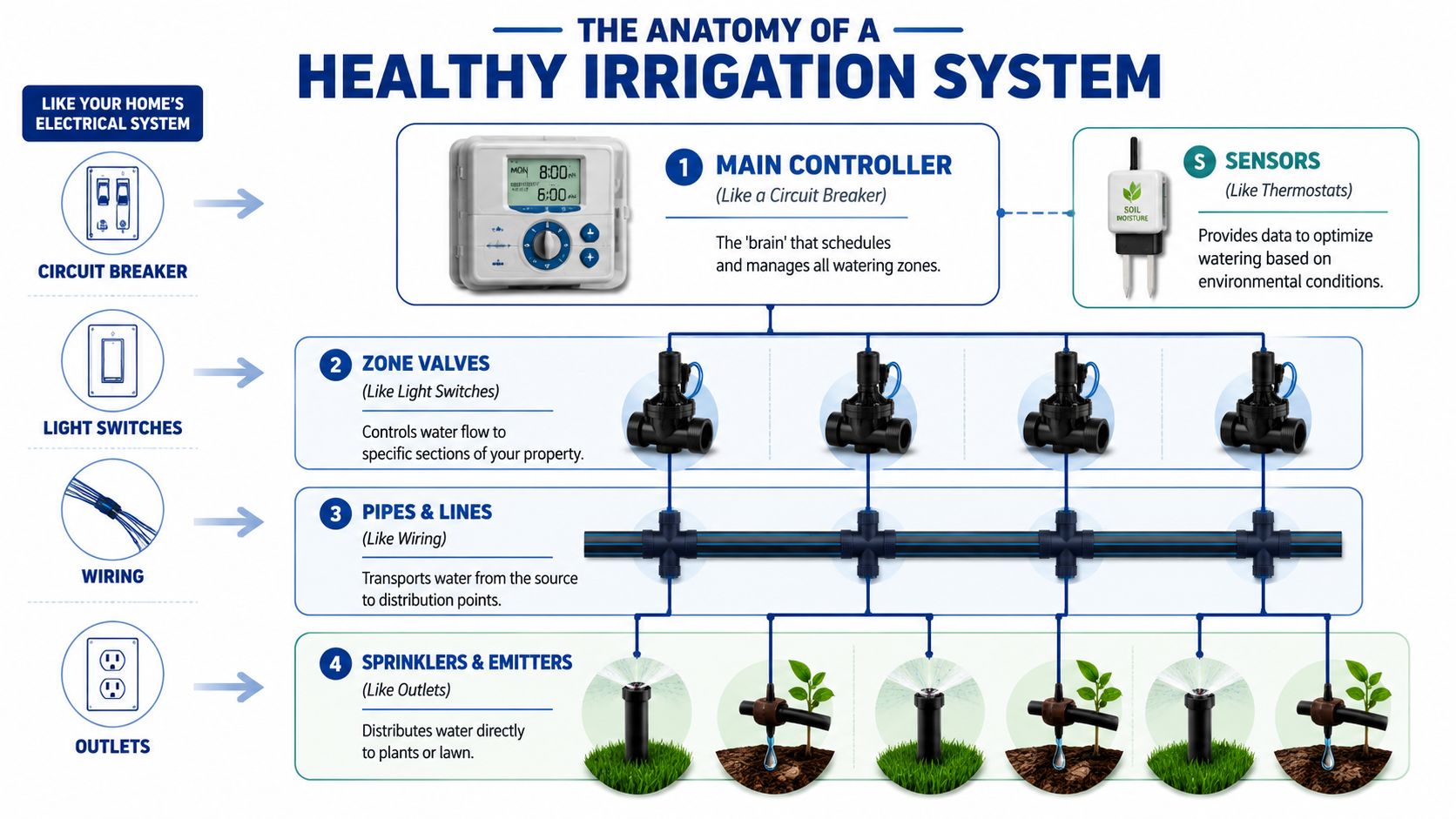
Most homeowners only see the heads popping up. The true performance of a water irrigation system depends on what's behind them.
Think of the system like a home utility network. Every part has a job, and weak performance at one point affects everything downstream.
The controller and sensors
The controller is the brain. It tells each zone when to start, how long to run, and on which days it waters. Older clock-style timers can only do so much. Better controllers can respond to weather or sensor input and make more sensible decisions.
Sensors matter because Dallas weather changes fast. A schedule that made sense last week may be wasteful after rainfall or too short during a heat wave. The controller only performs well if the settings, zone assignments, and seasonal programming are right.
The safety and flow components
Two parts get ignored until there's a problem.
- Backflow preventer protects the potable water supply.
- Zone valves direct water to one area at a time.
If a valve sticks, a zone may run when it shouldn't or fail to run at all. If the backflow assembly has issues, you've got a safety concern, not just an irrigation concern.
The underground network
Pipes and fittings are the transport system. They carry water from the supply to each zone. Small leaks underground can be hard to spot at first. You may only notice a greener patch, a soft area in the lawn, or a pressure drop at the heads.
At the end of the line, the sprinkler heads, nozzles, and drip emitters decide how the water lands. That's where design and maintenance meet. The right nozzle with the wrong pressure still won't perform well. A properly selected emitter clogged with debris won't help the plant it's meant to water.
Why the parts have to work together
A healthy irrigation system isn't a pile of components. It's a coordinated setup.
If the controller is smart but the heads are misaligned, water is still wasted. If the heads are fine but the valve leaks, the schedule won't save you.
This is why two homes with similar lawns can have very different results. One system is balanced. The other is patched together. Knowing the names and roles of the parts helps you ask better questions when something isn't working.
Smart Irrigation Design and Zoning Principles
Good irrigation design starts with one idea. Your yard is not one zone just because it's one address.
A Dallas property usually includes multiple microclimates. South-facing turf bakes. Beds under tree canopies hold moisture longer. Narrow side yards get less airflow. Sloped areas lose water differently than flat ones. Clay near the surface can behave differently from amended bed soil a few feet away.
Why zoning matters more than head count
Many homeowners judge a system by how many heads they see. That's the wrong metric. A well-designed system groups areas by how they use water.
Common examples of smart zoning include:
- Turf separate from shrubs because lawn watering frequency often doesn't fit woody plantings
- Sun zones separate from shade zones because they dry at different rates
- Slopes separate from flat areas because runoff risk changes
- Trees on dedicated watering so roots get deeper soaking instead of shallow lawn cycles
That's called hydrozoning in practice. It's one of the clearest differences between a system that only waters and a system that performs.
How North Texas soil changes the design
DFW clay is the reason many generic irrigation templates fail here. Clay can store moisture well, but it often won't accept fast application rates. If a zone is designed without accounting for that, the water starts moving across the surface before it moves into the root zone.
That affects spacing, nozzle choice, runtime planning, and whether the area should even be spray-irrigated at all. Some sections are better served by slower delivery and shorter repeated cycles. Others may need site modifications, not more sprinkler output.
Irrigation also ties into drainage and heat
Strong irrigation design doesn't stop at plant health. It also affects runoff, erosion, and site temperature. Emerging planning approaches for regions like DFW connect irrigation to stormwater and heat mitigation. Modeling seasonal demand against on-site stormwater harvesting can shrink potable irrigation use by 20 to 30% when plans prioritize deep watering for trees and use permeable surfaces (natural irrigation planning and water balance).
That matters on residential properties too. If rain can soak in instead of racing off hard surfaces, and trees are watered for root development instead of shallow surface dependence, the whole site becomes more resilient.
The best irrigation layout doesn't just keep plants alive. It helps the property manage water better before, during, and after a storm.
Water-Smart Strategies for a Resilient Texas Lawn
The quickest wins in Dallas usually come from better scheduling and better application, not from replacing everything underground. Most homeowners can improve results fast if they focus on a few high-impact moves.
Upgrade the controller before you chase bigger changes
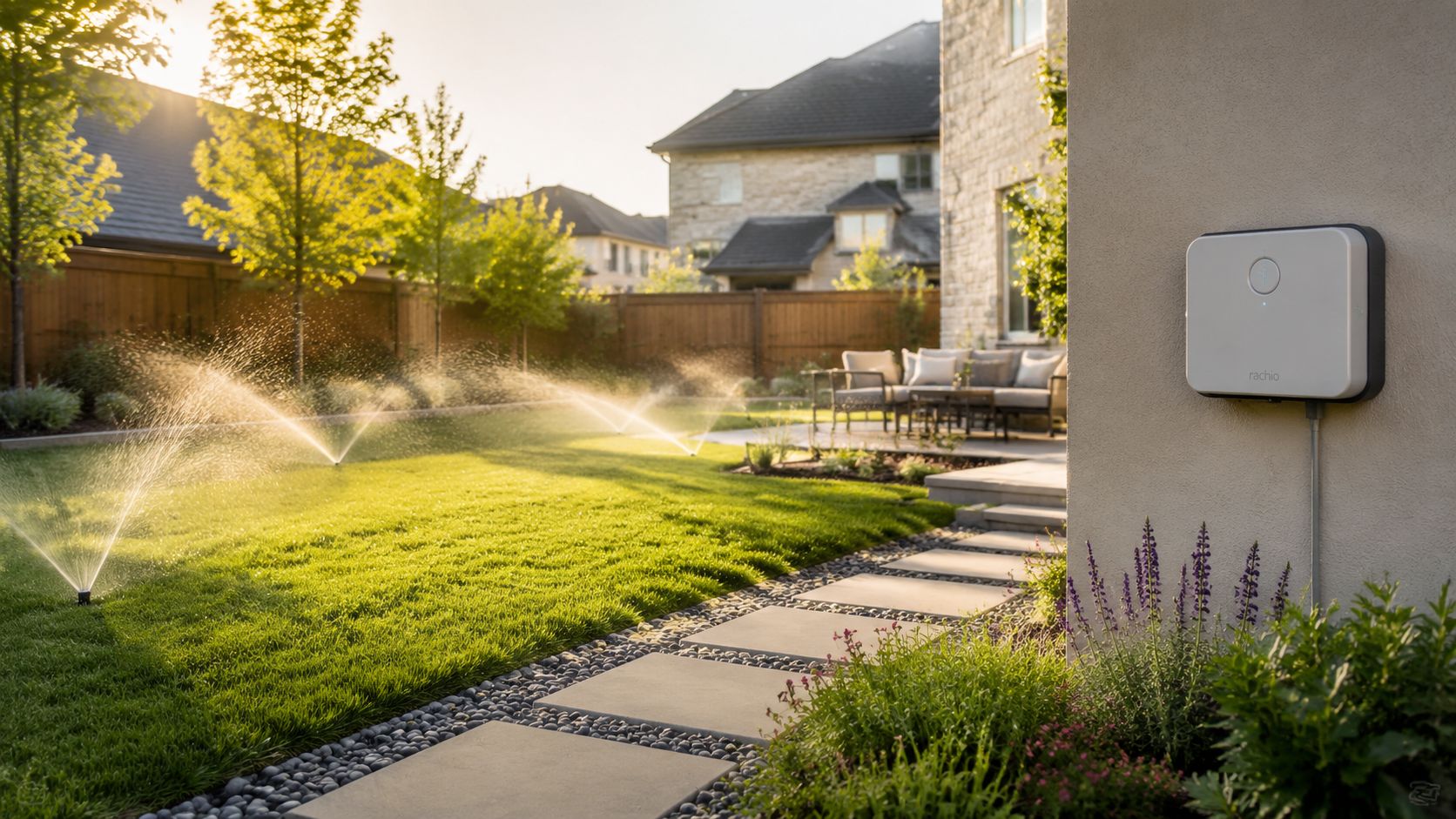
A smart controller is often the best first upgrade for an existing system. Weather-based and soil-moisture-based controllers can reduce outdoor water use by 20 to 40% compared with traditional timers when they're set up properly (Oklahoma State smart irrigation guidance).
That's valuable in North Texas because summer evapotranspiration is high. Fixed timers keep watering whether conditions changed or not. A better controller adjusts after rain, responds to weather demand, and cuts back the kind of unnecessary cycles that drive up bills.
Use cycle and soak on clay soil
This is one of the most important Dallas-specific practices. Clay soil often can't absorb a long continuous run without shedding water. When that happens, the street gets watered, the roots stay thirsty, and homeowners think they need more minutes.
Use cycle and soak instead:
- Run the zone for a shorter period.
- Let the water soak in.
- Run it again.
- Repeat as needed instead of one long session.
For turf, this method usually works much better than a single long watering window. It reduces runoff and gives the root zone a chance to capture moisture.
On heavy clay, longer watering isn't always deeper watering.
Make seasonal changes instead of set-and-forget watering
Spring programming should not stay in place through peak summer and then into fall. Even a good system wastes water if the schedule doesn't evolve.
A simple homeowner checklist helps:
- Check after rainfall and use the controller's delay function when conditions allow.
- Shift to early morning watering to reduce evaporation and limit wind distortion.
- Shorten or suspend shaded zones when they're staying wet longer than sunny areas.
- Watch tree watering separately because mature trees need a different approach from shallow-rooted turf.
If you're also reworking the grounds themselves, pairing irrigation changes with drought-tolerant landscaping tips for Dallas Fort Worth homeowners usually produces better long-term efficiency than changing the controller alone.
Do a quick monthly field check
You don't need specialized equipment to catch obvious waste. Once a month during the growing season, run each zone and look for:
- Tilted or buried heads that can't throw correctly
- Overspray onto pavement that signals poor adjustment
- Clogged nozzles causing weak or uneven patterning
- Drip breaks or loose fittings in beds
- Water pooling within minutes of startup
Small corrections prevent bigger issues later. If the system is already in place, routine observation often saves more water than homeowners expect.
Troubleshooting Common Water Irrigation System Problems
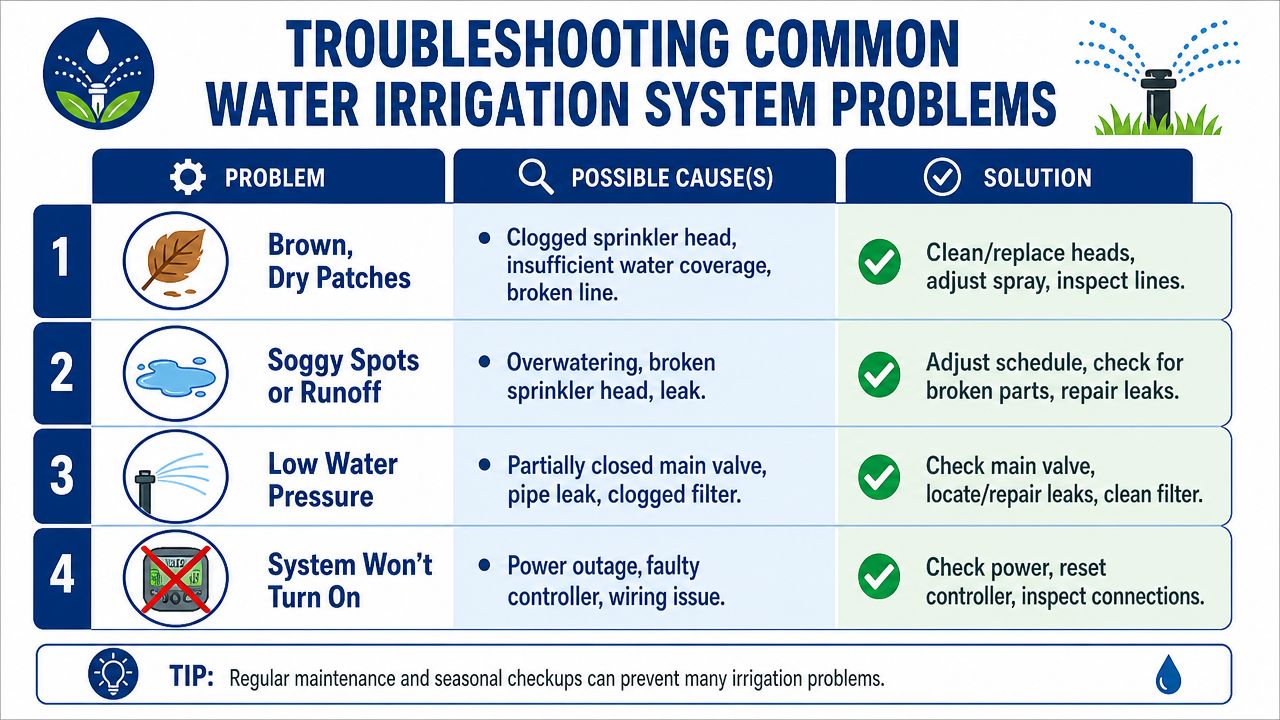
Most irrigation problems show up visually before they show up mechanically. The yard gives clues. The key is reading the symptoms correctly.
Brown patches and weak areas
A dry patch doesn't always mean the whole zone needs more time. It often means that one area isn't receiving water evenly.
Common causes include:
- Clogged nozzles
- Misaligned heads
- Blocked spray patterns
- Broken lateral lines
- Poor head-to-head coverage
Many homeowners in places like DFW see brown patches even though the system runs. A common reason is poor distribution uniformity, or DU. Professional calibration often uses catch-can testing and controller data to improve results and keep DU above the recommended 60 to 70% threshold (UNH irrigation system guidance).
A simple catch-can test is still useful for homeowners. Set identical containers across a zone, run the irrigation, and compare how much water lands in each one. If the amounts vary widely, the issue is system performance, not just runtime.
Soggy spots, mushrooms, and runoff
Water sitting on the surface points to a different set of problems.
| Symptom | Likely issue | First thing to check |
|---|---|---|
| Pooling near one head | Broken head or leak | Inspect that sprinkler body and nearby pipe area |
| Runoff down slope | Runtime too long or application too fast | Break schedule into shorter cycles |
| Consistently wet bed | Drip leak or valve not shutting fully | Open mulch and inspect emitters and fittings |
These problems are common in clay-heavy neighborhoods because the soil seals over quickly when water is applied faster than it can absorb.
Low pressure and dead zones
If heads aren't rising fully or spray looks weak, pressure may be the issue. Sometimes the cause is simple, like a partially closed shutoff or a clogged filter. Other times there's a leak underground or too many mismatched devices on one zone.
When a zone starts weak at every head, don't assume each head failed at once. Look upstream.
When power or programming is the real problem
Sometimes the irrigation hardware is fine and the controller is the problem. A bad schedule, a wiring fault, or a power interruption can make a healthy system look broken. If a zone never turns on, starts at the wrong time, or skips randomly, inspect the programming before digging up the yard.
Troubleshooting works best when you match the symptom to the most likely cause instead of jumping straight to replacement.
When to Partner with an Irrigation Professional
Some irrigation issues are reasonable DIY tasks. Replacing a nozzle, straightening a head, updating a schedule, or fixing a visible drip break are all manageable for many homeowners.
The line gets crossed when the problem involves design, hydraulics, recurring pressure issues, or system reconfiguration.
Problems that usually need expert diagnosis
Persistent low pressure is the clearest example. Proper diagnosis often requires calculating Total Dynamic Head, which accounts for elevation, friction loss, and required nozzle pressure. Underestimating TDH causes poor coverage, while overestimating it wastes energy and money, which is why complicated pressure issues are best handled by a professional (TDH and pump selection in sprinkler design).
A professional should also be involved when:
- You're creating a new planting arrangement and need zones matched to plant type and exposure
- You're adding beds, patios, or turf areas that change the original irrigation layout
- The same dry or wet issues keep returning after surface-level fixes
- You suspect a hidden mainline or valve problem
- You want a seasonal audit instead of waiting for visible damage
Why this is an investment, not just a repair call
A good irrigation review can prevent a chain of expensive property problems. Wrong watering damages turf, weakens shrubs, stresses trees, and can contribute to runoff and foundation-adjacent moisture issues. The cost of leaving a poorly tuned system alone usually shows up outside the irrigation box.
For homeowners comparing service providers, it helps to look for a company that can evaluate the whole site rather than only swap parts. That includes drainage, planting design, and irrigation together. If you're weighing local options, this guide on how to choose the right landscaping partner in Dallas gives a practical framework.
Rosewood Group provides irrigation design, installation, inspection, and optimization as part of broader grounds work across DFW. That matters when the issue isn't just a head or a valve, but how the entire property uses water.
If your yard is struggling through the Dallas heat, Rosewood Landscape Group can help evaluate your irrigation, zoning, drainage, and planting layout so the system works for North Texas conditions instead of against them.
Related posts
8 Best Shrubs for North Texas Landscapes in 2026
Permeable Paver Installation: A DFW Homeowner’s Guide

Zoysia Grass Fungus: Identify, Treat & Prevent in 2026
How to Improve Soil Quality: Easy Ways to Improve Soil
Take All Root Rot: Diagnose & Treat Your Lawn