Water sits in the yard for a day after a storm. The St. Augustine turns pale in July even though the sprinkler runs. New shrubs go in, sulk for a season, and then disappear. Most homeowners blame watering, fertilizer, or the plant itself.
In North Texas, the problem usually starts lower. The soil is doing exactly what tight, heavy clay does. It seals over when it's dry, turns sticky when it's wet, holds water where roots need air, and bakes hard once summer heat settles in.
That's why generic advice about how to improve soil quality usually falls flat here. “Just add compost” helps, but it doesn't solve a compacted clay profile by itself. If the subsoil is hardpan, surface amendments stay near the surface, roots stay shallow, and every weather swing hits harder.
A workable plan for Dallas-Fort Worth has to match our conditions. Heavy clay. High heat. Sudden downpours. Long dry stretches. The fix is part diagnosis, part structure correction, and part long-term maintenance. When you handle all three, lawns root deeper, beds drain better, and plants stop fighting the ground they're growing in.
Your Yard Is Trying to Tell You Something
A struggling North Texas yard usually gives clear signals long before plants die. You'll see puddles that linger after a storm. You'll notice turf thinning in the same spots every summer. You may even watch water run off the surface instead of soaking in, then wonder why the soil still feels brick-hard a day later.
Those symptoms don't point to one simple issue. They point to a soil system that isn't moving air, water, or roots the way it should.
What these common signs usually mean
When clay soil is compacted, rain can't move downward easily. It stacks up near the surface, then either ponds or runs off. Once the sun returns, that same layer dries into a crust. Grass roots stay shallow because they follow the easiest path. Shrub roots do the same, which is why plants can look overwatered and drought-stressed in the same month.
In DFW, that pattern is common around:
- New construction lots where equipment compressed the grade
- High-traffic lawn areas near gates, patios, and play spaces
- Low spots where runoff collects after storms
- Foundation-adjacent beds where soil gets packed and dries fast
Healthy-looking plants can still sit in bad soil for months before they fail. By the time leaves yellow, the root zone has often been struggling for a while.
Why clay gets blamed, and why that's only half right
Clay isn't the enemy by itself. North Texas clay can hold nutrients and support strong plant growth when its structure is open enough for roots, oxygen, and water movement. The primary concern is compacted clay with weak organic content and poor pore space.
That distinction matters. If you treat all clay soil like it's hopeless, you'll waste time chasing quick fixes. If you improve structure and stop repeating the same compaction cycle, the same site starts performing much better.
Most failed lawns and beds I see don't need more products thrown on top. They need the soil profile rebuilt so roots can use what's already there. That's the practical side of learning how to improve soil quality in North Texas. You're not trying to replace your soil. You're trying to make your existing soil livable.
Diagnosing Your North Texas Soil Problems
Before you amend anything, find out what you're dealing with. A yard can have heavy clay in one area, fill dirt in another, and a compacted drainage path cutting through both. A few simple tests tell you more than guesswork ever will.
Run the jar test first
The jar test gives you a basic read on soil texture. It won't replace a lab test, but it helps you see how much clay is in the mix.
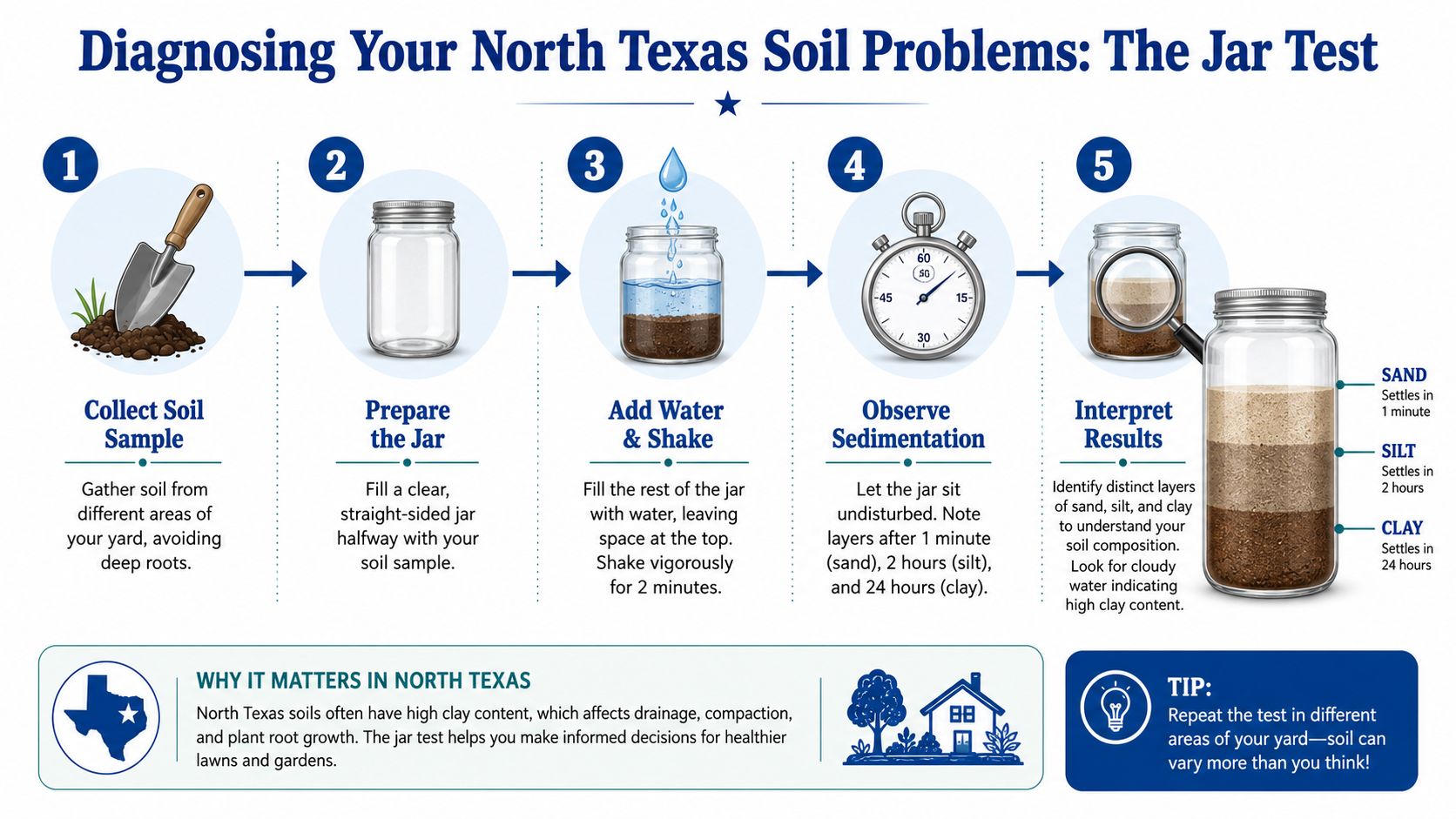
Use a clear, straight-sided jar and follow this process:
- Collect mixed samples from a few spots in the yard, especially where plants struggle.
- Fill the jar halfway with soil.
- Add water nearly to the top, leaving room to shake.
- Shake hard until the clumps break apart.
- Let it settle and watch the layers form.
What you're looking for is simple. Sand drops first. Silt settles next. Clay stays suspended longest, and the water often stays cloudy longer when clay content is high. If most of the material ends up in a fine, dense upper layer, you're dealing with the kind of soil that seals up fast in summer and drains slowly during storms.
Check compaction by hand
The squeeze test is crude, but useful. Grab a handful of moist soil, not soaked soil. Squeeze it in your palm.
- If it forms a hard, sticky ribbon, you likely have strong clay influence.
- If it smears and stays dense, compaction is part of the problem.
- If it crumbles with light pressure, the structure is more open.
Then push a screwdriver or soil probe into the ground. If it goes in easily near the surface and then stops abruptly, that usually points to a compacted layer below. That's common in North Texas lawns that were built quickly and then repeatedly mowed, walked, and watered without any structural correction.
Test how water moves
A simple percolation check tells you whether the issue is slow infiltration, deeper drainage trouble, or both. Dig a small hole in a problem area, fill it with water, and observe how the soil handles it. If water lingers for a long time and the sides of the hole look slick or smeared, the soil profile is resisting movement.
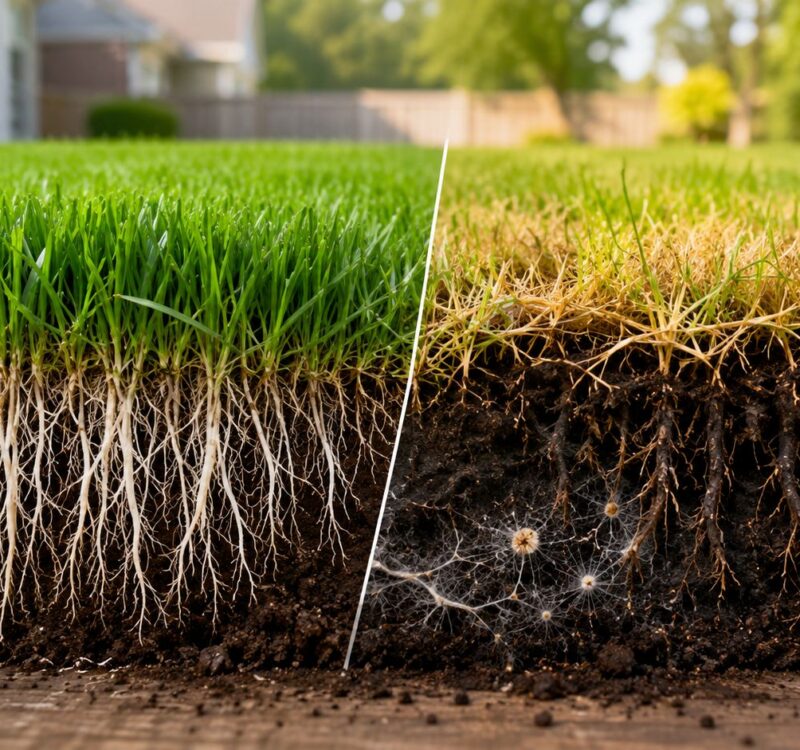
That matters because poor drainage isn't only a turf problem. It also creates the conditions that feed disease pressure. If your lawn has yellowing, thinning, or rotting patches after wet periods, it's worth reading about take-all root rot in North Texas lawns because weak drainage and stressed roots often show up together.
Practical rule: Test the worst area in the yard, not the best-looking one. Good soil in one bed doesn't cancel out compaction near the patio or side yard.
Know when a lab test is worth it
Home tests tell you texture and behavior. A professional soil lab helps with chemistry. That's where pH, nutrient availability, and amendment planning become clearer. The FAO summary of the Status of the World's Soil Resources notes that avoiding productivity losses and restoring degraded lands are primary strategies for sustainability, and it also points to the value of minimizing disturbance so soil structure, pore spaces, and earthworm channels stay intact.
For a homeowner, the practical takeaway is this. Don't disturb the soil blindly. Diagnose first. If you know whether your problem is texture, compaction, chemistry, drainage, or some combination, you stop wasting effort on the wrong fix.
Choosing the Right Soil Amendments
The common response to “improve the soil” is to buy compost. Compost matters, but amendment choice should match the problem. In North Texas clay, you're usually trying to do two jobs at once. You need to feed the soil and change the physical structure enough that roots can function.
What compost does well
Good organic material improves biology, buffering, and water-holding capacity, and also addresses a key deficiency in dense clay by fostering a more open, aggregated structure over time. That's not just theory. A nine-year study published in Frontiers in Sustainable Food Systems found that repeated applications of bulky organic materials for nine years or more increased Soil Organic Carbon by about 20 to 25%, equivalent to an additional 5 to 6 tons per hectare in topsoil. In that same study, farmyard manure increased topsoil nitrogen by 10%, extractable phosphorus by roughly 35%, extractable potassium by about 80%, and extractable magnesium by about 20%.
The lesson for homeowners is straightforward. Consistency beats one heavy application. Soil improvement is cumulative.
What compost does poorly on its own
Compost spread over the surface won't reliably solve subsurface compaction. It also won't magically keep a heavy clay bed open if people keep walking through it, mowers keep tracking over it, or runoff keeps sealing the surface. That's why “just add compost” often disappoints in DFW.
Here's a practical comparison:
| Amendment | Best use in North Texas clay | Limitation |
|---|---|---|
| Compost | Improves organic content and supports better soil life | Doesn't fix deep compaction by itself |
| Shredded leaves or aged organic matter | Good for bed building and gradual structure improvement | Slow payoff if the soil below is hardpan |
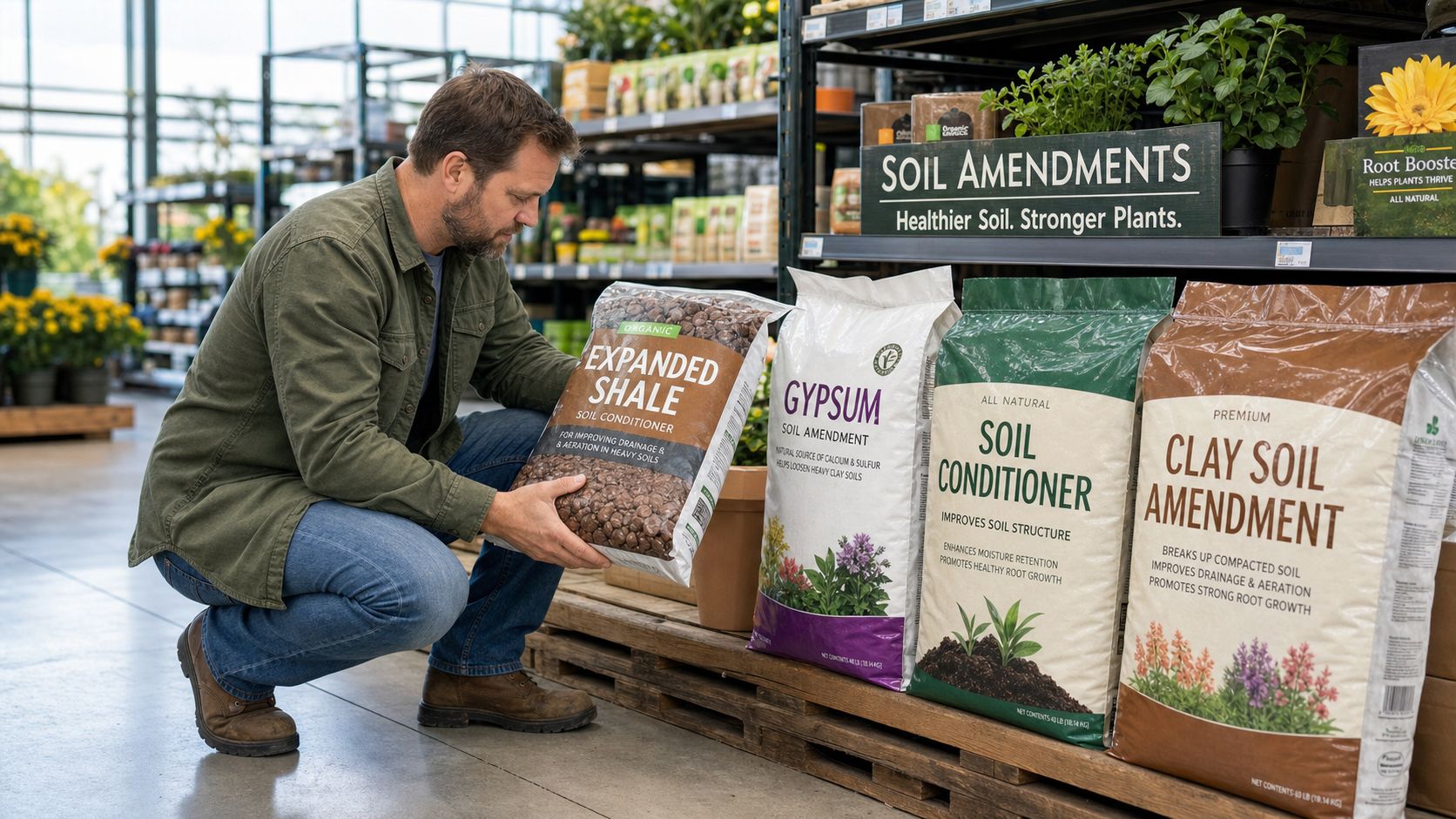
| Expanded shale or similar mineral conditioner | Helps create more lasting pore space in clay-heavy planting areas | Needs incorporation to matter |
| Gypsum | Useful specifically for clay compaction when organic matter alone is insufficient | Not a cure-all for every clay soil problem |
How much is enough
For heavy clay soils, expert guidance recommends incorporating 5 to 8 inches of organic matter into the top 6 to 12 inches of soil, then finishing with a 2 to 3 inch mulch layer. That approach improves structure and drainage more effectively than a light surface dusting, and mulch deeper than 3 inches can start blocking moisture infiltration and oxygen exchange, raising root rot risk. That guidance comes from the clay-soil amendment method demonstrated in this heavy clay soil remediation reference.
That amount sounds aggressive to homeowners because it is. Light amendment rarely changes a difficult clay bed in a lasting way. If you're rebuilding a planting area, proper incorporation matters more than brand labels on the bag.
Match the amendment to the landscape use
Beds, lawns, and tree zones shouldn't all be treated the same.
- Planting beds can handle deeper incorporation during renovation.
- Established lawns usually respond better to topdressing paired with aeration than to wholesale tilling.
- Tree root zones need a different approach because aggressive soil disturbance can damage roots. In those areas, methods like deep-root fertilization for trees are one option used to place nutrients and air movement lower in the root zone without tearing everything up at the surface.
If you want to know how to improve soil quality without wasting time or money, start with this rule. Add organic matter for biology. Add structural amendments where clay needs lasting pore space. Don't expect one material to solve every problem.
Fixing Compaction and Poor Drainage
Compaction is the part most homeowners underestimate. If the soil profile is tight below the surface, you can spread quality compost every season and still end up with shallow roots, runoff, and standing water. The fix usually requires both mechanical opening and biological follow-through.
Why surface-only treatment falls short
In high-heat regions like Dallas-Fort Worth, surface composting often fails to correct the underlying problem because microbial activity drops significantly below the top 2 inches, and the compacted layer remains intact. For hardpan that causes standing water, deep-rooted breaker plants like radish or rye are used to mechanically fracture compacted layers without destructive tilling, based on the guidance in this DFW-focused soil compaction discussion.
That's the key distinction. Surface feeding helps the top layer. Hardpan repair requires depth.
The mechanical option
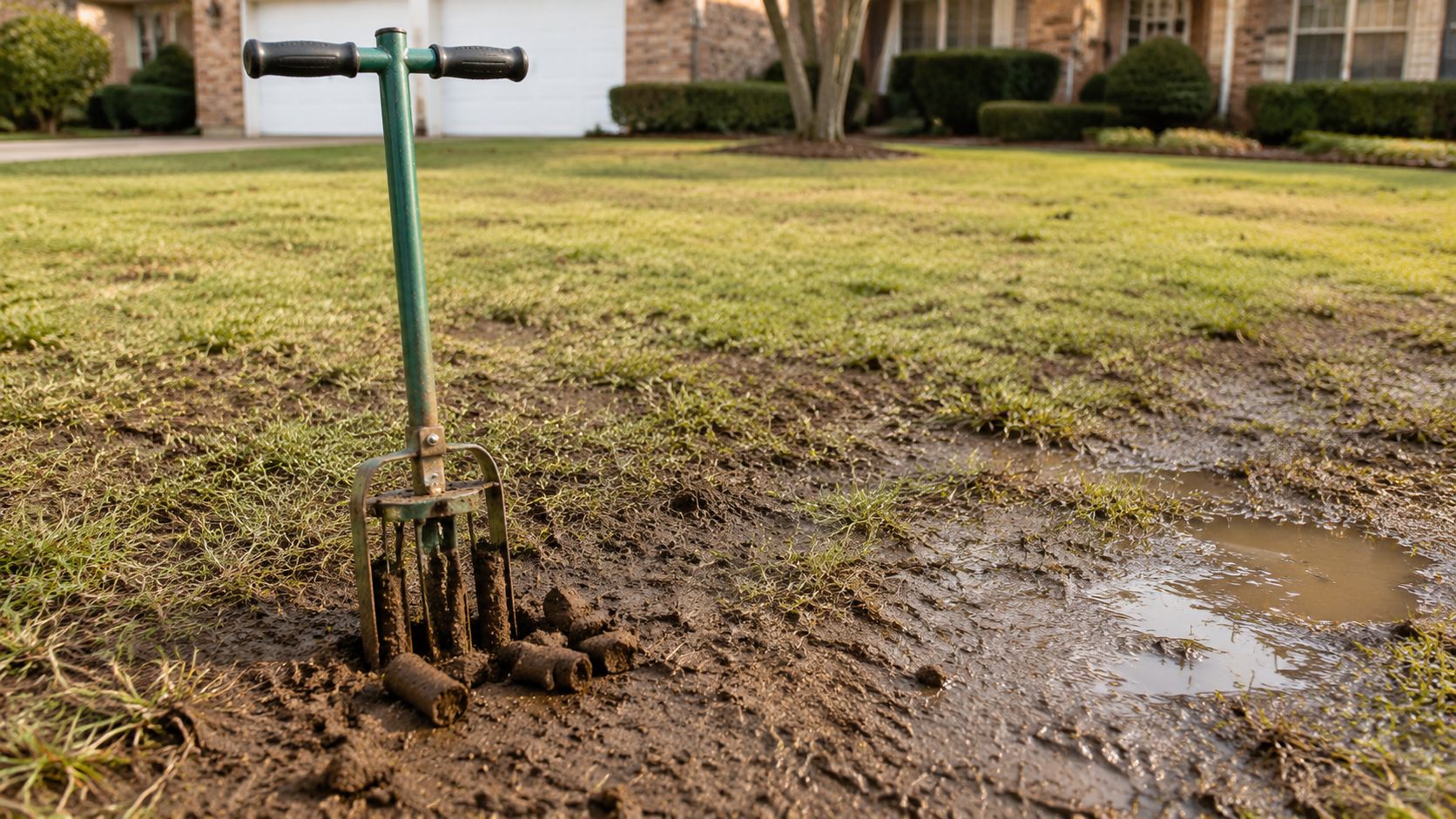
For lawns, core aeration is the usual first move. Pulling plugs does three practical things:
- Creates channels for air and water
- Reduces surface sealing after rain
- Makes topdressing useful because material can move into the root zone instead of sitting on top
Core aeration works best when the soil has some moisture but isn't muddy. If you aerate bone-dry clay, the machine struggles and the plugs are poor. If you aerate saturated soil, you smear the hole walls and don't gain much.
The biological option
For larger beds, garden areas, or sections of lawn being renovated, deep-rooted cover crops can act like living drills. They don't replace aeration in every setting, but they're valuable because they open pathways without inverting the whole soil profile.
Use them when you need to:
- Break a shallow hardpan with root pressure
- Keep soil covered during a transition period
- Avoid repeated tilling that destroys aggregates
Repeated full tilling feels productive because the soil looks loose that day. In clay, it often creates a short-term fluff layer over a problem that comes back harder.
Drainage is sometimes bigger than the soil
Some yards don't just have compaction. They also have slope failure, runoff concentration, gutter discharge problems, or low-grade design issues. In those cases, better soil helps but won't fully solve the water. If the yard stays wet after aeration and amendment, the layout itself may need correction through grading, swales, catch basins, or subsurface drains.
That's where a drainage plan becomes more important than another round of product applications. Homeowners dealing with recurring runoff or persistent ponding can compare solutions in this guide to fixing yard drainage problems in North Texas.
The approach that holds up longest
The durable fix is usually layered:
- Open the compacted soil mechanically where needed.
- Add the right amendment so the new pore space doesn't collapse back quickly.
- Use roots, mulch, and traffic control to protect the structure you just created.
- Correct site drainage if water is being pushed into the area faster than the soil can handle.
That combination works better than any single trick because compaction isn't one problem. It's a chain of problems. You break the chain by addressing depth, biology, and water movement together.
Application and Long-Term Maintenance
In North Texas clay, good soil work can fail if the application is shallow or the timing is wrong. I've seen plenty of yards get compost, mulch, and seed, then slide right back into hardpan because everything stayed at the surface. The goal is not to make the top inch look better. The goal is to improve the root zone and keep it open through heat, rain, and foot traffic.
Fall gives you the best window for that work. Soil is still warm enough for root growth, but the worst heat has usually backed off. Amendments settle in better, and you are not asking stressed plants to recover during a stretch of triple-digit weather.
How to apply amendments so they actually help
For new beds or full renovations, mix organic matter into the soil where roots will grow. A thin layer spread on top does very little for dense clay below. In practice, that means working amendment through the upper soil profile, then finishing with mulch at a moderate depth so the surface stays cooler and does not crust over.
Established lawns need a different approach because tearing up the whole yard usually creates a bigger mess than the original problem. Use a sequence that improves the soil without destroying the turf:
- Core aerate first to create channels into the clay
- Topdress with a light layer of screened compost so material can fall into the holes
- Water lightly after application to settle the amendment without sealing the surface
- Keep traffic off the lawn for a few days if the ground is soft
That process is slower than full tilling. It also holds up better in a lawn that has to survive North Texas summer stress.
Mulch protects the surface, if you keep it under control
Mulch helps more than many homeowners realize. It reduces surface sealing after heavy rain, cuts temperature swings, and slows moisture loss during long hot stretches. In clay soil, those surface protections matter because once the top layer bakes hard, water starts running off instead of moving down.
Too much mulch causes its own problems. Piled mulch can shed water, limit oxygen at the crown, and keep beds too damp after storms. Keep it even, keep it off trunks, and resist the urge to add a fresh thick layer every year without removing what already broke down.
If mulch is mounded high enough to look decorative from the street, it is probably working against the soil underneath.
Maintenance is what keeps clay from closing back up
North Texas clay always wants to reconsolidate. Heavy rain settles it. Summer heat hardens it. Traffic presses it tighter. If you improve the soil once and then go back to daily shallow watering, repeated compaction, and neglected beds, the gain does not last long.
The habits that preserve soil structure are simple, but they need consistency:
| Habit | What it does |
|---|---|
| Deep, less frequent watering | Pushes roots deeper and reduces weak surface rooting |
| Seasonal topdressing | Adds small amounts of organic matter without smothering turf |
| Controlled traffic | Keeps compacted paths from reforming in the same spots |
| Keeping soil covered | Limits crusting, erosion, and temperature stress |
One more trade-off matters here. Feeding the soil gradually works better than trying to force a fast transformation with heavy applications. Clay improves in stages. If you open the soil, add amendment at the right depth, and protect that structure over time, the yard becomes easier to manage, drains better, and holds up longer under Texas weather.
When to Engage Professional Landscaping Services
A North Texas yard can fool you from the surface. The top inch softens after rain, then a shovel hits dense clay that blocks roots, holds water, and turns a simple soil project into a drainage and compaction job.
That is usually the point to bring in outside help.
Signs the job is bigger than a weekend project
Call for professional help when the problem goes below surface amendment and into how the site handles water, traffic, and grade. I see this on clay-heavy properties where compost was added more than once, but the underlying failure was lower in the profile.
Common signs include:
- Water that still sits after storms even after core aeration or topdressing
- Repeated turf decline in the same areas season after season
- Hard, dense ground below a thin loose layer that hand tools barely penetrate
- Runoff cutting through slopes or washing soil out of beds
- Wet areas near the house where drainage affects both plants and the structure
- Large sections of yard that need uniform correction instead of spot treatment
In North Texas, the trade-off is straightforward. A small area can often be improved by hand. A broad area with compacted subsoil, poor fall, or trapped runoff usually needs equipment and a plan that reaches deeper than the surface.
What professional intervention changes
A good crew does more than spread amendment. They check whether the failure is compaction at depth, poor grading, roof water concentrated in one bed, buried construction debris, or clay so sealed over that water cannot move down or across properly.
That distinction matters.
On these properties, the same symptom can come from two or three causes at once. Thin turf in a low spot may be tied to standing water, but it can also point to a dense clay layer a few inches down that roots never got through. Beds that stay soggy may need less mulch, but they may also need subsurface aeration or a corrected outlet for runoff.
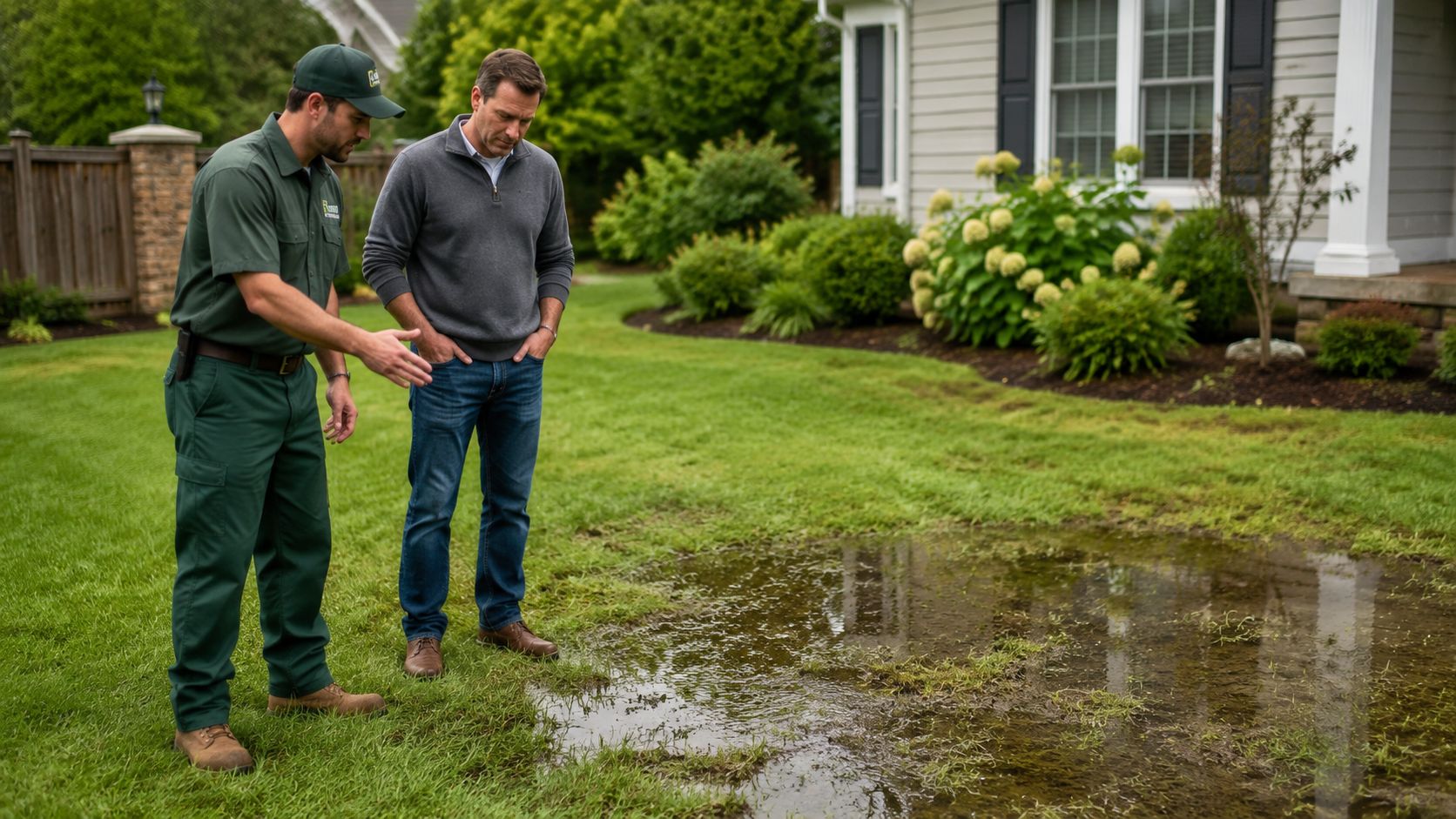
When the inspection is done right, the work gets more specific. Instead of throwing more compost at clay that is sealed tight underneath, you can correct the layer that is causing the trouble.
Some yards need organic matter. Some need deep soil opening, grade correction, or a better path for stormwater to leave the area. In North Texas clay, surface improvement alone often fails because the restriction is lower down.
If your yard keeps cycling through wet spots, hardpan, and plant decline, a site assessment usually saves money compared with repeating the same surface fix every season.
If your lawn or planting beds are fighting compacted clay, standing water, or recurring plant decline, Rosewood Landscape Group can help assess the site conditions and build a practical plan for soil improvement, drainage correction, and long-term performance in North Texas.
Related posts
8 Best Shrubs for North Texas Landscapes in 2026
Permeable Paver Installation: A DFW Homeowner’s Guide
Zoysia Grass Fungus: Identify, Treat & Prevent in 2026
Take All Root Rot: Diagnose & Treat Your Lawn