A lot of DFW homeowners notice the same pattern around mid to late summer. A mature Live Oak that used to look dense and balanced starts thinning out. A Magnolia drops into a dull, washed-out green. You water more, maybe even add a lawn fertilizer, and the tree still looks tired.
That's frustrating because these aren't disposable plants. A good shade tree is one of the most valuable parts of a North Texas outdoor space. It cools the yard, anchors the design, and often predates everything else on the property. If you're already choosing species carefully for this region, as covered in this North Texas tree selection guide, keeping established trees healthy matters just as much as planting the right ones in the first place.
Deep root fertilization for trees can help in the right setting. It's not a cure-all, and it shouldn't be sold that way. In North Texas, its real value shows up where compacted clay, turf competition, alkaline soil behavior, and drought stress make it hard for roots to function normally.
Your Guide to Healthier Trees in North Texas
When a tree struggles in DFW, the problem usually isn't as simple as “it needs fertilizer.” Heavy clay can stay tight and airless. Lawn roots can outcompete tree roots near the surface. Construction traffic can press the soil so hard that water and oxygen stop moving well. In many yards, nutrients may be present in the soil but still not easy for the tree to use.
That's where homeowners start hearing about deep root fertilization for trees. The service sounds straightforward. Feed the roots directly and the tree improves. Sometimes that's true. Sometimes the tree needs something else first, such as better watering habits, root-zone protection, mulch, or relief from compaction.
Why the DFW context matters
North Texas environments create a very specific set of pressures on trees:
- Clay-heavy soils hold moisture unevenly and often tighten up hard between watering cycles.
- Hot, dry stretches stress root systems and expose weak soil conditions fast.
- Turf-heavy yards compete with trees for water near the soil surface.
- Urban lots often leave trees growing in disturbed, compacted ground rather than natural woodland soil.
A good treatment plan starts by identifying which of those factors is driving the decline.
Field perspective: The trees that respond best to root-zone treatments are usually the ones growing in stressed sites, not the ones that are simply old or naturally slowing down.
What this guide helps you sort out
Homeowners usually want clear answers to four questions:
- What is deep root fertilization, exactly?
- When does it help?
- When is it mostly unnecessary?
- What formula makes sense for North Texas soils and tree species?
Those answers matter because healthy trees don't improve from fertilizer alone. They improve when the treatment matches the site problem.
What Exactly Is Deep Root Fertilization
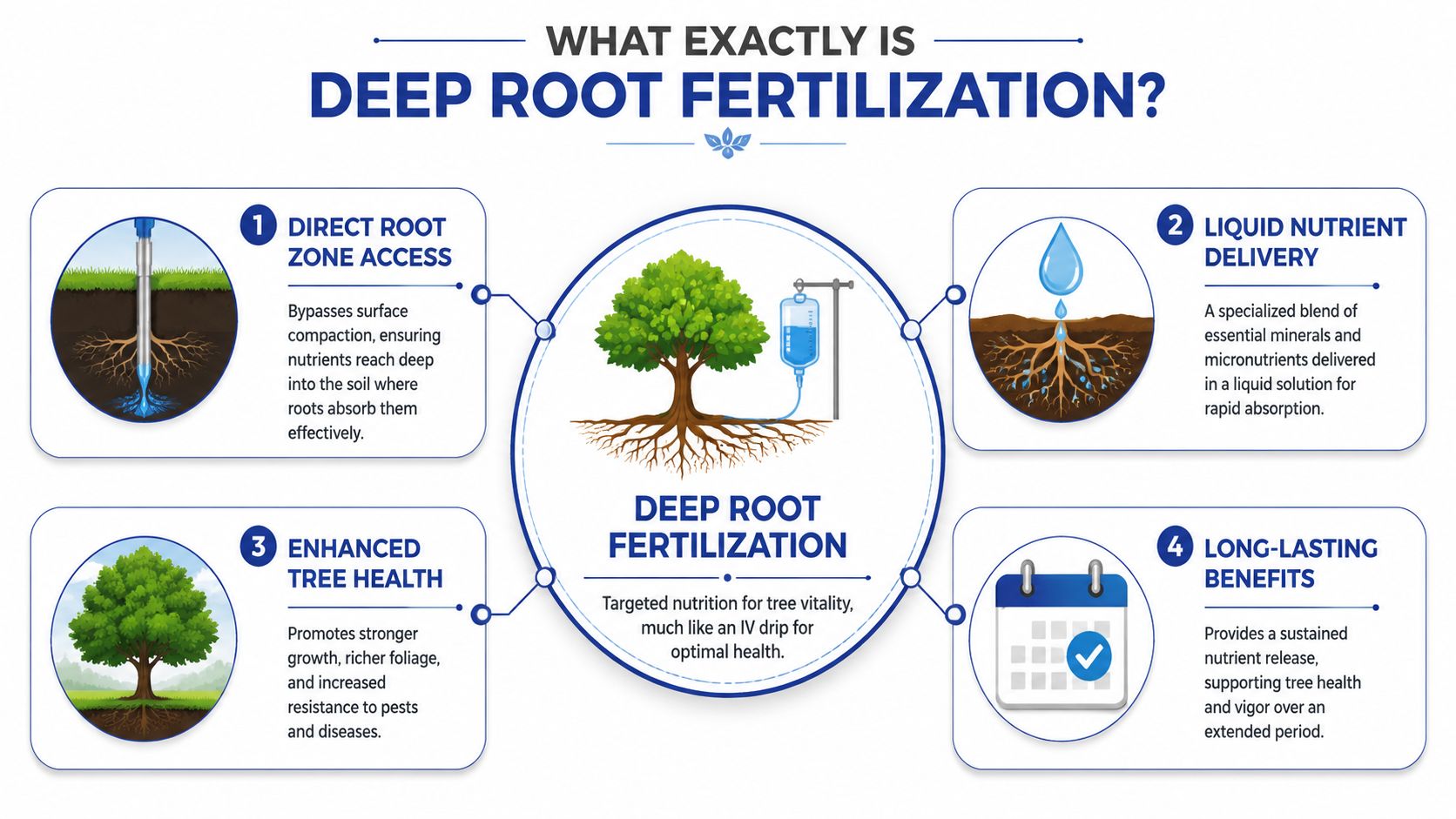
Think of deep root fertilization as an IV drip for your tree's root zone, not a magic injection into the trunk and not a bag of pellets tossed over the lawn. The method is a subsurface treatment. Fertilizer is dissolved in water and injected below the surface with a metal spike. Austin's municipal guidance describes it as a targeted approach for compacted urban soils, and notes that tree feeder roots can extend up to two feet deep in some conditions, which is part of why surface-applied nutrients may not always reach the active root zone efficiently in developed urban environments (City of Austin tree fertilization guidance).
What the treatment is trying to solve
In a natural setting, leaves fall, organic matter breaks down, and roots share space with a living soil system. In a suburban yard, that process gets interrupted. Turf covers the ground. Soil gets compacted by foot traffic, mowers, and construction. Water runs off instead of soaking in evenly.
Deep root fertilization is meant to work around those barriers by placing a liquid blend into the soil profile instead of waiting for nutrients to move down from the surface.
That matters most when surface feeding is getting blocked by:
- Dense turfgrass roots
- Thatch or groundcover
- Compacted clay
- Runoff on sloped or sealed areas
- Shallow, disturbed urban soils
What goes into the solution
A professional treatment isn't just “tree food.” Depending on the site, the injected mix may include nutrients, soil conditioners, humic or fulvic materials, mycorrhizae, or low-salt blends intended to improve the root-zone environment rather than just push top growth.
A well-planned injection targets the soil system, not just the leaves you're hoping look greener next month.
What deep root fertilization is not
It's not trunk injection. It's not a universal annual add-on for every tree. And it's not proof that deeper placement automatically means better uptake.
The practical reason to use it is targeted delivery in a compromised site. If the soil and watering are already working, a surface-based approach or simple mulching program may be just as sensible.
Benefits Over Traditional Surface Fertilizers
A bag of granular fertilizer spread across the lawn seems easy. Sometimes it is. But tree care in a North Texas yard isn't the same thing as feeding turf. Surface products have to move through grass, thatch, dry crusted soil, and whatever runoff pattern your property creates before the tree gets much benefit.
The main advantage of deep root fertilization for trees is precision. The treatment is placed where the root zone can access it, instead of relying on weather, irrigation timing, and surface conditions to do the job.
Why surface feeding often underperforms in tree zones
A key technical detail gets missed in a lot of marketing. Most fine, fibrous feeder roots are concentrated in roughly the top 2–8 inches of soil, and a review discussed by Garden Myths notes that broadcast fertilization can be as effective as subsurface methods in many settings. That means injection isn't automatically superior. Its value is that it can bypass compaction and surface competition where broadcast material may not penetrate well or may be intercepted before it helps the tree (Garden Myths review of deep root fertilization).
That nuance matters. If someone tells you injection works because trees “feed deep,” that's too simplistic. Trees often absorb best in the upper soil zone. The question is whether your site allows anything applied at the surface to reach that zone effectively.
Side-by-side comparison
| Attribute | Deep Root Fertilization | Surface Granular Fertilizer |
|---|---|---|
| Placement | Injected below the surface into the root zone | Spread across the soil or turf surface |
| Precision | Targeted to the tree's rooting area | Broader and less controlled |
| Turf competition | Helps bypass surface competition from grass | Grass may intercept nutrients first |
| Runoff risk | Can reduce nutrient loss from runoff | More vulnerable to wash-off if not watered in well |
| Best use case | Compacted or poor urban soils, stressed sites | Sites where soil is open and surface movement works well |
| Main limitation | May add little benefit if the site problem isn't nutrient access | May not move effectively through dense turf or compacted soil |
Where injection usually earns its keep
In practical terms, subsurface application tends to make more sense when a tree sits in a hard-used residential property:
- Post-construction yards where equipment compressed the soil
- Trees surrounded by thick St. Augustine or Bermuda with little open root area
- Sloped beds or runoff-prone sites where surface material doesn't stay put
- Heat-stressed urban trees that need water and root-zone support together
Where it doesn't have a clear edge
If the soil is loose, mulched, biologically active, and easy to wet thoroughly, injection may not outperform simpler options. A homeowner can waste money by treating the method as automatically better instead of matching it to the actual condition of the site.
Bottom line: Injection is a delivery method. It works best when delivery is the problem.
Signs Your DFW Trees Need a Nutrient Boost
Most struggling trees don't wave a flag that says “fertilize me.” They show stress in ways homeowners notice slowly. The canopy gets lighter. New leaves come in smaller than normal. The tree loses density from the tips inward, or one side starts looking weaker after a long hot stretch.
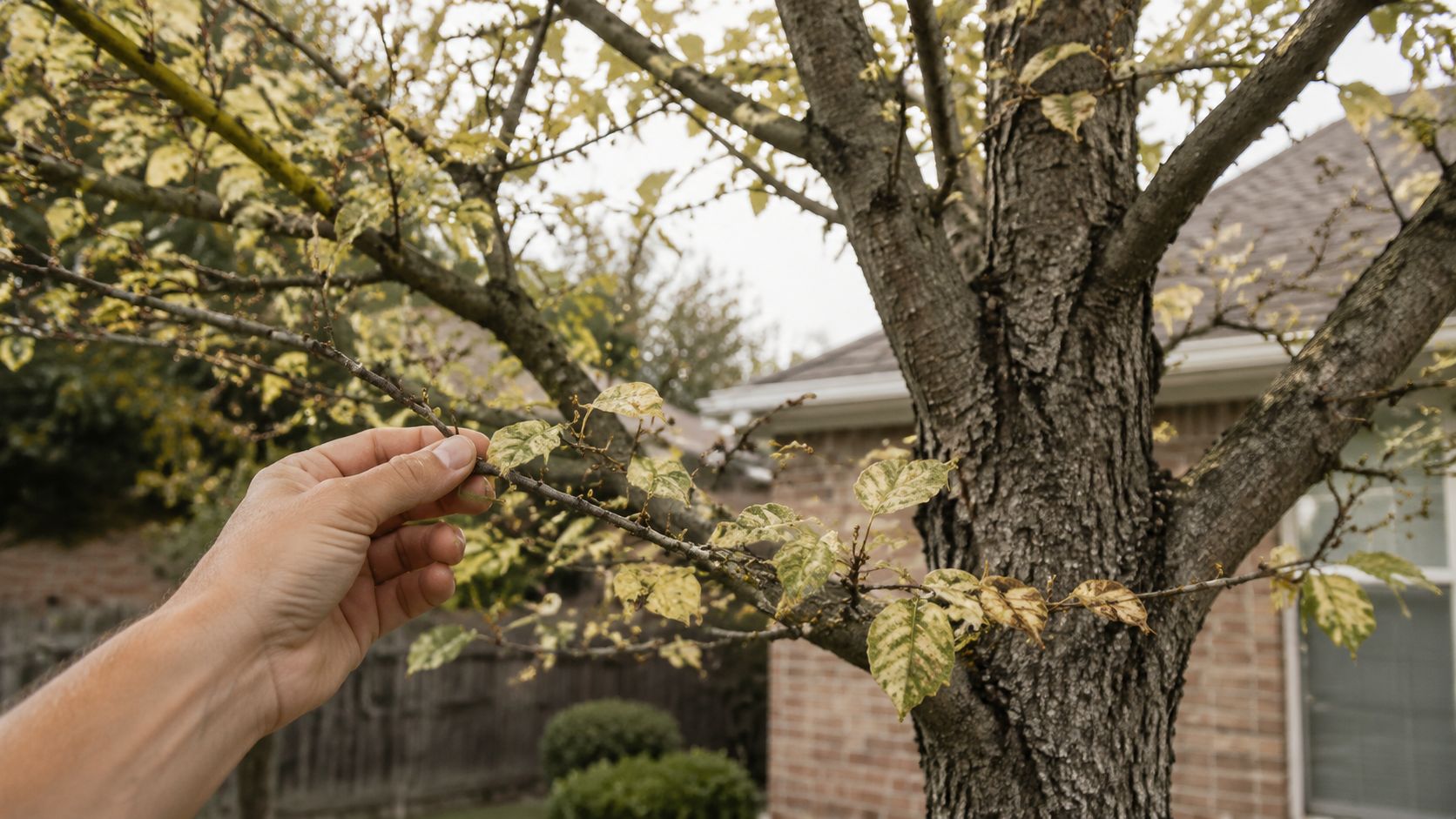
Those symptoms matter, but they don't all point to the same cause. In DFW, the same visual decline can come from drought stress, root damage, poor drainage, alkaline soil conditions, or plain old compaction. That's why homeowners should treat symptoms as clues, not diagnosis.
What to look for in the canopy and leaves
A tree may be a candidate for root-zone treatment if you're seeing several of these signs together:
- Yellowing between leaf veins on foliage that should be a deeper green
- Smaller leaves than usual on a tree that normally pushes stronger growth
- Thinning canopy where you can suddenly see more sky through the crown
- Premature leaf drop or early color change during stress periods
- Slow recovery after summer heat even when irrigation is consistent
- Dieback in small upper branches instead of uniform healthy extension
In North Texas, these symptoms often show up after extended heat and water stress. They also appear after trenching, grade changes, patio additions, pool work, or repeated traffic over the root zone.
Site conditions that make treatment more justified
Deep root fertilization is often marketed as if every declining tree needs it. That isn't accurate. Neutral arborist discussion points out that the treatment is most justified in compacted urban soils, on trees with confirmed nutrient deficiencies, or on trees under significant stress. In healthy soil, deeper injections can bypass many shallow feeder roots and add little benefit (arborist discussion on site-dependent effectiveness).
That site-first view is the honest one.
A few situations raise the odds that treatment is worth considering:
- Recent construction activity over or near the root zone
- Turf growing right up to the trunk flare
- Trees planted in narrow lawn strips or confined beds
- Visible drought stress after repeated hot, windy weather
- Longstanding chlorosis or weak growth that hasn't improved with basic care
What deep root fertilization won't fix
It won't correct girdling roots. It won't solve poor drainage by itself. It won't reverse major trunk decay. It won't make a badly planted tree behave like a healthy one.
If your property has broader water-management issues, it's worth looking at the bigger picture in these drought-tolerant landscaping tips for Dallas-Fort Worth homeowners. Tree stress often starts with site design and irrigation patterns, not just missing nutrients.
Don't judge a tree by leaf color alone. Look at the soil, the watering pattern, the recent site history, and whether the decline is isolated or property-wide.
The Professional Deep Root Fertilization Process
A proper treatment visit should look methodical, not rushed. The goal isn't to poke a few holes near the trunk and leave. The goal is to cover the tree's root zone evenly and use a formula that fits the site.
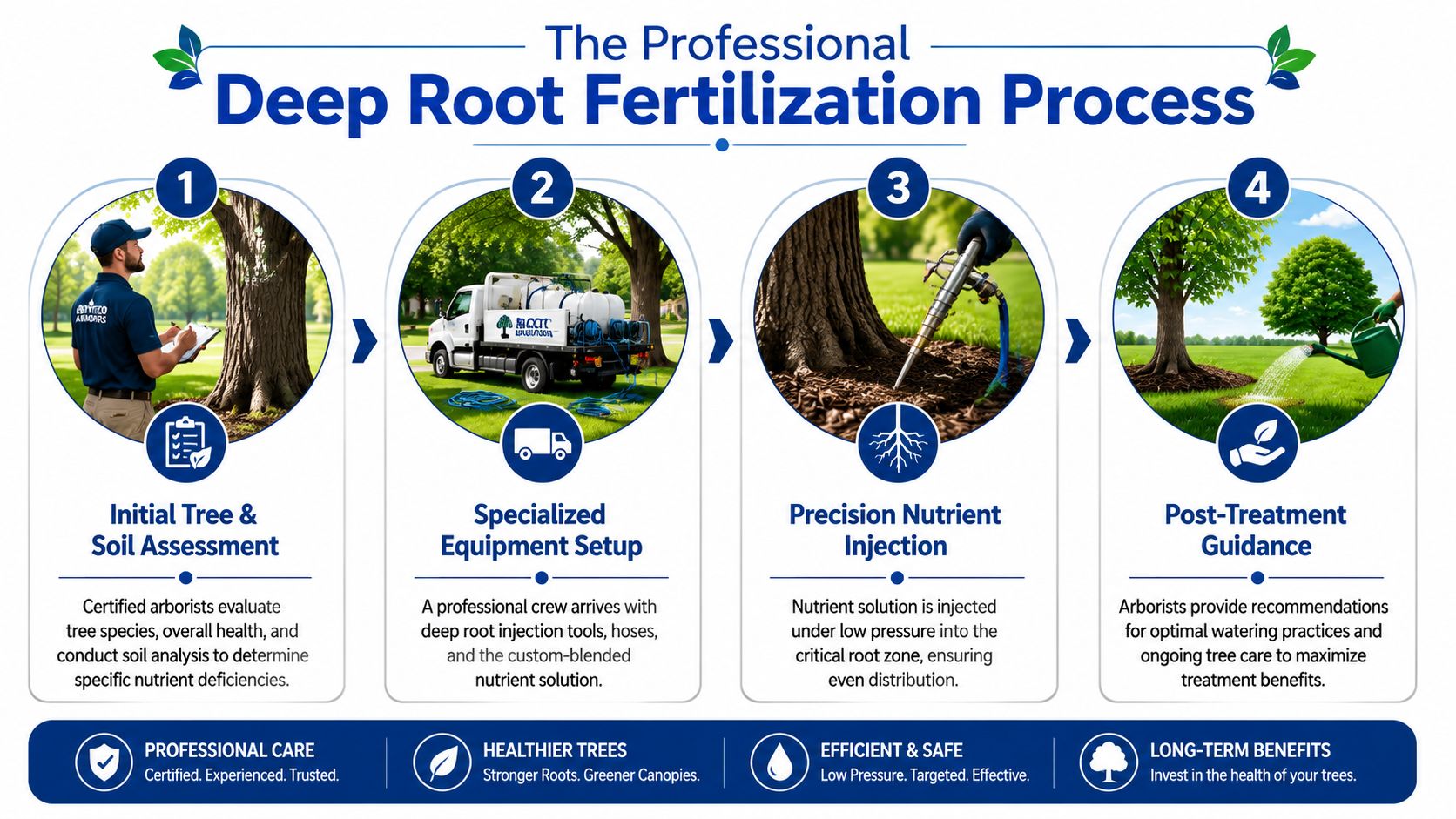
Step one through step three
Assessment comes first. A competent arborist or plant health technician looks at canopy condition, soil compaction, turf competition, grade changes, irrigation patterns, and species. A Live Oak in a broad front yard gets evaluated differently than a Magnolia pinned between a driveway and foundation bed.
The crew maps the treatment zone. Professional deep root fertilization is commonly delivered as a liquid injection at about 5–12 inches deep, arranged in a grid pattern under the canopy so the root zone gets coverage rather than random spot treatment (professional deep root application details). In practice, that usually means working across the dripline area, not just circling the trunk.
Injection happens systematically. The probe goes into the soil, the solution is released, and the technician repeats that pattern across the treatment area. Besides nutrient placement, the process can help water and air move into compacted soil pockets that have become hard and dry.
What homeowners should expect on site
A professional visit usually includes:
- Equipment with a tank and injection probe rather than a hose-end sprayer
- A repeatable pattern across the canopy footprint
- Attention to hardscape and splash control near walks, patios, and stone
- Cleanup after treatment, especially where soil has heaved or solution surfaced
- Care guidance afterward so watering and mulching support the treatment
The part many people overlook
The process only works as well as the diagnosis behind it. If the wrong tree gets treated, or the formula is too aggressive for the site, the nice equipment doesn't save the outcome.
For homeowners comparing providers, it helps to ask whether the company also handles broader plant health care services such as diagnosis, monitoring, and soil-focused care. Deep root fertilization should sit inside a larger tree-care strategy, not replace one.
Service standard: Good providers explain where they'll inject, why that area was chosen, and what they expect the treatment to address.
DIY vs Hiring a Professional for Tree Fertilization
Homeowners can buy tree fertilizer. That doesn't mean they can replicate professional deep root fertilization safely or effectively.
The first barrier is equipment. Store-bought spikes and hose-end products don't behave like professional root-zone injection systems. They don't distribute solution evenly through a large canopy area, and they don't give you much control over placement in tight clay soil. A few concentrated points in the ground aren't the same thing as treating a root zone.
Where DIY usually goes wrong
The biggest mistakes are usually one of these:
- Using the wrong product for the soil condition or species
- Applying too strong a mix and stressing roots instead of helping them
- Treating too close to the trunk while ignoring the wider feeder-root area
- Mistaking drought or drainage problems for nutrient deficiency
- Driving treatment too deep or too shallow with improvised tools
North Texas makes those mistakes more costly because clay soils don't forgive sloppy applications. If the product is salt-heavy, the root zone can react badly. If the soil is hard and dry, the treatment may not spread the way you assume.
What a professional brings besides equipment
A good arborist isn't just selling labor. They're reducing the chance of misdiagnosis.
That includes knowing when not to fertilize. If a tree is declining from root rot, buried flare, severe girdling roots, or chronic overwatering, fertilizer won't solve the underlying problem. An experienced provider also adjusts the formula, coverage area, and timing based on species and site conditions instead of applying one generic mix to every tree on the property.
How to choose help intelligently
If you hire this out, ask practical questions:
- What problem are you treating? If the answer is vague, keep looking.
- What will you inject? You want clarity on whether the mix is nutrient-focused, soil-conditioning, or both.
- Where will you apply it? The provider should describe the canopy area, not just say “around the base.”
- What follow-up care matters? Watering, mulch, and root-zone protection still matter after treatment.
- What credentials and insurance do you carry? For tree work, that isn't optional.
DIY can make sense for light surface soil improvement, mulching, and irrigation correction. Deep root injection is different. Once probes, formulations, and stressed mature trees are involved, the cost of getting it wrong usually outweighs the savings.
The Right Formula for DFW's Unique Soil and Trees
In North Texas, the formula often matters more than the fact that something is being injected. That's especially true in areas with alkaline clay, heat stress, and inconsistent moisture.
A lot of generic tree fertilizers lean too hard on nitrogen. That can create a fast cosmetic response in some cases, but it doesn't automatically improve soil function. Expert-oriented guidance on tree and shrub fertilization warns against high-salt, high-nitrogen, and high-phosphorus thinking, and argues that rebuilding the soil food web is often the more defensible goal. It also recommends formulations that include soil conditioners and mycorrhizae rather than relying on a generic feeding approach (tree and shrub fertilization guidance for soil-focused formulations).
What tends to make sense in North Texas
For many DFW properties, a soil-first blend is the safer direction:
- Low-salt formulations are easier on already stressed root systems.
- Moderate nutrient blends avoid forcing weak trees into soft, unnecessary growth.
- Humic or fulvic components can support root-zone condition in difficult soils.
- Mycorrhizae and biology-minded additives fit settings where soil life has been depleted.
- Water-compatible delivery helps in sites where hydration and nutrient movement are linked.
This isn't about making the tree “grow fast.” It's about helping roots function in a soil environment that often works against them.
Matching the treatment to common DFW trees
Different species show stress differently in local areas.
Live Oaks often need protection from compaction more than aggressive feeding. In tight clay soils, a balanced, low-salt root-zone treatment can make more sense than a high-analysis fertilizer.
Red Oaks can show decline quickly when site stress piles up. If chlorosis and weak vigor are tied to root-zone issues, the formulation should support uptake without adding unnecessary salt load.
Magnolias often react to harsh soil conditions and moisture inconsistency. These trees usually benefit from a gentler approach paired with mulch and irrigation correction.
Crape Myrtles are often overfed. In many cases, they need better soil management and proper watering more than stronger fertilizer.
What usually works better than “just feed it”
For many struggling trees, the best results come from combining treatments rather than relying on one service:
- Mulch over exposed root zones
- Irrigation adjustments for slower, deeper soaking
- Protection from mower and foot traffic
- Relief from turf competition where practical
- Targeted root-zone treatment when symptoms and site conditions support it
A thoughtful tree-care plan doesn't chase greener leaves for a few weeks. It improves the conditions that let the tree recover and hold up through North Texas weather.
If you want a site-specific recommendation, Rosewood Landscape Group can evaluate whether deep root fertilization fits your tree's condition or whether another approach makes more sense first. For DFW homeowners, that kind of honest diagnosis is what protects mature trees long term.
Related posts
8 Best Shrubs for North Texas Landscapes in 2026
Permeable Paver Installation: A DFW Homeowner’s Guide
Zoysia Grass Fungus: Identify, Treat & Prevent in 2026
How to Improve Soil Quality: Easy Ways to Improve Soil
Take All Root Rot: Diagnose & Treat Your Lawn