A lot of North Texas homeowners land here after trying the obvious fixes first. They've watered more, thrown down fertilizer, maybe even treated for insects, and the lawn still looks tired. The yellow patch keeps spreading. The grass thins out. By the time summer heat settles in, parts of the yard look like they're giving up.
That pattern is frustrating because it doesn't behave like a simple watering issue. In Dallas-Fort Worth, one of the most common reasons is Take-All Root Rot, often shortened to TARR. It shows up often in St. Augustinegrass and can also affect bermudagrass. It's especially troublesome in our area because alkaline soils, compaction, drainage problems, and long hot summers create the exact kind of stress this disease exploits.
A lawn with TARR usually won't recover from a one-time spray or a single weekend project. It needs a coordinated plan. That means correcting the soil conditions that favor the fungus, reducing turf stress, protecting remaining roots, and being patient while the grass rebuilds over more than one growing season.
That Stubborn Yellow Patch in Your Lawn
It usually starts as a patch that looks a little off. The grass isn't fully brown yet. It's more of a washed-out yellow, sometimes with thinning around the edges, and it doesn't perk up after irrigation. A homeowner in DFW will often describe it the same way: “It looks dry, but water isn't fixing it.”
That's the moment when take all root rot moves onto the suspect list.
In North Texas, this disease gets misread all the time because the top growth can look like several other lawn problems. Heat stress, drought stress, chinch bugs, even fertilizer burn can all create discolored areas. But TARR has a different story underground. The grass is declining because the root system is failing first, and by the time the blades are turning yellow or brown, the plant is already struggling below the surface.
If your St. Augustine is yellowing and you're trying to sort out whether this is disease, nutrition, or irrigation, this guide on why St. Augustine grass turns yellow is a useful companion read.
What makes TARR so maddening: the lawn often looks thirsty and weak, so homeowners do more of the very things that can keep the disease active, especially frequent watering and heavy nitrogen feeding.
This is also why a lot of store-bought lawn advice falls short in DFW. A generic “apply fungicide” answer skips the bigger issue. In alkaline North Texas soils, recovery usually depends on an integrated approach that changes how the lawn is managed across seasons, not just what gets sprayed this week.
How to Identify Take-All Root Rot
A good diagnosis starts below the leaf blade. On North Texas lawns, that matters because take-all root rot often gets confused with heat stress, drought stress, or a nutrient issue until someone checks the runners and roots.
Start with the pattern, not just the color
TARR usually shows up as irregular patches of washed-out yellow turf that gradually thin out. The color often fades from pale yellow to tan or light brown as the roots decline. In St. Augustine, the patch can look weak and off-color for a while before you see obvious dieback.
The shape matters. These areas are usually uneven and scattered rather than perfectly round. I also pay attention to where the problem started. Spots that stay wet longer, hold thatch, or struggle with soil drainage often become early trouble zones, which is why fixing yard drainage problems that keep the root zone too wet is often part of the diagnosis, not just the treatment plan.
Check the stolons and roots
This is the most useful at-home check.
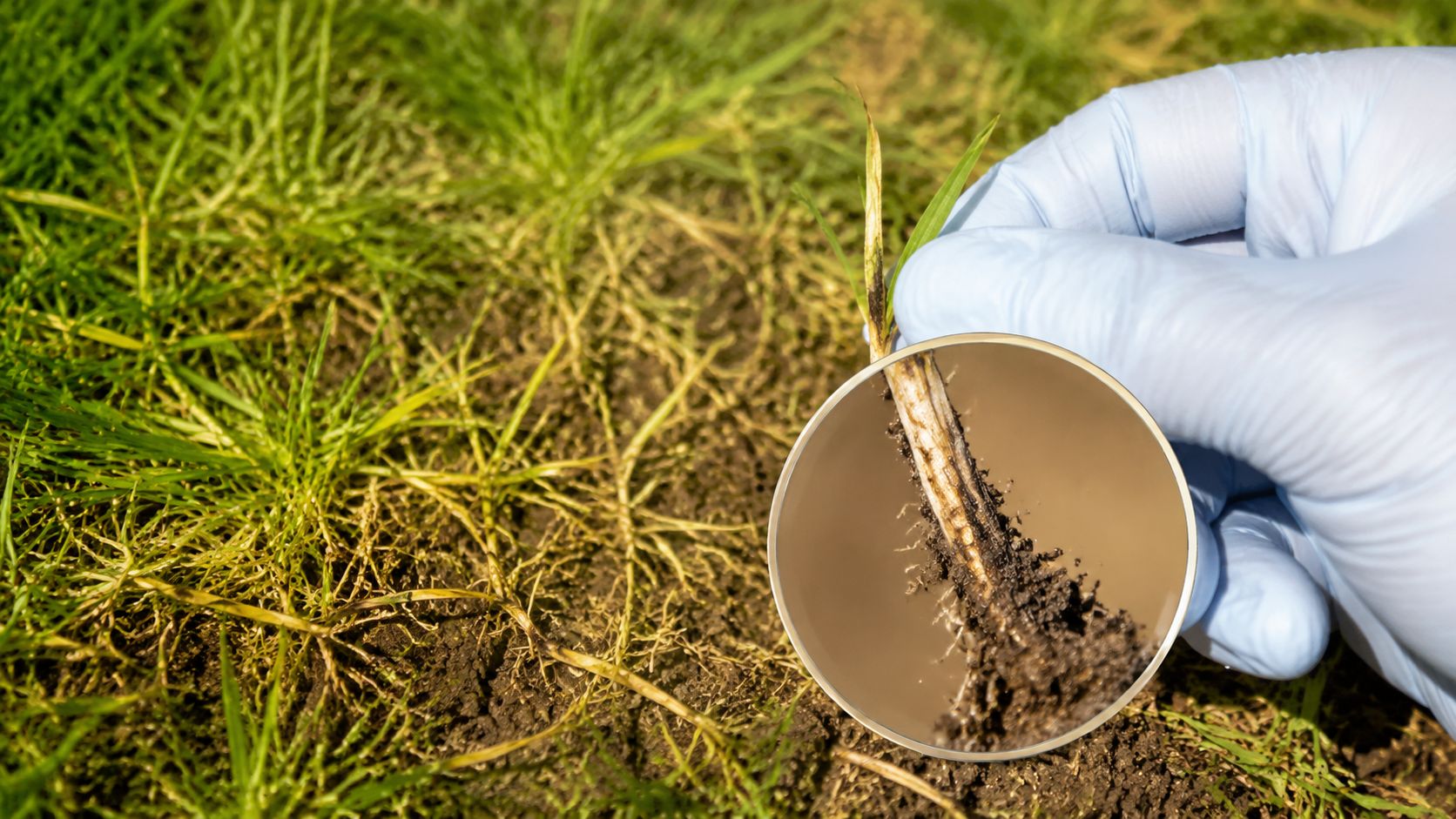
Go to the outer edge of the patch and pull up a few runners gently. Healthy turf stays anchored. Turf affected by take-all root rot often comes up with much less resistance because the root system is already compromised.
Then look closely at what came up. Healthy roots are firmer and lighter in color. Diseased roots are often short, dark, brittle, or decayed. Stolons may still be present, but the plant has lost the root mass it needs to handle North Texas heat.
That root failure is the giveaway. A lawn can have yellow blades for several reasons. TARR stands out because the roots are declining first, and summer stress exposes the damage.
If the grass looks thirsty but pulls up easily with dark, weak roots attached, adding more water usually makes the situation worse.
Compare it with the problems that fool homeowners
Misdiagnosis is common because several lawn issues can produce yellow or brown areas. The difference is in what fails first and how the turf responds.
| Problem | What you usually see | What points toward TARR |
|---|---|---|
| Take all root rot | Irregular yellowing, thinning, gradual decline | Easy pull-up, damaged roots, patch expands slowly from stressed areas |
| Brown patch | Lesions and blighted leaf tissue, usually in cooler conditions | Leaf blades show injury first, roots usually remain more intact |
| Chinch bug damage | Turf decline near sidewalks, driveways, and reflective heat | Insects or feeding activity are present, roots are not the primary failure |
| Simple drought stress | Folded or wilted blades that improve after watering | Turf with TARR stays weak because the root system cannot recover normally |
Inspect the edge of the patch
The edge tells you more than the center. The center is often already gone. The outer margin shows active decline, which makes it the best place to inspect roots, stolons, moisture conditions, and how firmly the grass is anchored.
This is also where the bigger North Texas picture starts to show. In alkaline soils, a lawn with a weak root system often struggles across more than one season. A fungicide might have a role, but identification should also point you toward the underlying site conditions that are keeping the grass from recovering.
If the symptoms are mixed or the lawn has already been treated without improvement, a professional diagnosis is usually money well spent. The wrong fix can set recovery back for months.
The Hidden Causes Fueling This Lawn Disease
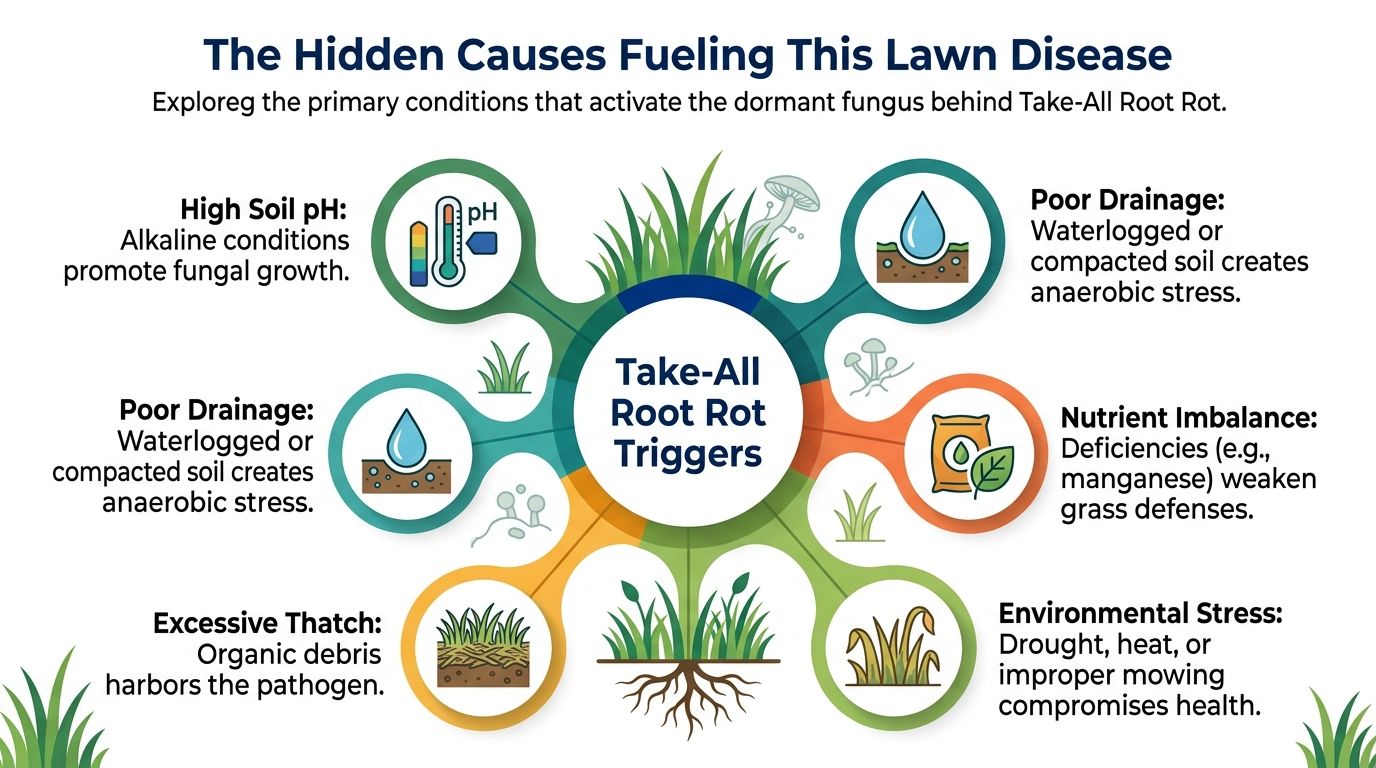
A North Texas lawn usually does not develop take all root rot from one bad week. I see it after months, and often more than one season, of stress piling up in the root zone. The fungus takes advantage when bermuda or St. Augustine is already struggling with high pH, wet soil, tight soil, heavy thatch, or a fertilizing program that pushes top growth faster than roots can support.
High pH gives the disease an advantage
North Texas starts with a real handicap here. Many local soils run alkaline, and that changes how the turf feeds itself and how well roots recover after stress.
The University of Georgia notes that take all root rot is favored by soil pH above 7.0, while suppression is better supported closer to pH 6.0 to 6.5 with non-lime acidifying materials such as elemental sulfur or iron sulfate (University of Georgia field report on take-all root rot).
For homeowners, the practical takeaway is simple. Do not treat yellowing as an automatic reason to add lime. In our area, that often pushes the lawn farther in the wrong direction.
Wet soil and low oxygen keep roots from recovering
Take all root rot gets worse where the root zone stays wet and stale. Overwatering plays a role, but so do grading problems, compacted clay, runoff from beds, and thatch that keeps moisture trapped near the surface.
If water stands after rain or irrigation, fixing those yard drainage problems is part of the disease plan. It is not a separate cosmetic issue.
This is one of the biggest trade-offs I explain to homeowners. Watering more may improve color for a few days, but it can keep the root zone in the exact condition that slows recovery. In summer, especially in DFW heat, that can feel counterintuitive.
Fertility mistakes can feed stress instead of recovery
Many TARR lawns are overfed first and diagnosed later. The grass turns pale, the homeowner assumes it needs nitrogen, and the lawn responds with a brief flush of top growth while the roots continue to fail.
High nitrogen programs tend to make this problem harder to manage, especially in alkaline soils. The same is true of lawns with thick thatch or compacted areas from traffic, construction, or repeated mowing on wet ground. Each factor by itself may be manageable. Stacked together, they create a root environment that favors decline.
This disease builds from conditions, not just infection
The pattern usually looks like this:
- Alkaline soil keeps the lawn at a disadvantage
- Drainage issues or frequent irrigation leave roots stressed and oxygen-poor
- Compaction and thatch limit air movement and root growth
- Nitrogen-heavy feeding pushes blades while the root system stays weak
That is why a spray-only approach rarely holds up in North Texas. Fungicides can have a place, but lasting improvement usually comes from correcting the site conditions that keep the disease active from season to season.
Your Integrated Management and Control Plan
A workable TARR plan in North Texas starts with one assumption. Recovery will take more than one season, and it will take more than one fix.
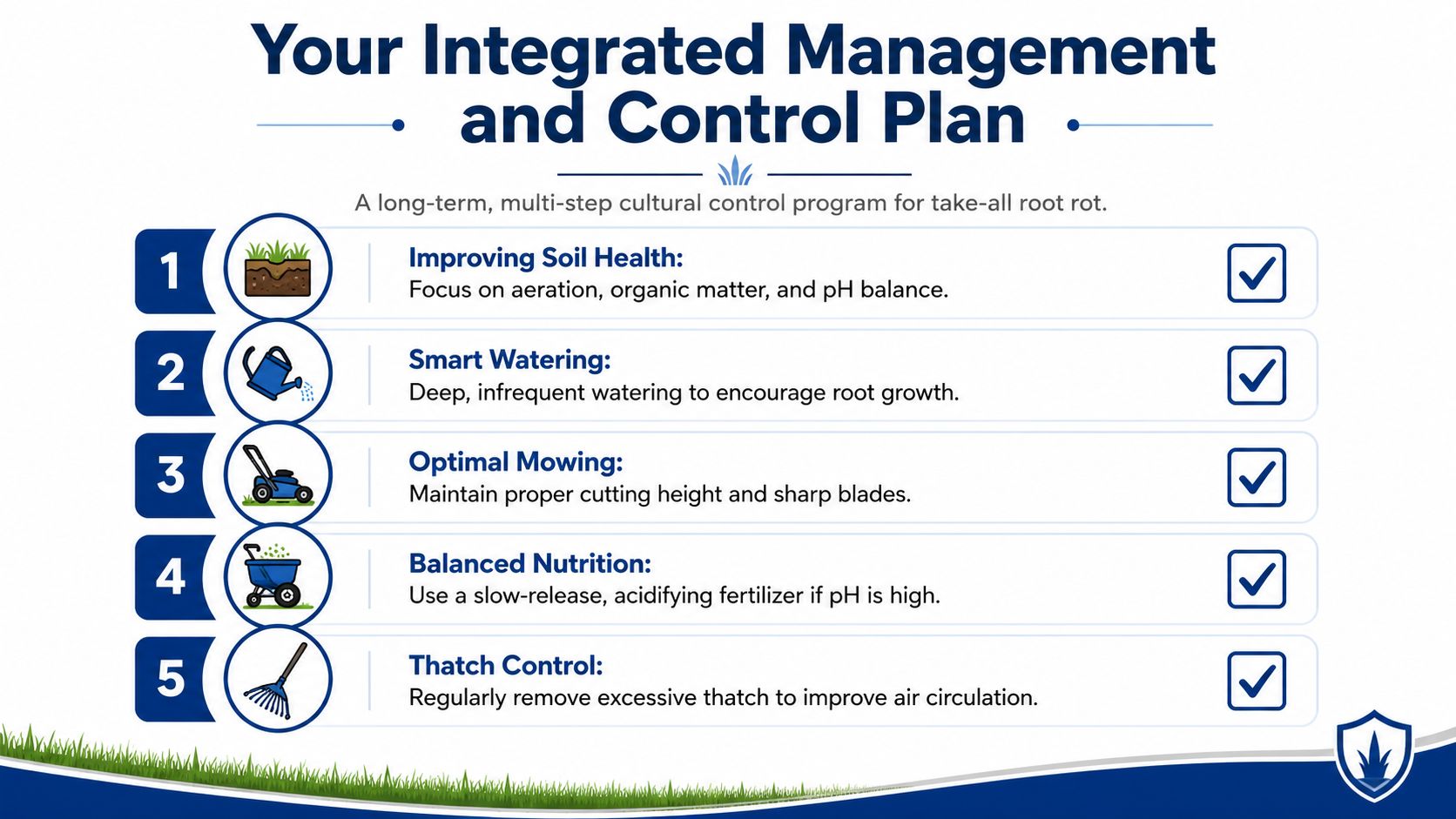
Homeowners usually call after trying the fast answers first. More water. A high-nitrogen fertilizer. A fungicide because the patch keeps spreading. In DFW lawns, especially on alkaline soils, those steps often miss the bigger problem. The grass is trying to recover in a root zone that still works against it.
That is why control has to be integrated. Soil conditions, irrigation, mowing, and fertility all have to support root recovery at the same time.
Fix the root zone first
Start below the surface.
If the soil is compacted or the thatch layer is heavy, roots stay shallow and stressed. Water also tends to sit where it should not. Core aeration helps open the profile, improves oxygen movement, and gives the lawn a better chance to rebuild roots instead of just pushing weak top growth.
High pH is another common obstacle in North Texas. TARR is harder to manage when the lawn is already struggling in alkaline soil, so use acidifying inputs where a soil test supports them. Ammonium sulfate or sulfur-based products are commonly part of that plan. The trade-off is speed. pH correction is slow, and pushing it too aggressively can create a different set of problems.
Practical rule: If the lawn has TARR, improve the root environment before chasing color.
Water for root depth, not surface color
Irrigation habits decide whether many TARR lawns recover or keep sliding.
Frequent, shallow watering keeps the upper soil damp and weakens the deeper root system you need in summer. In North Texas heat, I understand why homeowners do it. The lawn looks stressed by afternoon, and adding water feels like the safe move. But a lawn with compromised roots usually does better with deeper watering and more time between cycles, as long as coverage is even and the soil can drain.
That means checking more than your controller settings. Watch how long low spots stay wet. Look for runoff near sidewalks and driveways. Make sure one head is not soaking an area while another barely reaches it. In many yards, the main fix is less frequent watering plus nozzle adjustment, drainage improvement, or repairing a bad zone.
Reduce stress from mowing
TARR recovery gets harder when the lawn is being cut like a healthy lawn.
Keep St. Augustine on the taller side so it has enough leaf area to support recovery through heat. Use a sharp blade. Avoid scalping thin spots. Hold off on aggressive grooming if the turf is already under pressure.
This is a simple trade-off. A tightly manicured lawn may look cleaner for a week, but taller turf usually handles stress better and protects the crown while roots are trying to come back.
Rebuild fertility with restraint
Many damaged lawns get too much nitrogen at the wrong time.
Use a slower, steadier fertility program instead of a quick green-up product. Balance nitrogen with potassium rather than feeding nitrogen alone. If the lawn is chlorotic and roots are weak, foliar micronutrient support may help maintain function while the root system recovers.
Keep expectations realistic here. Fertility can support recovery, but it cannot outrun poor soil conditions or bad irrigation practices. I tell homeowners this all the time. If the roots are failing, a stronger fertilizer program usually makes the lawn look uneven faster, not better longer.
A practical program usually includes:
- Slow-release feeding instead of fast-release nitrogen
- Balanced potassium support rather than nitrogen-heavy applications
- Targeted micronutrients when a soil test or visual symptoms support them
- Fewer combined products while the lawn is under stress
Stay consistent long enough to see results
TARR rarely turns around on a neat schedule.
The first win is often that the patch stops getting worse. After that, color may improve before density does. Full fill-in can take much longer, especially if the lawn went into summer with a thin root system.
That timeline frustrates homeowners, but it is normal in our area. North Texas lawns deal with alkaline soil, long heat stretches, and repeated stress cycles. Lasting improvement comes from staying consistent with the full program long enough for the turf to rebuild strength between disease periods.
Using Fungicides and Repairing Damaged Turf
You treat the yellow patch, water a little more carefully, and still the lawn does not snap back. That is the point where many homeowners assume they need a stronger fungicide. In North Texas, the explanation is usually more nuanced. Fungicides can protect turf that still has a workable root system, but recovery depends on whether the site conditions have changed.
When fungicides actually help
Fungicides work best as a protective tool, not a rescue treatment for turf that has already lost most of its roots. By the time take all root rot is obvious above ground, the damage below ground is often well underway.
Timing matters. Product choice matters too. So does irrigation right after application, because many take all root rot materials need to move into the upper root zone to do their job. If the lawn has a long history of spring and fall decline, a preventive plan can reduce pressure during those higher-risk periods. If the lawn is already badly thinned and stressed going into summer, fungicide alone rarely changes the outcome.
That is the trade-off homeowners need to understand. A fungicide program may protect surviving turf long enough for roots to rebuild, but only if mowing, watering, soil chemistry, and compaction are being handled at the same time. For homeowners who want help building that kind of plant health care program for disease-stressed lawns, the full site picture matters more than the spray list.
When repair makes more sense than waiting
Some areas will recover by spreading from the edges. Some will not.
Use this decision lens:
| Lawn condition | Best next move |
|---|---|
| Light thinning with healthy stolons around the margin | Protect the area and give the turf time to fill back in |
| Uneven decline with some live turf across the patch | Repair selectively after the root zone is more stable |
| Large bare or nearly bare areas | Remove failed turf and re-sod after correcting the site problems |
I usually tell homeowners to judge the area by living turf, not color alone. If runners are still active around the edges and the crown tissue is alive, patience often beats tearing everything out. If the area has turned into open soil with scattered weak grass, replacement is usually faster and less frustrating.
Don't re-sod into the same bad conditions
Expensive repairs fail. Fresh sod looks good for a few weeks, then the same patch slips again because the root environment never improved.
Before re-sodding, fix the site first:
- Improve drainage so water does not sit around the roots after rain or irrigation
- Loosen compacted soil so new roots can move down instead of staying shallow
- Address high-pH pressure where appropriate with a realistic acidifying plan, not a one-time quick fix
- Set establishment irrigation carefully so the sod stays moist early without keeping the soil constantly saturated
- Use fungicides as support, when disease history and timing justify them
That last point matters in DFW. Our alkaline soils, long heat stretches, and repeated stress cycles create conditions where a repair job can look successful in the short term and still fail the next season. The better approach is to treat replacement as one part of a multi-season recovery plan. New sod needs a healthier root zone, measured fertility, and disciplined watering if you want the repair to hold through a North Texas summer.
When to Hire a Plant Health Care Professional
A homeowner can do a lot with good information. But there's a point where take all root rot stops being a lawn-care problem and becomes a site-management problem.

Signs the lawn needs expert help
If any of these sound familiar, bringing in a professional usually saves time and reduces wasted treatments:
- The damage keeps spreading even after you've improved watering and stopped overfeeding.
- Large sections of the yard are involved, making spot treatment unrealistic.
- You suspect more than one issue such as disease plus drainage, irrigation coverage problems, or compaction.
- You can't measure or correct the root-zone conditions on your own.
- The lawn needs renovation, not just maintenance.
A trained plant health care team can look at the whole site. That matters because TARR often overlaps with irrigation design flaws, runoff patterns, low spots, mower stress, and poor soil structure.
What a professional should evaluate
A good diagnosis goes beyond naming the fungus. It should answer the practical questions that determine whether the lawn recovers.
That includes:
- Soil conditions such as pH trend, compaction, and organic buildup
- Water movement across the property and whether the root zone stays wet too long
- Irrigation performance including coverage, runtime, and distribution problems
- Turf vigor in healthy versus declining areas
- Repair scope for sections that are unlikely to fill back in on their own
The right professional doesn't just identify take all root rot. They identify why this lawn developed it here, in these spots, under this management history.
Why integrated service matters in DFW
North Texas properties often need more than disease treatment. They need coordination between lawn care, irrigation adjustment, drainage improvement, and renovation work. That's why plant health care is most effective when it isn't isolated from the rest of the property.
If you're at the point where the lawn needs deeper troubleshooting, a dedicated plant health care program is the right kind of support to look at the problem holistically.
For many homeowners, the primary value isn't just a fungicide recommendation. It's getting a plan that answers these questions clearly:
- What conditions are keeping the disease active?
- Which damaged areas are worth saving?
- Which areas should be rebuilt?
- What has to change this season so the same problem doesn't come back next year?
That's the difference between temporary improvement and real recovery.
If your lawn has the classic signs of take all root rot and you're tired of trying one-off fixes, Rosewood Landscape Group can help evaluate the full picture. Their team serves the Dallas-Fort Worth metroplex with plant health care, drainage solutions, irrigation support, and lawn renovation work suited for North Texas conditions.
Related posts
8 Best Shrubs for North Texas Landscapes in 2026
Permeable Paver Installation: A DFW Homeowner’s Guide
Zoysia Grass Fungus: Identify, Treat & Prevent in 2026
How to Improve Soil Quality: Easy Ways to Improve Soil