
You walk into the backyard in August, coffee in hand, and there it is. A patch in the St. Augustine that looked fine last week now looks tired, yellow, and half-dead. You water a little more. Maybe you blame the sprinkler coverage. Then the patch spreads, or the grass lifts too easily, or the area along the driveway starts crisping up faster than the rest of the yard.
That's the moment most North Texas homeowners waste money.
They guess. They throw down an insecticide, or a fungus product, or more water. Sometimes all three. In DFW, that's a bad habit because heat stress, irrigation problems, thatch buildup, and actual pests in lawns can look similar at first glance. If you don't confirm the cause, you can spend a weekend and a pile of cash treating the wrong problem.
A healthy lawn in this climate needs more than good intentions. It needs diagnosis first, then action. If your yard keeps sliding backward every summer, it usually comes down to one of two things: the lawn is under stress, or something is feeding on it while it's under stress. The difference matters.
Is It the Texas Heat or Something More Sinister
A common DFW scenario goes like this. A homeowner notices a brown patch near the patio or along the curb line. They assume the brutal sun cooked it. That's not a crazy guess. North Texas heat punishes turf. But a lot of lawn damage that gets blamed on weather is a pest problem that was never verified.
The trap is that damaged turf often gives mixed signals. Dry soil can make grass thin out. Chinch bugs can also make grass thin out. Grubs can wreck roots underground while the top still looks decent for a while. Then one hot stretch hits, and the whole area collapses fast.
That's why I tell people to slow down before they treat. Don't start with products. Start with proof. If you're already dealing with repeated lawn stress, a broader Dallas lawn care approach usually matters more than one emergency spray.
Most lawn damage in North Texas gets misdiagnosed because people treat the symptom they can see instead of the cause they haven't confirmed.
What usually fools homeowners
Three things create the most confusion in local lawns:
- Heat stress: Grass fades, curls, or goes dull when the root system can't keep up.
- Watering issues: Too little water weakens turf. Too much can create its own problems.
- Insect feeding: The damage often shows up after the insects have already been active for a while.
What to do first
Before you buy anything, check the pattern.
- Random patch that won't recover after watering: Start suspecting root or insect issues.
- Damage along hot hardscape edges: Look harder for chinch bug activity.
- Spongy turf or grass that lifts too easily: Think below the surface.
North Texas lawns don't need panic. They need inspection. That's the difference between a simple correction and a month of guessing.
How to Identify Common Lawn Pests in North Texas
Generic pest articles love photos. That's not enough. You need field checks you can do in your own yard. The biggest mistake with pests in lawns is assuming the first ugly patch tells the whole story.
Start with symptoms, then confirm with a test.
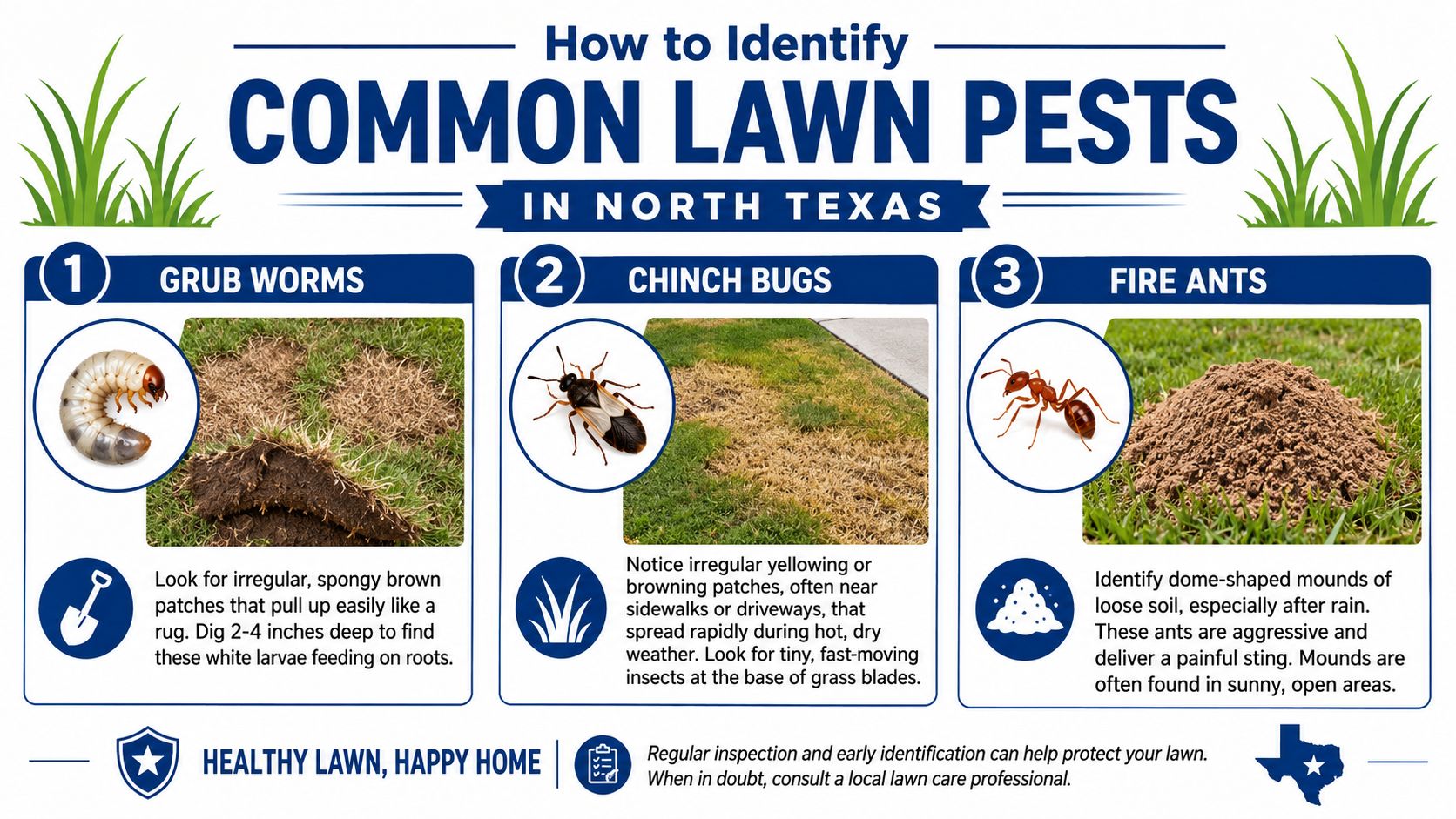
Look for the pattern before you look for the bug
Different pests leave different clues.
| Pest | What you'll usually notice |
|---|---|
| Grubs | Irregular brown patches, weak roots, turf that may pull up too easily |
| Chinch bugs | Yellowing or browning areas that often show up in hot, sunny spots |
| Fire ants | Mounds of loose soil, usually obvious after rain or irrigation |
| Surface-feeding caterpillars and similar insects | Ragged or thinning turf, especially where feeding happens fast |
That first read matters because it tells you where to inspect. Don't wander the whole lawn. Check the edge of the damaged area, where active feeding is easier to catch.
Use the soap-flush test
For North Texas warm-season turf, the soap-flush test is one of the most useful tools you can use. The standard protocol is mixing 2 to 4 tablespoons of liquid dish soap in 1 gallon of water and pouring it over a 1-square-yard area. Soil insects rise within 10 minutes, and the count can be used to compare against response thresholds, according to this turf IPM guide on Lawn Love.
Here's how to do it without overthinking it:
- Pick the right spot: Test the border between healthy and damaged turf.
- Mix the solution: Use the soap and water ratio above.
- Pour slowly: Cover the full test square evenly.
- Watch the surface: Give it several minutes. Insects may emerge gradually.
- Count what appears: Don't guess from one bug. Observe the actual activity.
Practical rule: If you haven't tested, you haven't diagnosed.
This method is useful because it beats blind treatment. It gives you visible evidence without tearing the yard apart.
Check for chinch bugs the simple way
A lot of homeowners miss chinch bugs because the damage looks like drought at first. In hot weather, that confusion gets worse. The low-tech answer is the can float test. Insert an open-ended can into yellowing turf, fill it with water, and watch for chinch bugs floating up.
This matters in North Texas because heat-stressed turf and chinch bug damage overlap visually. If you skip the test, you can end up pouring more water on a pest problem and making the lawn weaker.
Don't ignore what the grass itself is telling you
Some clues don't require any special tool:
- Grass pulls up with little resistance: Roots may be compromised.
- Patch edges are spreading outward: Active feeding is still happening.
- Birds or critters start digging in one zone: They may be after insects under the turf.
- Mounds appear after moisture: Fire ants are announcing themselves.
What most people get wrong
They identify an insect and stop there. That's not enough. The key question isn't “Do I have bugs?” The key question is “Are these bugs causing the damage I'm seeing?”
Lawns can host insect activity without needing treatment. That's where pest response thresholds matter. In turf IPM, treatment decisions should be based on confirmed infestation levels, not panic. The same Lawn Love guide notes a response threshold example of 10 to 15 white grubs per square foot for Popillia japonica before chemical action is justified in that context.
That mindset saves money and avoids pointless applications. It also keeps you from killing off beneficial activity just because the lawn looked rough after a hot week.
The North Texas Pest Activity Calendar
North Texas doesn't have one pest season. It has waves. If you don't understand the rhythm, every lawn problem feels like an emergency. It isn't. Timing tells you what's likely, what's fading, and what probably isn't the issue at all.
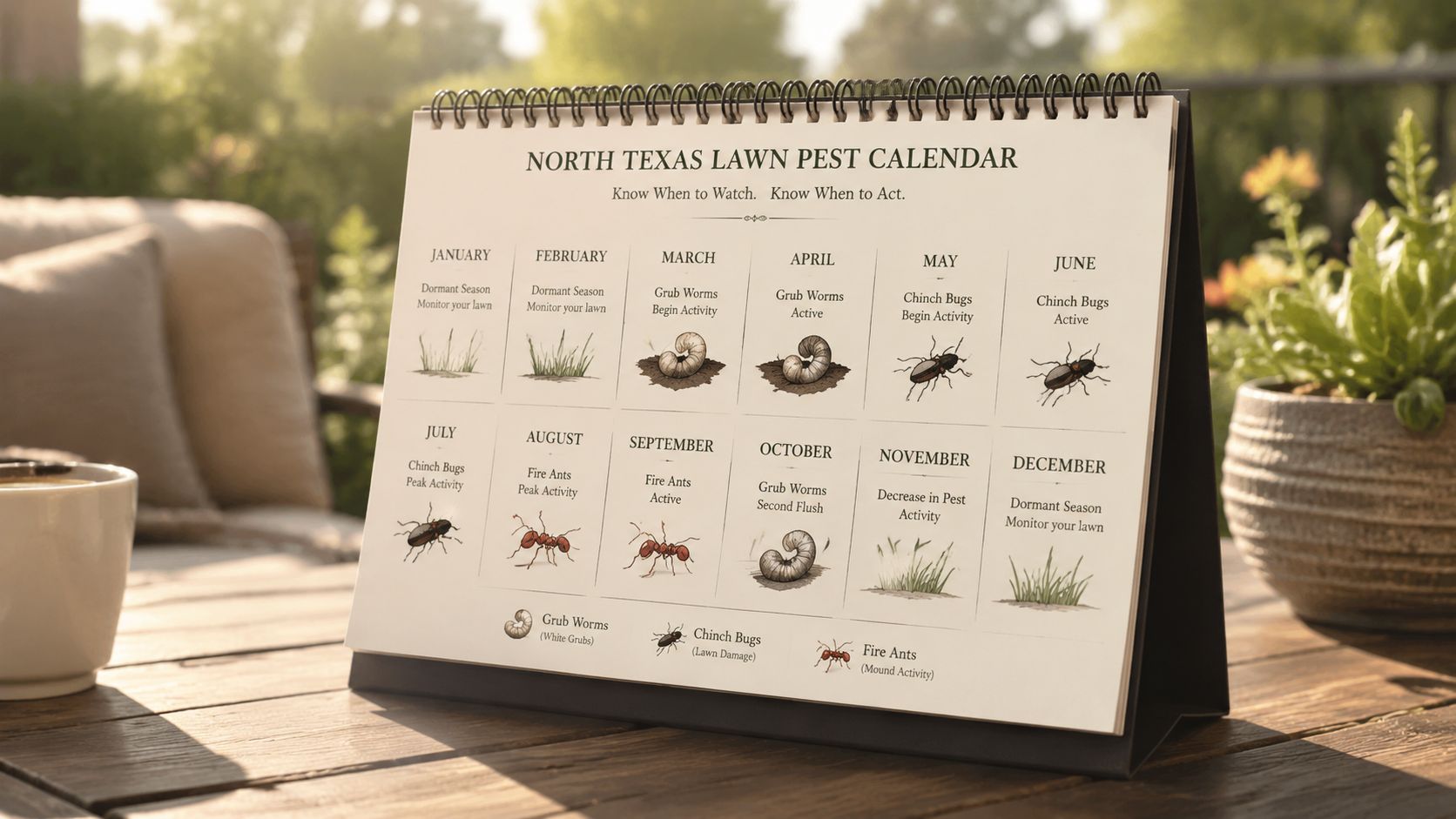
A good seasonal routine matters as much as treatment. If you want the lawn to hold up through summer, a solid summer lawn maintenance plan earns its keep.
What to watch by season
| Season | What usually deserves your attention |
|---|---|
| Spring | Early stress shows up, but not every patch is a bug issue. This is when scouting habits should start. |
| Early summer | Heat begins exposing weak turf, and surface insect issues become easier to confuse with irrigation trouble. |
| Late summer | Root-feeding problems become more obvious. The Lawn Love IPM guidance notes grub feeding peaks in late summer when larvae are actively consuming root tissue. |
| Fall | Some damage lingers from summer pests, while cooler and wetter conditions can make non-insect issues easier to mistake for bug damage. |
Why late summer tricks people
Late summer is when a lot of North Texas lawns finally show the cost of earlier stress. That's why homeowners often say, “It happened overnight.” Usually it didn't. The lawn was already weakened. Then heat and feeding pressure caught up with it.
White grub damage is a good example. By the time the turf feels loose or starts browning badly, the roots may already be compromised. Surface feeders can create the same false sense of sudden collapse.
In DFW, August is when hidden problems stop hiding.
Why not every seasonal change is insects
Spring and fall can muddy the picture. Turf may discolor during weather swings, wet periods, or after traffic stress. That doesn't mean you should reach for insect control. It means you should scout before you act.
A useful habit is to inspect on a schedule instead of waiting for visible damage. Walk the lawn. Check edges near concrete. Look at areas that stay damp longer. Notice where the grass is thinning first, not where it's already dead.
A calendar is better than a reaction
If you know when your lawn usually struggles, you can inspect earlier and catch the cause before it spreads. That's the advantage of thinking seasonally. You stop treating every brown patch like a mystery and start reading the lawn like a pattern.
Building a Pest-Resistant Lawn with Cultural Controls
You can spot the yards that invite pests in August. The grass is cut too low, the soil stays damp on top, and the turf feels spongy underfoot. In North Texas, that combination turns routine summer stress into a pest problem fast.
Start with the lawn itself. A dense, actively growing lawn gives chinch bugs, sod webworms, and grubs fewer easy openings. A weak lawn does the opposite.
Mow like you expect heat to hit
Scalping is one of the fastest ways to weaken turf in DFW. Keep mowing height in the range recommended for common local lawns, and avoid taking off too much blade at once. As noted by ExperiGreen's lawn pest control guide, DFW lawns generally perform better when they're kept around 2.5 to 3.5 inches and watered thoroughly rather than constantly.
That extra leaf blade matters here. It shades the soil, slows moisture loss, and reduces the stress that surface-feeding insects exploit.
Short grass may look tidy for a day. Then it starts paying the price.
Water for roots, not for appearances
North Texas lawns need deep watering that pushes moisture into the root zone. They do not need a daily sprinkle that keeps the surface wet and the roots shallow.
If you keep watering lightly and the lawn still declines, stop guessing. Check the soil. Use a screwdriver, a soil probe, or even a shovel to see how far moisture is reaching. Then compare that area with the damaged spots. This hands-on check saves money because it helps you separate irrigation trouble from insect feeding before you buy the wrong product.
A lawn that greens up for a day after watering and crashes again often has a bigger problem than thirst.
Control thatch before it turns into shelter
Too much thatch gives pests cover and makes the lawn harder to read. Water may not soak in evenly. Insect activity gets harder to spot. The turf starts showing mixed symptoms that send homeowners in the wrong direction.
Check it, don't assume. Cut a small plug from the lawn and measure the spongy layer between the green blades and the soil. If that layer is thick, deal with it. Otherwise, you're treating symptoms while the setup for repeat problems stays in place.
Use simple habits that lower pest pressure
These basics do more than any random store-bought spray:
- Keep turf dense: Thin spots are where trouble starts.
- Fix soggy areas: Constantly wet patches attract problems and weaken roots.
- Clean up edges: Pest activity often builds first along hot pavement, fences, and neglected borders.
- Reduce standing water: If mosquitoes are part of the issue, empty containers and correct drainage around the lawn.
Here's the payoff. Good mowing, proper watering, and thatch control also make diagnosis easier. When the lawn is maintained well, the soap flush test and close scouting give you cleaner answers because you're not sorting through damage caused by bad care at the same time.
That's how you stay ahead of North Texas pest cycles. You make the lawn harder to attack, and you make pest activity easier to confirm when it does show up.
Choosing the Right Treatment and Using Pesticides Safely
You run a soap flush, watch insects surface, and then grab the first bug killer you see at the store. That is how North Texas homeowners waste money.
Treat the pest you confirmed. Skip the spray if you have not confirmed it. In DFW, heat stress, dry spots, chinch bugs, sod webworms, and grub damage can look similar at first glance. If you spray before you identify the culprit, you can miss the problem and set the lawn back even further.
Broad-spectrum products are usually the wrong first move. They knock down more than the target, disrupt beneficial activity, and often leave you with the same problem a few weeks later because the underlying cause was never addressed. Use Integrated Pest Management instead. Scout first, match the product to the pest, and treat only where the evidence supports it.
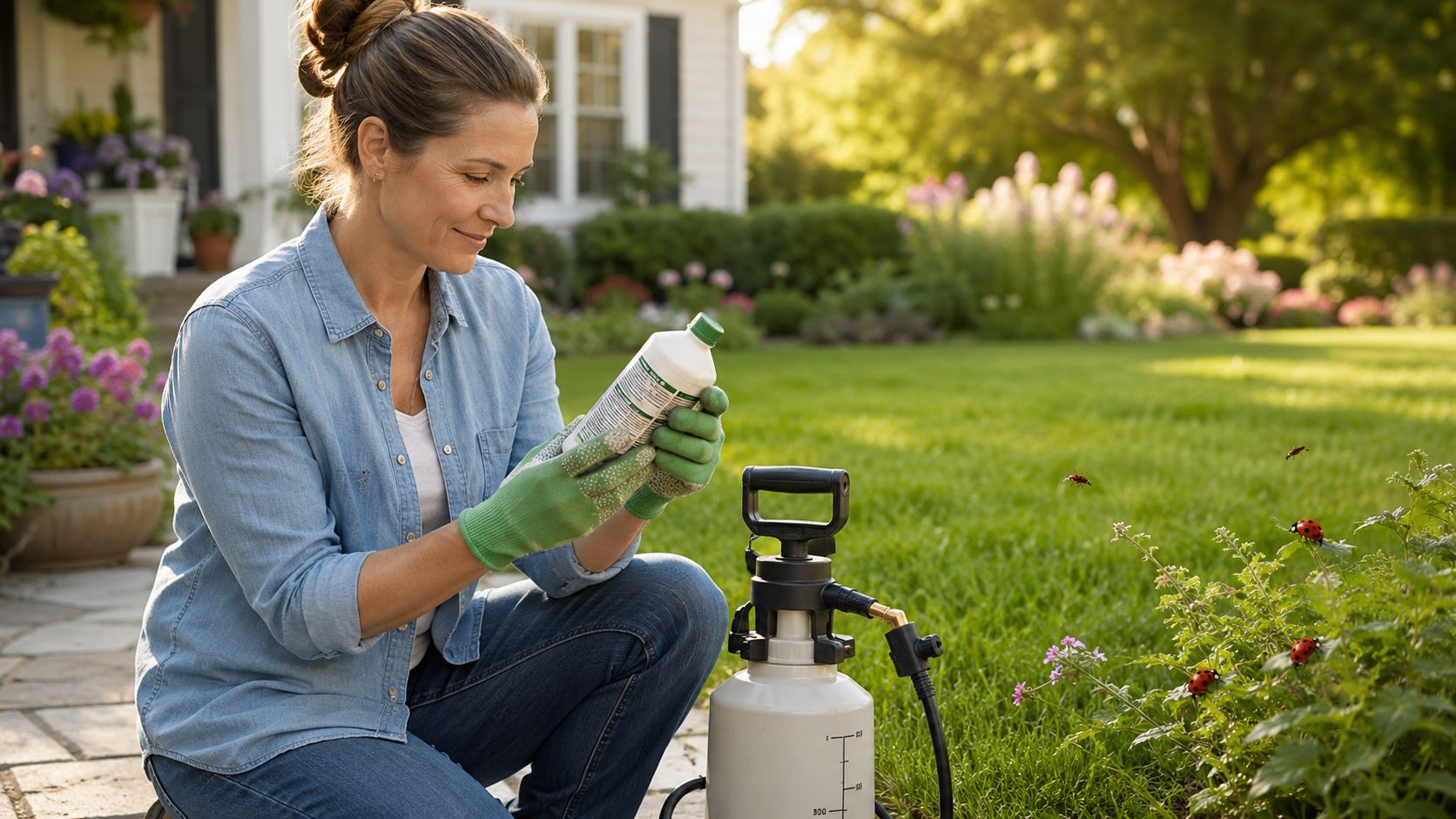
Match the treatment to the pest and the patch
Good treatment is specific.
- For confirmed soil insects: Use a product labeled for that insect group and follow the timing on the label. Timing matters in North Texas because pest activity shifts fast with heat.
- For small active areas: Spot treat the problem zone instead of spraying the whole lawn.
- For stress without proof of insects: Do not force a pesticide solution onto a mowing, irrigation, or drainage problem.
That last mistake is common. A rough-looking yard does not automatically have a pest problem.
Read the label like it matters, because it does
The label tells you where the product can be used, how much to apply, whether it needs watering in, and how long kids and pets should stay off the grass. Ignore that, and you are guessing with chemicals.
Also pay attention to where the problem starts. In North Texas, pest activity often shows up first along foundations, sidewalks, driveways, and hot fence lines. If insects are moving from turf toward the house, a perimeter treatment can make sense as part of a broader IPM plan. Grasshopper Gardens explains how perimeter insect control helps reduce pest movement toward structures.
Use a treatment sequence that actually works
Keep it simple:
- Confirm the pest with scouting or a soap flush test
- Measure how far the activity has spread
- Choose the narrowest effective product
- Apply it only where the label and the infestation call for it
- Recheck the area before treating again
That sequence saves money and prevents the usual cycle of repeat applications with no real diagnosis.
If you want site-specific guidance on diagnosis, treatment timing, and broader yard health, Rosewood Landscape Group's plant health care service provides that kind of support.
When to Call a Professional Like Rosewood Landscape Group
Some lawn problems are fine for DIY. Others aren't worth your weekend.
If the damage keeps returning, if you've got more than one issue happening at once, or if the lawn is declining across multiple zones, that's when a pro becomes useful. Not because homeowners can't learn, but because complex pest problems often overlap with irrigation flaws, drainage issues, soil stress, and plant health problems nearby.

Signs you're past the DIY stage
Call for help when you see any of these:
- The damage is widespread: One test patch is manageable. Multiple expanding zones usually need a fuller inspection.
- The problem keeps coming back: If you treated once and got only a brief cosmetic rebound, the root cause probably wasn't solved.
- You suspect more than one issue: In DFW, pest stress and cultural stress often stack on top of each other.
- You don't have confidence in the diagnosis: That's reason enough. Guessing is expensive.
Why professional help is normal, not excessive
The pest control business is huge because homeowners regularly run into situations that need trained eyes. The U.S. pest control industry is projected to generate $26.1 billion in 2025, with residential services accounting for about 70% of revenue, and the market includes more than 32,720 companies, according to BrioStack's pest control industry statistics. Most of those companies are local operations serving regional markets like DFW.
That tells you something simple. Lawn and property pest problems are common, and a lot of people decide it's smarter to outsource the diagnosis and treatment.
If you've already tried watering adjustments, scouting, and a targeted fix, but the lawn still keeps sliding, stop repeating the same experiment.
What a pro should actually help with
A useful professional doesn't just spray and leave. They should be able to:
- Differentiate stress from feeding damage
- Inspect the full property, not just the ugliest patch
- Connect lawn issues to drainage, irrigation, and nearby plant health
- Recommend whether treatment, cultural correction, or both are needed
That's the standard homeowners should expect, not a sales pitch.
Creating Your Resilient and Healthy North Texas Lawn
The goal isn't to create a sterile yard with zero insect activity. That's not realistic, and it's not smart. The goal is to build a lawn strong enough that pests in lawns don't turn every rough patch into a full-blown failure.
That starts with proper diagnosis. Then it moves to mowing height, watering habits, and thatch control. Only after that should chemical treatment enter the conversation. When homeowners reverse that order, they usually spend more and get worse results.
There's also a bigger reason to quit the spray-first mindset. Approximately 80 million pounds of pesticides are applied to lawns and gardens across North America annually, according to the National Wildlife Federation's discussion of lawn chemical impacts and alternatives. That's a huge amount of chemical input for these outdoor spaces that often needed better identification and better IPM decisions before anything else.
A resilient North Texas lawn is built, not rescued. Scout the lawn. Confirm the issue. Strengthen the turf. Treat only when the evidence says you should. That's how you protect your yard without wasting money or making the problem harder to solve next season.
If your lawn keeps showing mystery patches, recurring insect pressure, or signs of broader grounds stress, Rosewood Landscape Group can help you evaluate the property as a whole and decide whether the fix is irrigation, cultural correction, targeted treatment, or a combination of all three.
Related posts
8 Best Shrubs for North Texas Landscapes in 2026
Permeable Paver Installation: A DFW Homeowner’s Guide
Zoysia Grass Fungus: Identify, Treat & Prevent in 2026
How to Improve Soil Quality: Easy Ways to Improve Soil
Take All Root Rot: Diagnose & Treat Your Lawn