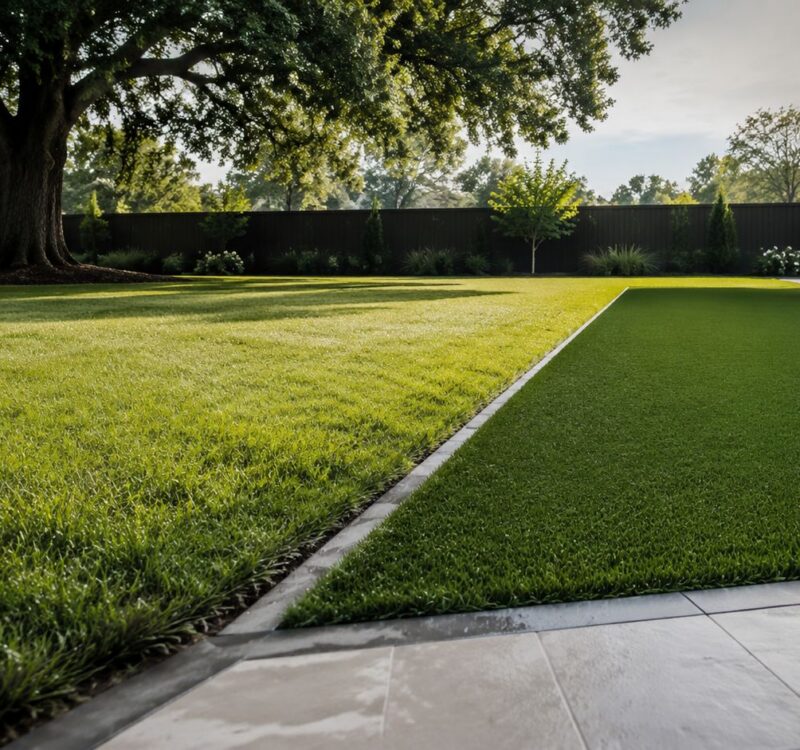
A lot of Dallas-Fort Worth homeowners reach the same point at the same time. The house is finished, the interiors feel polished, and the backyard still looks like a temporary condition. The lawn struggles through summer, drainage turns into a guessing game after a hard storm, and the patio never quite feels like part of the home.
That disconnect is why luxury outdoor design matters here. In North Texas, a beautiful outdoor space doesn't happen by choosing expensive materials or dropping in a few specimen plants. It comes from solving heat, clay soil, runoff, shade, privacy, and daily use in one coordinated plan.
The Dream and Reality of a DFW Outdoor Space
A typical high-end DFW property has good bones and one frustrating flaw. The architecture is sharp, the interiors are layered and intentional, but outside you often see scorched turf, foundation beds planted without a long-term plan, and a patio that gets too much afternoon sun to use comfortably.
That's not a style problem. It's a climate-and-planning problem.
North Texas is challenging for outdoor environments. Summer heat exposes every bad plant choice. Clay soil holds water in one area and bakes hard in another. A sudden downpour can send water toward the house if grading and drainage weren't handled from the start. Many outdoor spaces look acceptable in spring and fall, then fail in August or after the first major storm.
I've seen the same pattern across estate properties. Owners want a resort-level outdoor environment, but what they have is a collection of disconnected parts. A pool that doesn't relate to the home. Planting beds that feel busy instead of refined. Screening that either doesn't provide privacy or closes the yard in too tightly.
Luxury works outdoors when the space feels calm, usable, and inevitable, as if it always belonged to the house.
The best projects solve that tension by treating the site like part of the architecture. Paths align with interior sightlines. Shade is deliberate. Planting masses are restrained. Drainage is invisible but effective. Outdoor rooms support the way the family lives, whether that means quiet morning coffee, large weekend entertaining, or a lawn area where children and dogs can use the space without wrecking it.
If your home already looks distinguished from the street, the grounds should carry that same level of discipline from the front approach to the back property line. That's the difference between a pretty yard and a finished estate. For examples of how that transition can be handled at a high level, see luxury landscaping for country club homes.
Laying the Groundwork with Scoping and Site Analysis
Most expensive outdoor design mistakes happen before the first shovel goes in. They happen when a project starts with inspiration photos instead of site analysis.
In luxury outdoor design, the first job is to define how the property needs to perform. A family that hosts thirty people on weekends needs a different plan than a couple who wants a quiet garden, filtered shade, and one strong focal point from the breakfast room. The site has to answer those needs without fighting DFW conditions.
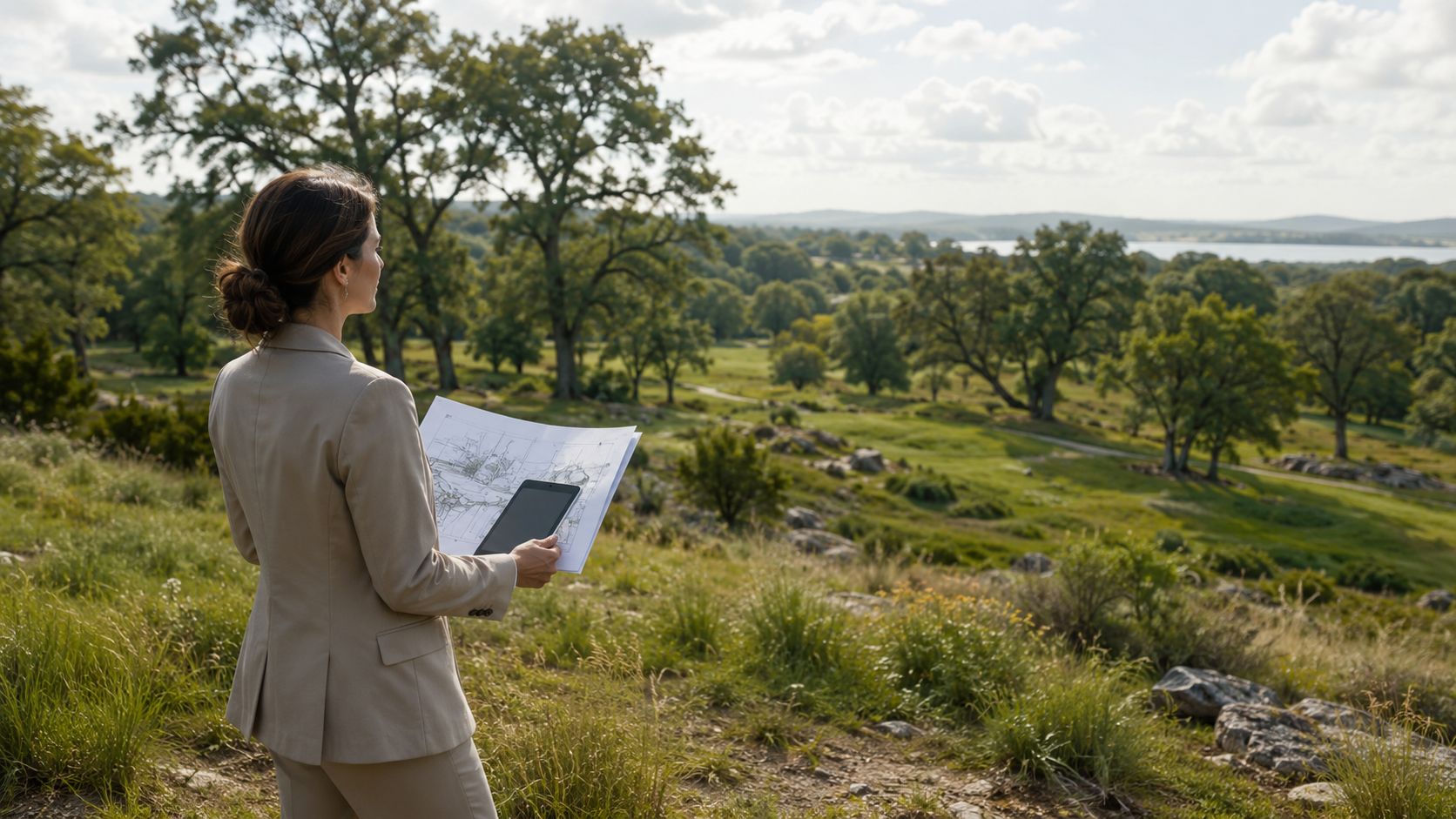
Start with use before style
Before choosing materials or plant palettes, pin down the core requirements.
- Daily living patterns: Where do you step outside most often, and where do people naturally gather?
- Entertainment needs: Do you need a dining terrace, a lounge, a fire feature, or all three with enough separation that each space still feels intentional?
- Service access: Where will crews, deliveries, and maintenance move without crossing the main entertaining axis?
- Seasonal comfort: Which spaces need morning sun, afternoon shade, wind protection, or direct visibility from inside?
A good site program keeps the project from becoming a list of features. Features alone don't create a luxury experience. Relationships do.
Read the DFW site like a contractor and a designer
North Texas punishes assumptions. You need to walk the property at different times of day and after rain if possible.
Focus on these field conditions:
Sun exposure
West sun is often the element clients underestimate most. A beautiful terrace can become unusable if it takes direct late-day heat with no overhead cover, filtered canopy, or architectural shade.Drainage and runoff
Watch where water stands, where it sheets across paving, and where it moves toward the structure. On clay-heavy sites, surface water can linger longer than owners expect. That affects planting health, hardscape stability, and foundation protection.Soil behavior
DFW clay can compact hard and drain slowly. That doesn't mean the site can't support lush planting. It means soil prep, root zone planning, grading, and irrigation design have to do more work than they would in easier conditions.Existing vegetation
Some mature trees are worth building the whole composition around. Others create poor shade patterns, root conflicts, or visual clutter. Don't preserve everything just because it's established.
Practical rule: If water movement, sun pattern, and soil condition haven't been mapped, the design is still premature.
Build the scope before the drawings
A disciplined process matters here. One established framework for luxury outdoor design starts with site inventory and analysis, then moves through user needs, functional space diagrams, conceptual design, and final documentation. It also emphasizes that premium designers often limit primary plant species to three to five repeated throughout the site for a cleaner, more coherent result, as outlined in this discussion of luxury landscape design principles and master planning.
That kind of planning isn't theoretical. It saves revisions, prevents mismatched installations, and makes budgeting far more accurate.
If you're preparing for a project, review a practical planning framework like how to plan a garden. It helps organize the questions that should be answered before design decisions get expensive.
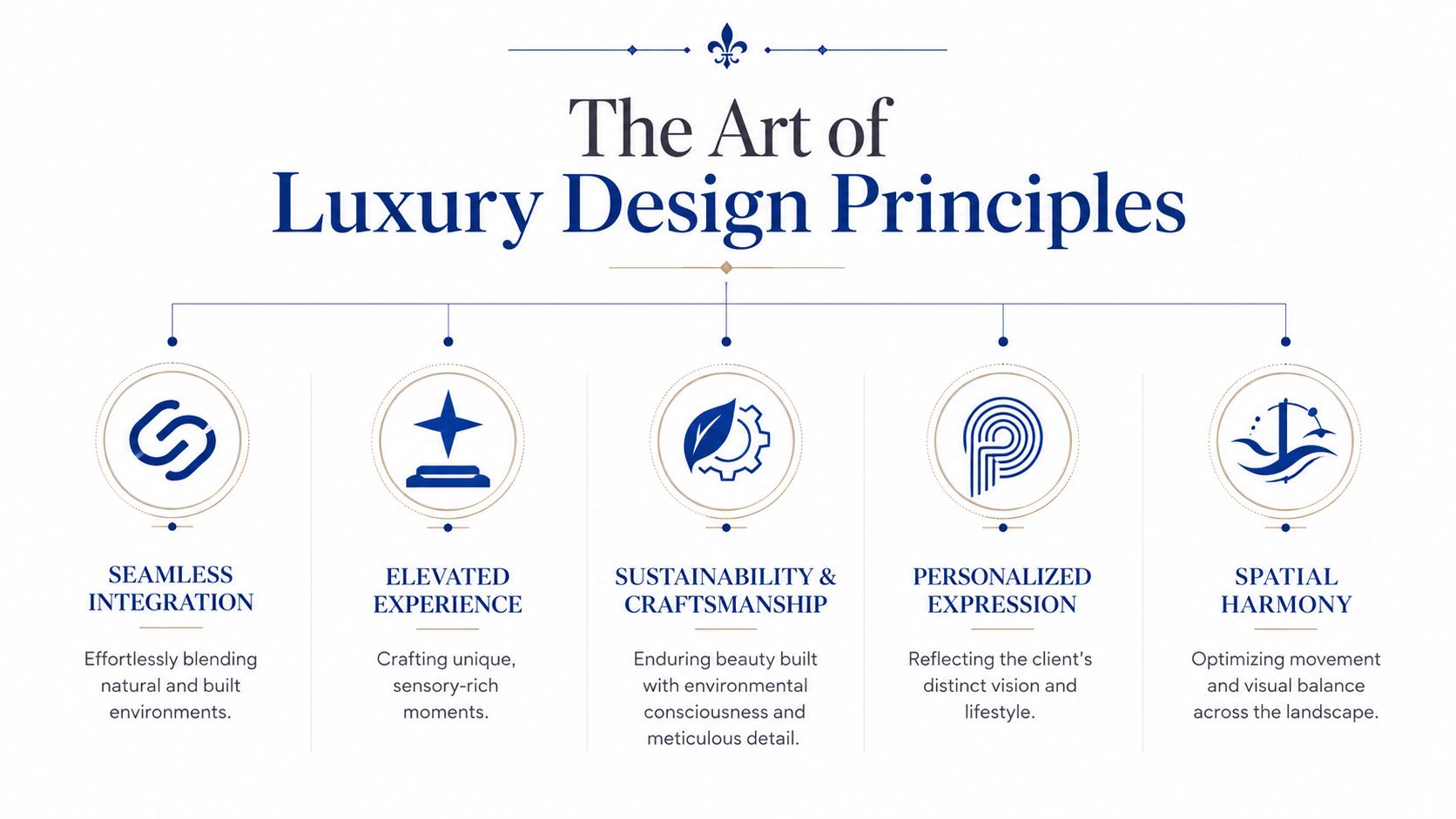
The Art of Luxury Design Principles
A high-end DFW property can have every premium finish on the wish list and still feel unsettled. The difference is usually design discipline. Strong outdoor design is less about adding features and more about controlling what repeats, what gets emphasis, and what deserves quiet.
The best estates feel calm because the composition is clear. Arrival courts, side-yard corridors, entertaining terraces, and borrowed views all relate to each other. Nothing feels random, and nothing fights the architecture for attention.
Use fewer plants more deliberately
In North Texas, a restrained plant palette is not just a style choice. It usually performs better over time.
I prefer a structural palette with a limited number of primary species repeated across the property. One evergreen form may carry the framework. One grass or textural plant can soften edges and add movement. One canopy tree, used where space and exposure allow, can tie major zones together. Supporting material stays selective.
That approach solves several common DFW problems at once. Summer heat exposes weak plant choices fast. Clay soil creates uneven vigor if species needs are all over the map. Maintenance also gets more predictable when crews are caring for repeated groupings instead of dozens of one-off selections.
It also makes the house read better.
A luxury property should not look like a plant collection. It should look settled, intentional, and easy to maintain at a high standard in August, not just in April.
Shape outdoor rooms with purpose
Large yards need structure. Smaller yards need even more.
The strongest properties use defined rooms with specific jobs. Dining belongs where service from the house is easy. A quiet court should feel enclosed enough for morning coffee or late conversation. Open lawn works best as visual relief or flexible use space, not as leftover square footage between beds and paving. Pool zones need clear circulation and enough deck area to avoid that crowded furniture-on-coping look.
In DFW, these rooms also need to respond to sun and wind. Western exposure can make a beautiful terrace unusable in late afternoon without shade or orientation control. A lounge that feels perfect in March may be abandoned by July if heat reflection from stone and masonry was ignored. Good design accounts for the hour of use, not just the overhead plan.
A strong plan directs movement, creates places to pause, and keeps each zone comfortable enough to use.
Frame views and handle privacy with precision
Privacy is rarely a simple perimeter issue here. Many upscale neighborhoods have mature trees, but they also have overlooking second floors, golf course exposure, alley access, or rear lots with direct sightlines into entertaining areas.
Selective screening works better than trying to wall off the entire property. Dense evergreen planting belongs where views are direct and persistent. Lighter canopy can preserve openness where borrowed views add value. Grade shifts, structures, and layered plant massing often solve privacy more gracefully than a single tall hedge.
There are trade-offs. Dense screening can reduce airflow, increase irrigation demand, and create pressure on root zones if it is packed too tightly into clay soil. Open screening feels better spatially, but it requires more careful placement to block the right angle of view. That is why privacy should be designed as part of the overall composition, not treated as a late add-on.
Bring natural elements in with restraint
Natural expression still matters in premium outdoor work, but it has to fit the property and the climate. Analysts at Verified Market Reports noted in their garden design market data that biophilic elements were appearing in many high-end outdoor projects in 2023.
In DFW, the best version of that idea is usually controlled and site-specific. A shaded court with layered planting and filtered light can feel richer than an oversized feature trying too hard to imitate a resort. A water element should account for evaporation, maintenance access, and sound level near seating areas. Living walls can work, but only in protected microclimates with the right irrigation and service plan.
Natural elements should support the way the property lives. If they demand constant correction, they were chosen for appearance alone.
Building Your Oasis with Hardscapes and Amenities
The amenities people remember most are rarely the ones that looked biggest on the initial wish list. They're the ones that fit daily life, handle weather well, and feel connected to the home.
A refined outdoor kitchen in DFW isn't just a grill against a wall. It needs proper approach space, enough counter area to plate and serve, shade during the hottest part of the day, and a relationship to the interior kitchen that doesn't force constant back-and-forth across the yard. If it's too far from the house, too exposed, or jammed into a circulation path, it won't get used the way clients imagine.
The same goes for fire features, pavilions, and pool terraces. Integration beats accumulation every time.
Build around sequences of use
Think about how an evening unfolds. Guests arrive through the front court. They pass a strong entry composition, move toward the rear terrace, gather near the kitchen, drift to a shaded lounge, and later settle around a fire feature once the sun drops.
That sequence should feel natural. Hardscape widths, stair placement, furniture zones, and lighting all support it.
A few decisions usually separate polished projects from awkward ones:
- Covered space placement: The cover should protect the main seating zone, not just one corner of the patio.
- Material transitions: Stone, concrete, porcelain, and wood-look surfaces need a clear hierarchy. Too many finish changes cheapen the experience.
- Circulation width: Main walk paths must allow people to move comfortably while others are seated nearby.
- Pool adjacency: Leave enough terrace around the pool for use, not just appearance in plan view.
Smart technology belongs in the plan, not as an add-on
The old version of luxury landscaping treated technology as secondary. That's outdated.
A current high-end build often includes AI-driven irrigation and adaptive lighting systems, and high-end synthetic turf is increasingly used on elite estates for heat resilience and water savings, as noted in this overview of modern luxury home landscape design.
That matters in DFW because the climate rewards precision. Smart irrigation can respond to changing conditions more intelligently than a fixed schedule. Adaptive lighting can shift the mood of a space from family dinner to evening entertaining without turning the property into a commercial-looking light show.
Good outdoor technology disappears into the experience. You notice comfort, not the control system.
When synthetic turf makes sense
Synthetic turf still gets dismissed in some circles because many people picture bright green, flat-looking installations with poor edges and visible seams. That's not the right comparison.
High-end turf has a role in selective applications. Putting greens are the obvious one. Small, difficult side yards are another. There are also estate situations where turf helps preserve a clean visual field in punishing heat or in spaces with heavy recreational use.
It's not a universal replacement for living lawn. It can get hot in direct sun, and the detailing has to be exact. But when the pile, backing, infill choice, base prep, edge restraint, and surrounding materials are handled well, it can absolutely belong in a luxury composition.
The key is to use it where it solves a real problem, not where it avoids design thinking.
Cultivating Resilience with DFW Plant Selection and Smart Irrigation
A luxury outdoor space in North Texas has to survive first and impress second. If the planting palette can't handle heat, reflected light, alkaline clay, and inconsistent rainfall, the project will always look like it's recovering.
The right approach is to build a living framework. Use evergreen structure, layer in seasonal color where it can be maintained, and place higher-touch specimens only in the microclimates that support them. That's how you get richness without constant replacement.
Choose plants by role, not impulse
A well-composed DFW outdoor space usually needs four things from its plant palette. It needs canopy, screening, structure, and seasonal softness. Once each role is clear, the selection process gets easier and the result feels more disciplined.
Here's a practical starting point.
| Plant Type | Recommended Species | Key Characteristics |
|---|---|---|
| Shade tree | Live Oak | Broad canopy, strong long-term structure, well suited to large estate scale |
| Accent tree | Japanese Maple | Refined form and color, best in protected locations with afternoon relief |
| Evergreen screening | Yaupon Holly | Dense, dependable, takes pruning well, useful for layered privacy |
| Sculptural focal plant | Agave | Architectural form, strong heat tolerance, excellent contrast against stone and gravel |
| Foundation structure | Boxwood or similar clipped evergreen form | Formal massing near architecture, works best with disciplined maintenance |
| Ornamental movement | Muhly grass or similar grass form | Softens hardscape edges, adds motion and seasonal texture |
| Seasonal perennial color | Salvia and other heat-tolerant flowering perennials | Long bloom interest when placed in well-drained, sun-appropriate beds |
That table isn't a universal recipe. It's a framework. Plant choice always depends on exposure, drainage, irrigation zoning, and the level of maintenance the client wants to support.
Respect microclimates on the property
Most estates in DFW have several microclimates even within one yard. South and west exposures can be punishing. Courtyards may trap heat. Areas near a pool deck often deal with reflected glare. The north side of a house can support a different texture and leaf quality than the back fence line.
That's why a plant that performs beautifully in one part of the property can struggle somewhere else on the same lot.
Use this lens when making decisions:
- Protected focal plants: Place finer-textured material where buildings or canopy buffer afternoon stress.
- Tough screening plants: Put durable evergreens where they'll face wind, reflected heat, and long summer exposure.
- Statement succulents: Use agaves and similarly sculptural forms where drainage is sharp and the architecture wants a cleaner line.
- Lusher expressions: Reserve higher-water visual richness for the areas you see and use most often.
Plant luxury isn't about rarity. It's about putting the right plant in the right stress level and maintaining a consistent visual language.
Irrigation should support root health, not just keep things green
In North Texas, overwatering can be just as damaging as underwatering. Clay soils can hold moisture longer than the surface suggests, especially in lower pockets and shaded zones. A generic schedule often creates shallow roots, disease pressure, and wasted water.
Smart irrigation earns its place. Systems that use local weather inputs and soil moisture awareness can fine-tune watering more effectively than a fixed timer. They help direct water where the grounds need it and avoid soaking every zone equally just because they're on the same property.
A good irrigation strategy should include:
- Hydrozoning: Group plants with similar water needs together instead of mixing everything on one valve logic.
- Head placement and coverage: Turf, beds, and containers shouldn't be watered as if they all behave the same way.
- Runoff control: Break watering into shorter cycles where clay soils can't absorb a heavy application all at once.
- Seasonal adjustment: Summer, spring, and fall should not run the same program.
For a practical overview of system planning and efficiency, review water irrigation system guidance for North Texas landscapes.
Execution and Care with Budgets Timelines and Your Pro Team
Luxury outdoor design becomes expensive when the team improvises. It becomes valuable when the work is scoped correctly, documented thoroughly, and built by people who understand sequencing.
That's why budget conversations should happen early and plainly. This isn't just about what you can afford to install. It's about what you can build and maintain at a standard that matches the house. Among affluent homeowners, 52% spend over $100,000 annually on luxury landscaping projects, and 68% of High-Net-Worth Individuals prioritize luxury landscaping in property purchases, according to luxury landscape design industry statistics. That doesn't mean every project should reach that level. It does mean serious outdoor environments are widely treated as an investment, not an afterthought.
What affects budget and timeline most
The biggest drivers usually aren't the decorative items. They're the hidden and structural pieces.
- Site preparation: Grading, drainage correction, demolition, and soil work can determine whether the visible finish lasts.
- Hardscape complexity: Steps, walls, pools, pavilions, utilities, and custom details require coordination across trades.
- Material lead times: Specialty stone, lighting components, fabricated metal, and custom outdoor kitchen elements can slow a project if they aren't planned early.
- Phasing: Some estates are best built in stages so the core framework is right before secondary garden layers go in.
Timelines should leave room for design review, revisions, permitting where needed, procurement, installation, punch work, and post-install adjustments. Rushed scheduling often shows up later in settlement, drainage issues, or planting failure.
How to choose the right firm
The right partner should be able to explain the project in plain language and in technical language. Both matter.
Ask direct questions:
- Who handles design, installation, and long-term care?
- How do you document drainage, irrigation, and material specifications?
- What's your process for change orders and scope control?
- Who supervises the site daily?
- How do you protect design intent during installation?
A luxury project needs one accountable team or one lead firm that can effectively coordinate the whole process. Otherwise, quality drifts. The plan says one thing, the install crew interprets another, and the maintenance team inherits the mismatch.
Choose the team that sees the property as a long-term asset, not a one-time install.
If you're ready to turn a DFW property into an outdoor space that looks refined and performs in real North Texas conditions, Rosewood Landscape Group can help with design, installation, irrigation, drainage, hardscaping, and ongoing care under one roof.
Related posts
8 Best Shrubs for North Texas Landscapes in 2026
Permeable Paver Installation: A DFW Homeowner’s Guide
Zoysia Grass Fungus: Identify, Treat & Prevent in 2026
How to Improve Soil Quality: Easy Ways to Improve Soil
Take All Root Rot: Diagnose & Treat Your Lawn