You're probably dealing with one of two situations right now. Either the site looks acceptable most days, but problems keep surfacing at the worst possible moment, or your current vendor is technically showing up, yet you still get complaints about weeds, runoff, broken heads, dead color, or sloppy edges near the entrance.
That's normal in North Texas. DFW properties take a beating from long heat stretches, sudden storms, water restrictions, aggressive weed pressure, and tenants who notice details the minute standards slip. Commercial grounds maintenance isn't just mowing and blowing. It's an operating system for the exterior of the asset.
A strong program protects appearance, safety, water use, and budget predictability at the same time. A weak one creates surprise costs, tenant friction, and constant back-and-forth with vendors. New property managers often learn this fast. The outdoor environment is one of the few parts of a commercial property that everybody sees, but very few teams manage with the same discipline they apply to roofing, HVAC, or life safety.
Beyond Curb Appeal The Strategic Value of Grounds Maintenance
The usual trigger is small. A retail tenant emails photos of overgrown turf near the monument sign. An ownership rep notices declining shrubs by the main drive. A broken sprinkler head floods a sidewalk the day before a tour. None of those issues are rare. The true problem is that they rarely stay small.
Good commercial grounds maintenance protects more than appearance. It supports leasing conversations, tenant confidence, stormwater performance, pedestrian safety, and the day-to-day impression people form before they ever walk through the front door. In DFW, that matters because the climate exposes weak maintenance programs quickly. Poor irrigation management shows up in stressed turf. Deferred pruning turns into visibility and clearance problems. Missed drainage issues become muddy entries and erosion after a storm.
The business side of this work is getting bigger, not smaller. The commercial grounds maintenance market reached a valuation of $12.91 billion in 2026 and is anticipated to expand at a CAGR of 7.89% through the forecast period, which signals sustained demand for professional upkeep in commercial settings, according to commercial grounds maintenance market analysis.
That growth lines up with what property managers already know on the ground. Owners expect consistency. Tenants expect standards. Budget holders want fewer surprises.
Practical rule: If the landscape team only hears from you when something looks bad, you're managing reactively and paying for it indirectly.
One of the smartest mindset shifts is to treat the grounds like part of asset management, not like a soft expense that gets attention only when someone complains. That's also why the hidden value of consistent landscape maintenance for commercial properties in Dallas-Fort Worth is less about cosmetics and more about consistency, retention, and risk control.
What strategic value looks like in practice
A strategic program does a few things well:
- Prevents visible decline: It catches irrigation failures, weed breakouts, and plant stress before tenants notice.
- Supports budget control: It replaces emergency cleanup and repeated callbacks with scheduled work.
- Improves site reliability: It keeps entries, walks, and high-visibility zones aligned with the standard ownership expects.
- Creates cleaner vendor accountability: It gives you a documented scope, measurable expectations, and fewer gray areas.
If a property manager understands that point early, vendor conversations improve immediately. You stop asking, “Can you mow for less?” and start asking, “What program will hold this site together through a DFW summer?”
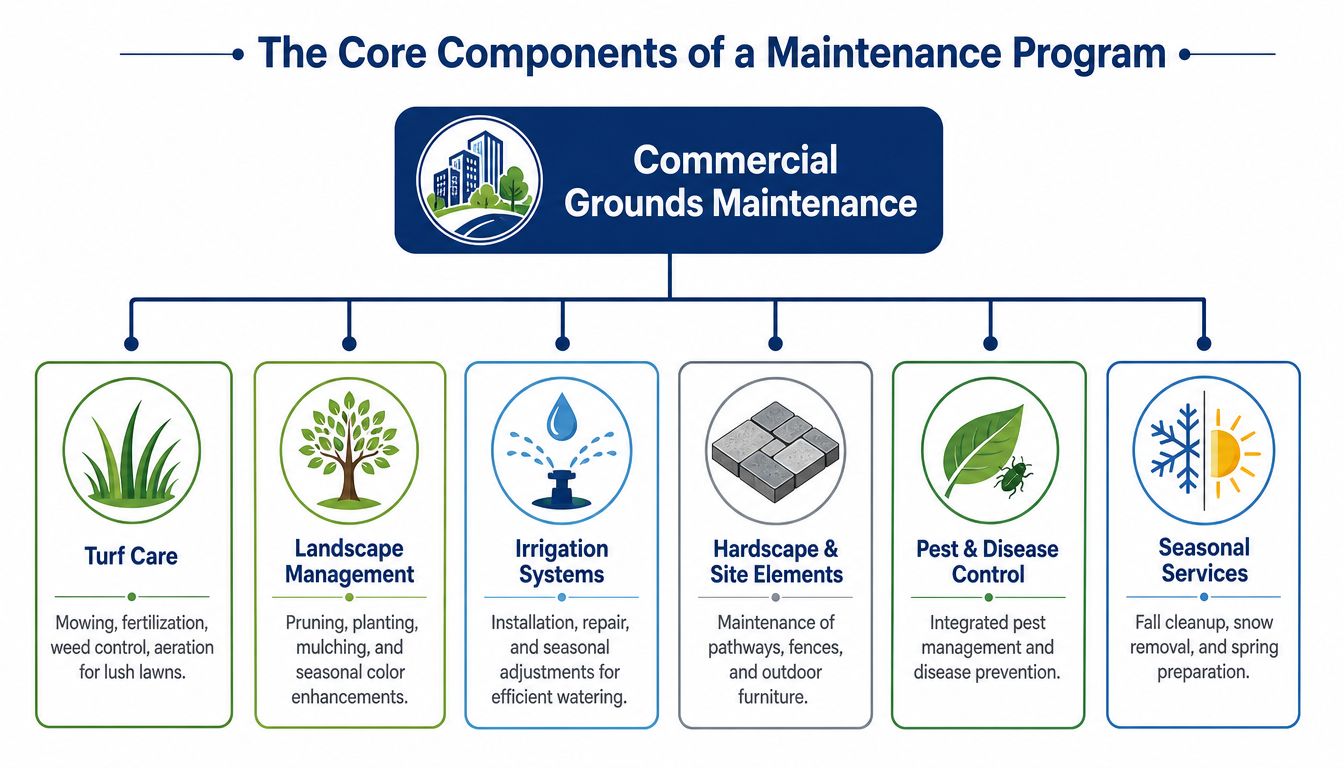
The Core Components of a Maintenance Program
A professional maintenance program works like a high-performance vehicle. The paint matters, but not as much as the engine, cooling system, suspension, and diagnostics. If one system is neglected, the whole asset shows it.
Turf care
Turf is usually the most visible part of the site, and it's often the first thing people judge. On a commercial property, turf care isn't just mowing. It includes cut quality, edging, weed control, seasonal fertilization, stress monitoring, and making sure crews don't scalp weak areas or rut soft soils after rain.
What works in DFW is disciplined consistency. Routes need to account for heat stress, growth surges, and irrigation coverage. What doesn't work is cutting on autopilot at the same height, the same way, regardless of weather or turf condition.
Watch for these operational signs:
- Clean edging at curbs and walks: This makes a property look managed, even before someone notices planting beds.
- Uniform color and density: Patchiness often points to irrigation, compaction, or chemical timing problems.
- No chronic clippings in hardscape areas: That usually signals rushed production, not quality control.
Landscape management
Shrubs, ornamental grasses, perennials, and seasonal color need a different level of attention than turf. Good crews know the difference between pruning for health, pruning for clearance, and shearing everything into the same shape because it's fast.
A lot of commercial properties lose visual quality when vendors over-prune or prune on the wrong schedule. In North Texas, that gets worse when plant selection and exposure aren't respected. South and west exposures can punish material quickly, especially near reflective hardscape.
Grounds management should include:
- Pruning for structure and visibility
- Mulch management
- Bed weed control
- Plant replacement planning
- Seasonal rotation where the property demands color
A site can have a full mowing schedule and still look neglected if the shrub masses, entry beds, and focal points are unmanaged.
Irrigation systems
Many maintenance programs falter in this area. Irrigation is treated like a side service when it should be a core operational discipline. In DFW, that's expensive. Water is too important, plant stress develops too fast, and broken coverage patterns can damage the property's appearance in a short window.
A technical point matters here. In commercial grounds maintenance, proper irrigation isn't just about turning zones on. A municipal specification requires water penetration throughout the full root zone of trees and shrubs, with deep delivery to the full depth of planting pits. That standard reduces waste by 20 to 30% compared with shallow irrigation cycles, according to municipal irrigation and planting specifications.
That's the difference between watering for plant survival and watering for root development.
A competent vendor should be able to discuss:
- Coverage uniformity
- Head alignment and pressure problems
- Controller adjustments by season
- Deep watering for trees and shrubs
- Leak response and repair protocols
For property managers who want a clearer view of what a complete system should include, commercial irrigation system services in DFW provide a useful example of the inspection, repair, and optimization scope to ask about during vendor review.
Hardscape, drainage, and site detail
Hardscape and drainage are often left out of grounds conversations until they fail. That's a mistake. Standing water, soil washout, slippery pavement, displaced mulch, and erosion at bed edges all affect appearance and safety.
The grounds maintenance provider doesn't need to be your civil engineer, but they do need to identify problems early and document them clearly. A site walk should account for:
- Low spots holding water after irrigation or rain
- Mulch migration and exposed roots
- Trip edges near walks and curbs
- Debris accumulation in drainage paths
- Damage around signs, light poles, and site furniture
Plant health and seasonal service
Commercial properties in North Texas need regular observation, not occasional rescue. Insects, fungal pressure, nutrient deficiencies, freeze damage, and heat decline don't fix themselves. The best maintenance programs build plant health into the service rhythm instead of treating it as an add-on after decline becomes obvious.
That includes seasonal cleanup, storm response, bed refreshes, and practical recommendations about what should be replaced versus what should be treated.
A strong program is coordinated. Turf, irrigation, drainage, beds, pruning, and site cleanliness all support each other. If your vendor treats them as separate islands, the property will show the disconnect.
Structuring Your Commercial Service Agreement
Most service problems start in the contract, not in the field. If the agreement is vague, the site standard will be vague too. A property manager then spends the year arguing about what was “included,” what counts as an “extra,” and whether a visible decline is a workmanship issue or a billing opportunity.
The broad market tells you where the industry is headed. Grounds maintenance holds a 42.0% share of the global grounds care services market in 2026, driven largely by recurring annual contracts for commercial properties, according to global landscaping services market data. That makes sense. Commercial sites need repeatable service, not one-off heroics.
Full-service agreements
A full-service agreement is usually the cleanest structure for office, retail, mixed-use, healthcare, and other image-sensitive assets. The vendor handles routine grounds care under a fixed scope with a recurring billing structure, and the property manager spends less time authorizing every minor task.
This model works well when:
- The property has high visibility
- Ownership expects a stable presentation standard
- You want fewer work-order decisions
- The site includes irrigation, beds, turf, and common-area complexity
The upside is control and predictability. The downside is that you need a very clear scope. If the contract says “maintain grounds as needed,” that's not a scope. That's an argument waiting to happen.
Per-service agreements
Per-service, or a la carte, contracts look cheaper at first. They can make sense for small, simple sites, distressed assets in transition, or properties where ownership only wants bare-minimum exterior care.
The trade-off is hidden in the management burden. Every enhancement, repair, seasonal visit, irrigation issue, and cleanup can become a separate approval cycle. That slows response and often raises total friction even if the monthly line item looks lower.
This model tends to fail when the property manager assumes the vendor will “just handle it” anyway. They won't. If it isn't written in, expect a proposal.
Hybrid agreements
Hybrid structures are common in DFW because many properties need a stable baseline but don't want every possible task bundled. A hybrid might include routine mowing, edging, bed care, and seasonal inspections under a recurring fee, while repairs, color rotations, drainage corrections, and larger plant replacements are handled separately.
That can work very well if the property manager knows which items should be fixed cost and which should remain approval based. It's often the best middle ground for portfolios with mixed ownership styles.
Comparing Commercial Grounds Maintenance Contract Models
| Model | Best For | Pros | Cons |
|---|---|---|---|
| Full-service | High-visibility properties, larger campuses, properties with complex landscape systems | Predictable budgeting, fewer approval delays, stronger site consistency | Requires a tightly written scope and good vendor accountability |
| Per-service | Smaller or transitional sites, ownership focused on minimal spend | Low commitment, easy to control individual approvals | More admin work, slower response, higher risk of deferred care |
| Hybrid | Mixed-use portfolios, sites needing baseline care plus selective upgrades | Balances control with consistency, flexible for repairs and enhancements | Can create confusion if responsibilities aren't spelled out clearly |
Clauses that deserve extra attention
Don't let the vendor draft the whole agreement in broad language and assume it protects you. Push for detail in the Statement of Work.
Include language around:
- Visit frequency: Define when recurring service occurs and how weather delays are handled.
- Service standards: Specify expectations for edging, litter removal, line trimming, pruning appearance, and bed condition.
- Irrigation responsibility: State whether inspection, adjustment, repair, and reporting are included.
- Response times: Clarify how urgent issues like flooding heads, fallen limbs, or hazardous obstructions are handled.
- Approval thresholds: Set a clear process for extra work authorizations.
- Reporting: Require site notes, recommendations, and photo documentation where appropriate.
If a contract can't tell a new account manager exactly what “good” looks like on your property, it's incomplete.
The best agreement isn't the shortest or the cheapest. It's the one that reduces ambiguity, protects the asset, and saves the property manager from becoming the daily referee.
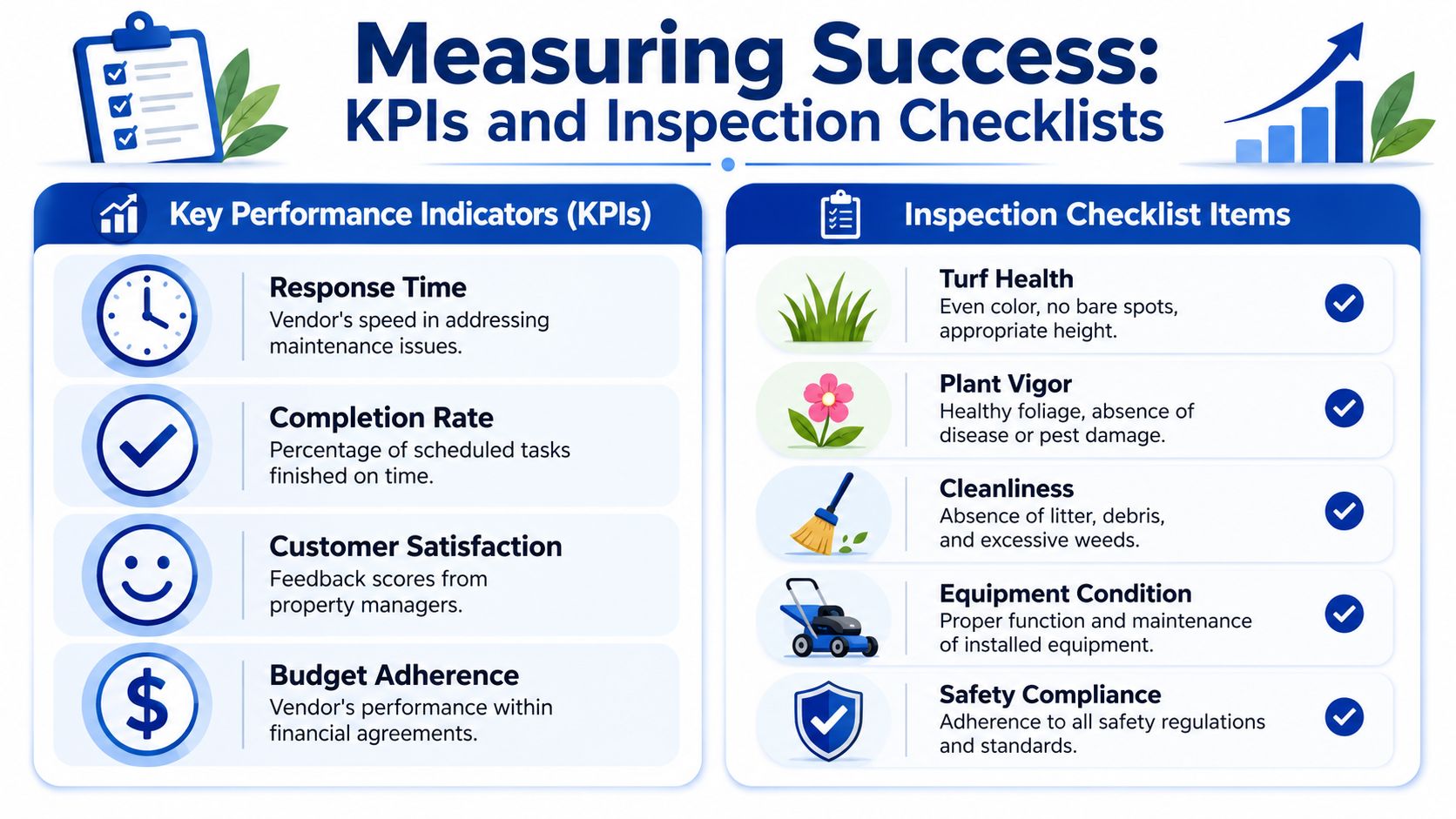
Measuring Success KPIs and Inspection Checklists
If you don't inspect the work, you're managing by complaint. That's common, and it's one reason mediocre vendors survive so long. A property manager gets a site that looks “mostly okay,” then reacts only when a tenant points out a dead bed by the main entry or a sprinkler washing across the sidewalk.
You need a simple scorecard. Not a complicated dashboard nobody uses. Just a repeatable way to verify that the maintenance standard is being met.
Practical KPIs that matter
Most grounds maintenance KPIs should be operational, not theoretical. Track what helps you hold the vendor accountable.
A useful set includes:
- Completion reliability: Did the scheduled scope happen on the planned visit?
- Issue response time: How quickly were leaks, damage, or safety concerns addressed?
- Site presentation score: How does the property rate on turf, beds, pruning, and cleanliness during inspections?
- Water-use variance: Are irrigation issues creating obvious waste or stress?
- Open item aging: How long do unresolved repairs or recommendations sit without action?
These don't require complex software. A shared inspection form, recurring site walk, and documented follow-up will handle most of it.
Use service frequency as a benchmark
Benchmarks matter because they keep conversations objective. For example, an industry-standard turf schedule calls for weekly mowing and edging from late spring through early fall in four-season climates, with pruning 2 to 4 times annually and mulch refreshment 1 to 2 times yearly. Preventive scheduling can reduce reactive maintenance costs by up to 35%, according to commercial landscape maintenance service benchmarks.
That doesn't mean every DFW property should copy that schedule without adjustment. It does mean “we'll show up when needed” is not a real maintenance plan.
A field checklist for site walks
Use the same checklist every time. Walk the same route. Start at the main entrance, then hit side entries, monument signs, dumpster enclosures, rear service areas, and irrigation hot spots.
Check for:
- Turf condition: Even cut, no scalping, no missed strips, no obvious weed breakout.
- Edges and lines: Curbs, sidewalks, and bed edges should look intentional, not ragged.
- Plant health: No dead material left in place, no broken limbs hanging, no obvious stress in key beds.
- Mulch and bed presentation: Coverage should be clean and stable, not washed out or thin in focal areas.
- Irrigation performance: No broken heads, geysers, overspray on pavement, or zones running at the wrong time.
- Cleanliness: Trash, leaf buildup, and debris should be addressed in common areas.
- Safety details: Sightlines, pedestrian paths, and trip conditions should be clear.
Walk the site one day after service, not during service. Crews can make a property look active while still leaving problems behind.
When a vendor knows you inspect against a defined standard, work quality usually improves fast. Not because the checklist is complicated. Because it removes ambiguity.
A Seasonal Maintenance Calendar for North Texas
North Texas doesn't reward generic maintenance calendars. You're managing warm-season turf, rapid weed pressure, hard summer heat, clay soils, wind, intense sun exposure, and weather swings that can move from drought stress to storm cleanup in the same week. The calendar has to fit that reality.
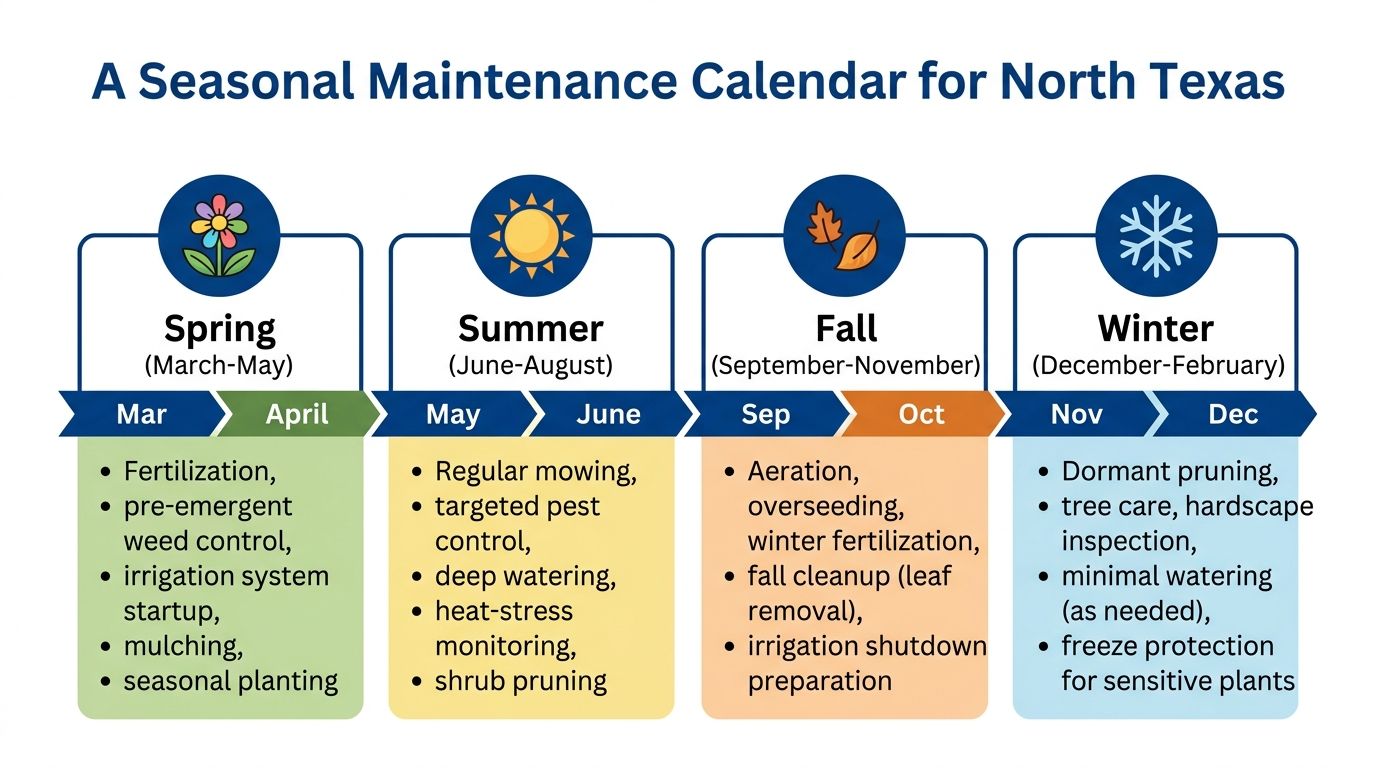
Spring
Spring is reset season. This is when a site either comes out clean and organized or starts the year behind.
Focus on:
- Pre-emergent and weed control timing
- Mulch refresh where beds are depleted
- Irrigation startup and zone testing
- Shrub shaping and dead material removal
- Seasonal planting at entries and focal zones
This is also when poor winter oversight shows up. Broken heads, bare areas, washouts, and plant losses should be identified early so they don't linger into leasing season.
Summer
Summer in DFW exposes weak irrigation, poor plant selection, and careless mowing faster than any other season. Turf can decline quickly, but shrubs and trees often show the more expensive damage.
Summer priorities should include:
- Deep watering where plant material needs it
- Heat-stress monitoring
- Adjusted mowing practices during extreme stress
- Targeted pest and disease observation
- Fast response to irrigation failures
A lot of properties lose money in summer because they overwater shallowly and underinspect. That combination creates waste and still leaves plants stressed.
Fall
Fall is one of the most valuable maintenance windows in North Texas. Temperatures become more manageable, root development improves, and crews can correct a lot of wear from the summer season.
Good fall work usually includes:
- Aeration where turf conditions warrant it
- Overseeding or turf recovery planning where needed
- Leaf and debris cleanup
- Pruning adjustments
- Winter preparation for irrigation and sensitive material
Fall is also the right time to document what should be replaced, renovated, or redesigned before spring budgets are set.
Winter
Winter isn't dead time. It's inspection time. Structural pruning, hardscape review, drainage observation, and freeze response all matter.
During winter, a property manager should expect:
- Dormant pruning where appropriate
- Tree care and clearance work
- Drainage and hardscape inspection
- Minimal watering as needed
- Freeze protection for vulnerable material
In DFW, winter is when disciplined managers fix systems. Undisciplined managers wait until spring and then wonder why the site starts uneven.
The monthly task too many proposals miss
Monthly irrigation inspection deserves its own line item. It's often skipped or buried, and that's costly. Industry data shows 60% of commercial irrigation systems have leaks or malfunctions that go undetected without regular checks, leading to 25 to 40% water waste, according to commercial irrigation inspection guidance.
That's especially relevant in North Texas, where a small valve issue, tilted head, or pressure problem can damage plant material and inflate water use before anyone notices.
If you're reviewing a proposal and monthly irrigation inspection is missing, ask why. It's one of the clearest indicators that a vendor is pricing for appearances rather than long-term site performance.
How to Choose Your Maintenance Partner The RFP Checklist
A commercial grounds maintenance contract is not a commodity purchase. If you buy it like janitorial square footage, you'll usually end up managing chronic problems at a lower unit price. That isn't savings. That's transfer of workload from the vendor to the property manager.
The lowest bid often wins only because the RFP was too shallow. If the request focuses on acreage, mowing frequency, and a lump sum, vendors will compete by narrowing assumptions. The result is predictable. You award the contract, then discover that irrigation oversight, bed detail, seasonal cleanup, reporting, and response expectations were never aligned.

What your RFP should force vendors to clarify
A good RFP gets specific enough that weak operators expose themselves. Ask for written responses, not just a price sheet.
Include these requirements:
- Scope detail: Ask exactly what routine service includes, what it excludes, and what triggers an extra charge.
- Irrigation accountability: Require the vendor to explain inspection frequency, repair process, and how findings are documented.
- Staffing model: Find out whether the same crew leader returns consistently or whether the property is handled by rotating labor.
- Safety and insurance: Require current documentation and a clear explanation of on-site safety practices.
- Communication protocol: Ask who owns the account, how service updates are delivered, and how urgent issues are escalated.
- Quality control: Require a description of inspections, supervisor visits, and how performance problems are corrected.
- DFW experience: Ask for examples of similar local properties and climate-specific recommendations.
- Values and accountability: Ask whether the company has documented operating values and how those values are reflected in hiring, training, and field decisions.
- Technology and reporting: Ask whether there's a customer portal or another organized system for communication and account visibility.
One practical resource for refining those criteria is what to look for in a commercial landscape maintenance company, which mirrors many of the issues property managers run into after award, not before.
Red flags during vendor review
Some red flags are obvious. Others show up in how a proposal is written.
Watch for:
- Generic language: If every site gets the same boilerplate scope, the vendor may not have walked the property carefully.
- No irrigation discussion: In DFW, that's not a minor omission.
- No mention of drainage or site-specific trouble spots: That usually means the estimator priced the mow, not the asset.
- Unclear supervisor access: If you can't identify who owns quality control, you'll struggle later.
- Heavy dependence on exclusions: Some exclusions are normal. Too many means the base price is artificially thin.
Questions worth asking in the walk-through
Use the pre-bid walk to hear how the vendor thinks.
Ask things like:
- What are the first three problem areas you see on this property?
- What would you change in the service plan for summer stress?
- How do you inspect irrigation between major failures?
- What tasks should be fixed fee here, and what should stay approval based?
- How do you document recommendations so they don't disappear between visits?
A serious partner will answer directly. They'll talk about exposure, drainage patterns, worn turf corridors, pruning cycles, controller issues, and budget trade-offs. A commodity bidder will mostly talk about crew capacity and price.
In DFW, one option property managers may review is Rosewood Group, which provides commercial maintenance, irrigation, drainage, plant health care, and related site services under one provider model. That type of end-to-end capability can be useful when a property needs fewer handoffs between vendors.
Rosewood's Commitment to DFW Properties
A new property manager in DFW usually sees the same pattern within the first quarter. The low bid looked fine on paper, then irrigation issues sat too long, heat stress showed up in the wrong areas, and small presentation problems started reaching tenants before the vendor mentioned them. By that point, the monthly price is no longer the actual number. The actual number includes callbacks, replacements, complaints, and time lost managing handoffs.
That is where vendor ownership matters. A useful maintenance partner protects the site, the budget, and your time. The work should be managed with clear standards, documented recommendations, and direct accountability for follow-through.
Rosewood Group is one option property managers may consider in DFW, especially when a site needs maintenance, irrigation, drainage, plant health care, and related exterior services under one provider. That single-provider model can reduce delays between trades and make it easier to assign responsibility when something slips. The company's project background in high-visibility areas such as Uptown's West Village also suggests experience with sites where appearance, access, and consistency all affect tenant expectations.
For a property manager, commitment is not a slogan. It shows up in day-to-day execution:
- Problems are identified early: Dry zones, drainage concerns, visibility issues, and worn entries are called out before they become tenant complaints or replacement costs.
- Recommendations are tied to decisions: You get clear notes on what should be included in base service, what should be quoted separately, and what can wait.
- Quality holds from month to month: The site does not swing from sharp one visit to rough the next because supervision is inconsistent.
- Seasonal changes are handled on time: Summer water management, storm cleanup, and winter prep are planned, not improvised.
Good vendor relationships feel like operational support, not constant chasing.
If you are reviewing providers in Dallas-Fort Worth, ask for a site walk focused on current conditions, service scope, approval thresholds, and who owns quality control after the contract is signed. If you want that kind of review, contact Rosewood Landscape Group to schedule a commercial property inspection and consultation in DFW.
Related posts
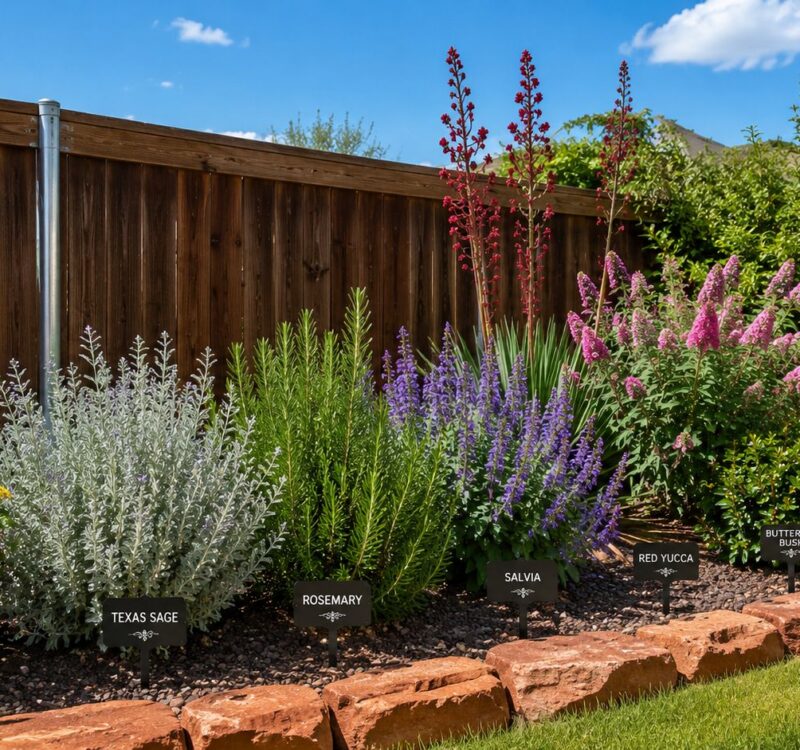
8 Best Shrubs for North Texas Landscapes in 2026
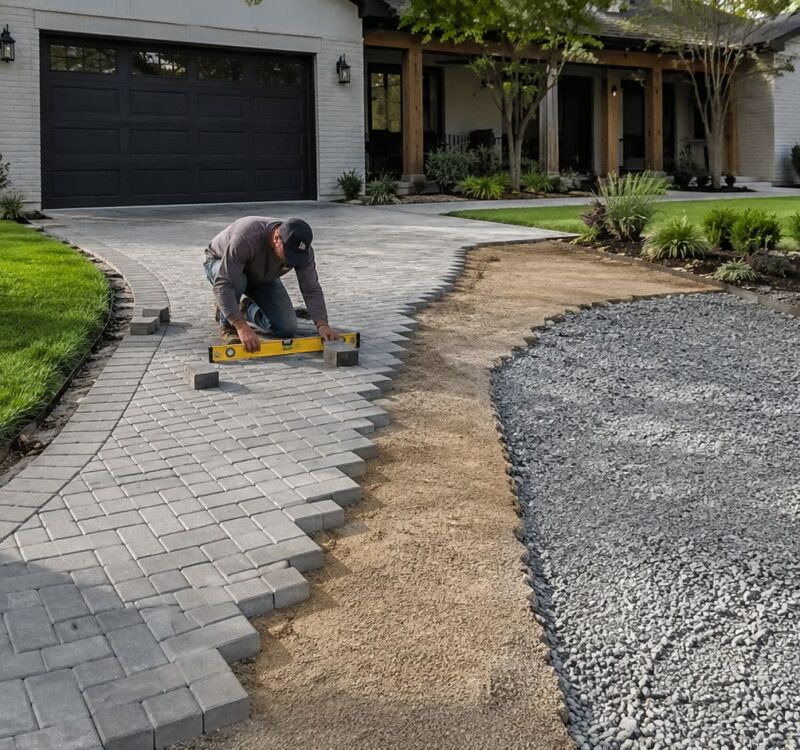
Permeable Paver Installation: A DFW Homeowner’s Guide

Zoysia Grass Fungus: Identify, Treat & Prevent in 2026
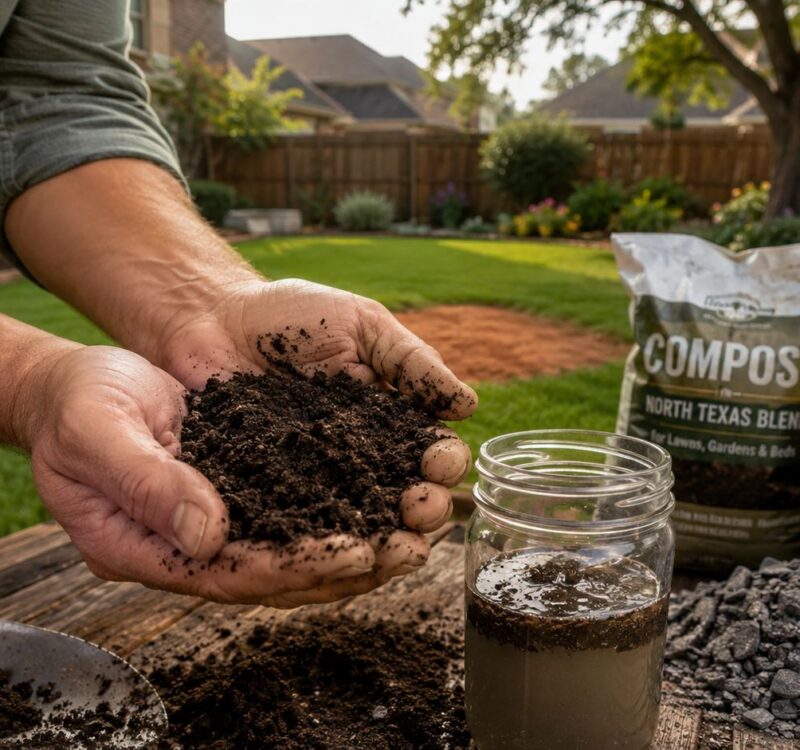
How to Improve Soil Quality: Easy Ways to Improve Soil
Take All Root Rot: Diagnose & Treat Your Lawn