July in Dallas-Fort Worth has a way of exposing every weakness in an irrigation system. The lawn starts fading near the sidewalk, one bed stays soggy, another dries out by noon, and the water bill shows up right when you've been trying to figure out whether the sprinklers are helping or just wasting water.
A lot of North Texas homeowners are still running irrigation with the same kind of timer they've had for years. It turns on because the schedule says so. It doesn't care that it rained yesterday in Frisco, that the west-facing turf in Southlake got baked all afternoon, or that your clay soil can't absorb water as fast as your spray heads are putting it down.
That's where smart irrigation controllers earn their keep. They don't make a bad system perfect by themselves, but they do give a well-designed system a much better brain. For DFW properties, that matters. Our summers are harsh, our soil is tricky, and local watering restrictions mean sloppy scheduling isn't just inefficient, it's a hassle.
Your Guide to Smarter Lawn Watering in DFW
The basic problem is simple. Most older controllers are set once in spring, ignored through summer, and adjusted only after the lawn starts showing stress or the bill gets your attention.
That old approach breaks down fast in North Texas because conditions swing hard. We can get intense heat, dry wind, sudden rain, then another hot stretch a day later. A fixed timer treats all of that the same.
Why traditional timers struggle in DFW
A standard clock timer does one thing well. It follows orders. If you tell it to water every Tuesday, Thursday, and Saturday at 5 a.m., it will.
The trouble is that your grounds doesn't need the same amount of water every week. St. Augustine in full sun needs different management than Bermuda in an open lawn. Foundation beds under tree cover dry differently than turf by the street. And Blackland Prairie clay holds water differently than sandy fill soil brought in during construction.
When the controller can't react, homeowners usually end up with one of two results:
- Overwatering after rain: the system still runs, water pools on hard clay, and runoff heads toward the curb.
- Underwatering during heat spikes: shallow schedules don't keep up, roots stay near the surface, and turf burns faster.
- Uneven results across zones: shady beds stay damp while sunny corners struggle.
- Constant manual tweaking: someone has to remember to change runtimes, shut the system off, and turn it back on.
Practical rule: In DFW, the issue usually isn't whether a lawn gets water. It's whether it gets the right amount at the right time.
What smart control actually changes
Smart irrigation controllers replace rigid scheduling with responsive scheduling. Instead of asking, “What did I program in March,” they ask, “What does this outdoor area need now?”
That doesn't mean every property suddenly becomes fully automated and flawless. Head spacing still matters. Pressure still matters. Broken nozzles still waste water. But once the hardware is in decent shape, the controller can stop a lot of the routine overwatering that comes from set-and-forget programming.
For busy homeowners, that's the key value. You spend less time managing sprinkler schedules and more time knowing the system is adjusting to real conditions instead of guessing.
What Exactly Is a Smart Irrigation Controller
Think of a traditional irrigation timer like an old alarm clock. It goes off at the same time whether you slept badly, stayed up late, or already woke up. A smart irrigation controller acts more like a capable assistant. It still works on a schedule, but it also pays attention to changing conditions before it decides what to do.
A smart controller serves as the command center for your sprinkler system. It opens and closes irrigation zones like a regular controller, but it uses added inputs to decide whether to water, how long to water, and when to skip a cycle.
Two common types you'll see
Most smart irrigation controllers fall into two practical categories.
Weather-based controllers
These controllers use local weather data and site settings to adjust irrigation schedules. They look at factors such as recent rainfall, temperature patterns, and seasonal demand, then increase or reduce watering automatically.
For most DFW homes, this is the style homeowners encounter first. It's popular because it can retrofit onto many existing systems without burying new sensors all over the yard.
Soil moisture-based controllers
These systems rely on in-ground sensors that read moisture levels in the root zone. If soil is already holding enough water, the controller can hold off. If the soil dries down, the system can respond.
This can work very well, especially on properties with distinct planting areas or turf that's difficult to manage by schedule alone. The trade-off is that sensor placement matters a lot. Put a sensor in the wrong spot and you can end up managing the whole zone based on an unrepresentative sample.
What they do well, and what they don't
The best smart irrigation controllers handle changing conditions better than old timers. They also give homeowners app access, easier scheduling, and a clearer view of what the system is doing. If you want a broader look at irrigation topics, Rosewood's water irrigation system articles are a helpful starting point.
They don't fix poor design. If spray heads mist into the street, a valve sticks, or one zone mixes turf and shade-loving shrubs with very different needs, the controller can only work with what it's been given.
The controller is the brain, not the whole body. If the system underneath has problems, smart scheduling won't hide them for long.
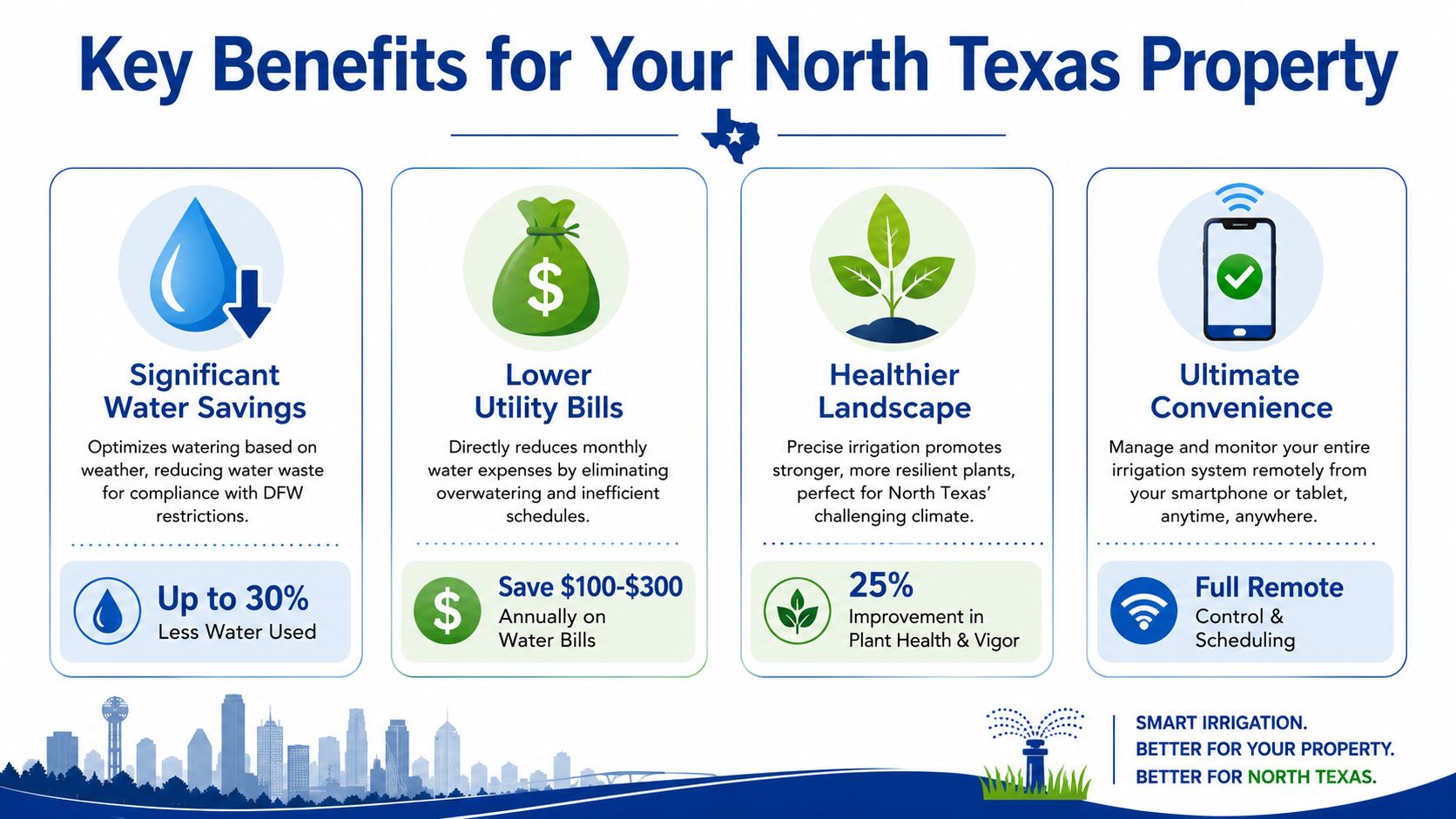
Key Benefits for Your North Texas Property
For a DFW property owner, the appeal isn't the app by itself. It's better control in a climate that punishes waste and inconsistency. When smart irrigation controllers are matched to the site correctly, they solve very specific North Texas problems.

Better watering for clay soil and summer heat
North Texas clay doesn't absorb water the way many homeowners expect. When a zone runs too long in one stretch, water often sits near the surface, runs off, or collects in low spots before roots can benefit from it.
A smart controller helps by adjusting runtime more intelligently and supporting watering strategies that fit the site better. On many DFW systems, that means shorter, better-timed cycles instead of long blanket runs. Turf and plantings get a more useful soak, and you reduce the sloppy overwatering that leaves sidewalks wet and roots shallow.
That matters during extended heat. A lawn with a healthier watering pattern usually handles hot stretches more evenly than one that bounces between too much water and not enough.
Lower waste without constant manual changes
One of the strongest practical reasons to upgrade is that the controller can respond when weather changes and you're busy. If a storm moves through, you don't need to remember to run outside and shut the system down. If conditions shift, the schedule can shift with them.
The one hard number worth knowing comes from the EPA. It estimates that homeowners can save nearly 7,600 gallons of water annually by replacing a standard clock timer with a WaterSense labeled irrigation controller, according to the EPA's page on residential outdoor water use in the U.S..
That won't make every DFW yard identical. Savings depend on the property, the existing system, and how badly the old schedule was missing the mark. Still, the direction is clear. Better control reduces unnecessary watering.
Healthier landscapes and easier compliance
Overwatering causes more trouble in DFW than many homeowners realize. It can leave turf soft, encourage disease pressure, and create stress in ornamental beds that really need air in the root zone as much as they need moisture.
A smarter schedule helps you thread the needle:
- For sunny turf areas: water can be timed to support deeper, steadier root performance.
- For shrubs and beds: zones can avoid the constant sogginess that weakens plants.
- For restricted watering periods: app-based control makes it easier to adjust quickly when local rules change.
- For travel and second homes: you can check schedules without being on site.
If you want a deeper look at why proper irrigation matters in grounds performance, Rosewood's article on why irrigation is important adds useful context.
Choosing the Right Controller for Your Property
Not every smart controller fits every site. The right choice depends less on marketing and more on how your property is laid out, how many zones you have, who will manage it, and how much control you need.
Residential homeowners
For most single-family homes in DFW, the first question is simple. How many zones does the system have today, and how many should it have after cleanup or upgrades?
A typical homeowner should focus on usability before extras. If the app is confusing, the system won't get used properly. If the controller makes basic edits difficult, people stop adjusting it and the benefit fades.
Key residential priorities usually include:
- App clarity: You should be able to see zones, schedules, and rain delays without digging through menus.
- Zone capacity: Buy for the actual system, not for guesswork. Extra capacity can help if future outdoor additions are planned.
- Weather responsiveness: This is often the best fit for homeowners who want reliable automation with minimal involvement.
- Simple override options: You need fast access for hand watering, seasonal changes, and temporary shutdowns during repairs.
- Compatibility with existing wiring: Some retrofits are painless. Others expose valve or common wire issues that need correction first.
Commercial properties and HOAs
Commercial sites, retail centers, office parks, and HOA common areas need a different lens. The question isn't only whether the controller can run zones. It's whether staff or contractors can manage the site efficiently and consistently.
These properties often benefit from stronger remote management features, clearer alerting, and easier multi-site oversight. Durability also matters more when controller locations are exposed, heavily accessed, or maintained by multiple parties over time.
Here's a simple comparison.
Smart Controller Selection Criteria
| Factor | Residential Property | Commercial / HOA Property |
|---|---|---|
| Zone count | Sized for the home's current layout and near-term additions | Sized for larger systems, expansion, and complex common areas |
| App experience | Homeowner-friendly, simple edits, clear manual controls | Centralized management, staff access, easier oversight across teams |
| Best fit style | Often weather-based for easy adoption | Often advanced weather-based or sensor-supported setups |
| Reporting needs | Basic schedule visibility is usually enough | Stronger logging and usage oversight are more valuable |
| Site complexity | Turf, beds, side yards, backyard living spaces | Multiple hydrozones, medians, entries, detention areas, athletic or amenity spaces |
| Maintenance demands | Occasional homeowner review | Ongoing vendor or facilities management |
What usually works best in DFW
On residential sites, the best controller is often the one that the homeowner will trust and check. On commercial sites, the best controller is usually the one that helps a manager make decisions faster and catch issues sooner.
Don't buy based on the biggest feature list. Buy based on whether the controller fits the property and the people running it.
Installation and Smart System Setup
The physical swap from an old timer to a smart irrigation controller can be straightforward. The setup is where most of the value gets won or lost.

DIY works sometimes
If the existing controller is in decent condition, labeled clearly, and the wiring is clean, a capable homeowner can sometimes replace the box without much drama. Many manufacturers walk users through setup by app, and for straightforward systems that can be enough.
But DIY tends to run into trouble in three places. Zone wires are mislabeled. The old schedule gets copied over without rethinking the site. And the controller gets installed, but the site data inside it is too generic to be useful.
That last problem is common. If every zone gets broad default settings, the system may be technically smart while still watering like a blunt instrument.
Professional setup is about calibration
A proper setup starts with the property, not the app. The controller needs accurate information about what each zone is watering and how that area behaves.
On a North Texas property, that often includes:
- Soil conditions: Blackland Prairie clay behaves differently than amended bed soil or imported fill.
- Plant type: Turf, annual color, shrubs, and foundation plantings don't all want the same schedule.
- Sun exposure: West-facing and south-facing zones dry faster than shaded side yards.
- Slope and runoff risk: Sloped lawns and berms need more careful cycle timing.
- Sprinkler type: Rotors, sprays, and drip should never be treated as if they apply water the same way.
- Known weak spots: Corners near pavement, narrow strips, and windy exposures often need special attention.
When installation includes a full irrigation review, the controller becomes part of a smarter system instead of a gadget bolted onto an old problem. Homeowners looking into professional help for design, repair, or optimization can review Rosewood's irrigation services in DFW.
The setup details that matter later
The best smart system setups account for real-life use. Seasonal adjustments should be easy. Wi-Fi should be stable at the controller location. Rain and manual shutoff controls should be easy for the homeowner to find.
A clean install also leaves behind something simple but valuable: clear zone labeling. If someone needs to disable a broken head in the front bed or run a quick test after a repair, that small bit of organization saves a lot of frustration.
Common Myths About Smart Irrigation Debunked
Smart irrigation controllers still get dismissed for reasons that sound reasonable until you've worked with them on actual properties.
Myth 1: They're just expensive gadgets
That's true if the irrigation system is neglected and no one sets the controller up properly. In that case, you've bought nicer hardware without improving the result.
On a well-matched system, though, the controller solves a real operating problem. It cuts down on waste from outdated scheduling and reduces the need for constant manual adjustments.
Myth 2: They're too complicated for normal homeowners
Most current controllers are far easier to use than the old wall boxes with tiny screens and layered menus. If you can use a banking app or a thermostat app, you can usually handle the basics.
The better question isn't whether the technology is advanced. It's whether the interface is clear and whether the initial setup was done right.
Myth 3: They don't work with older sprinkler systems
Plenty of older DFW systems can support a smart controller. Age alone isn't the deciding factor. Wiring condition, valve function, pressure, and zone design matter more.
Some older systems need repair first. That doesn't mean the controller is a bad fit. It means the upgrade should happen in the right order.
A smart controller can improve scheduling fast, but it won't compensate for broken heads, stuck valves, or poor zone layout.
Myth 4: If it's smart, I never have to think about irrigation again
That's one of the most common misunderstandings. Smart irrigation controllers reduce guesswork, but they don't eliminate ownership.
You still need periodic inspections. Sprinkler heads get knocked out of alignment. Drip lines clog. Landscaping changes over time. The controller helps the system make better decisions, but someone still has to make sure the system itself is in good shape.
Get Expert Help From Rosewood Landscape Group
Choosing a smart irrigation controller is the easy part. Matching it to the property is where the true benefit shows up.
An outdoor area in DFW has to deal with hard summer heat, fast-changing weather, clay-heavy soil, and planting areas that rarely behave the same way across the whole yard. That's why the best results usually come from treating the controller as one part of a broader irrigation strategy. Zone design, pressure, runoff, plant type, and scheduling all have to work together.
This is what a professional evaluation should sort out. The right process looks at how the system is currently performing, where water is being wasted, which areas are under stress, and what controller setup fits the site. That's very different from replacing the old timer and hoping the app does the rest.

For homeowners, that can mean a greener lawn with less routine fuss. For commercial sites and HOAs, it can mean a system that's easier to manage and less reactive during the hottest parts of the season.
If your sprinkler system still runs on a fixed timer, or if your current “smart” controller never seems to water the way it should, it's worth getting a site-specific review instead of guessing.
If you want expert guidance on selecting, installing, or tuning a smart irrigation controller for your North Texas property, contact Rosewood Landscape Group. Their team can evaluate your system, identify waste points, and build a smarter watering plan that fits your grounds, soil, and schedule.
Related posts
8 Best Shrubs for North Texas Landscapes in 2026
Permeable Paver Installation: A DFW Homeowner’s Guide

Zoysia Grass Fungus: Identify, Treat & Prevent in 2026

How to Improve Soil Quality: Easy Ways to Improve Soil
Take All Root Rot: Diagnose & Treat Your Lawn