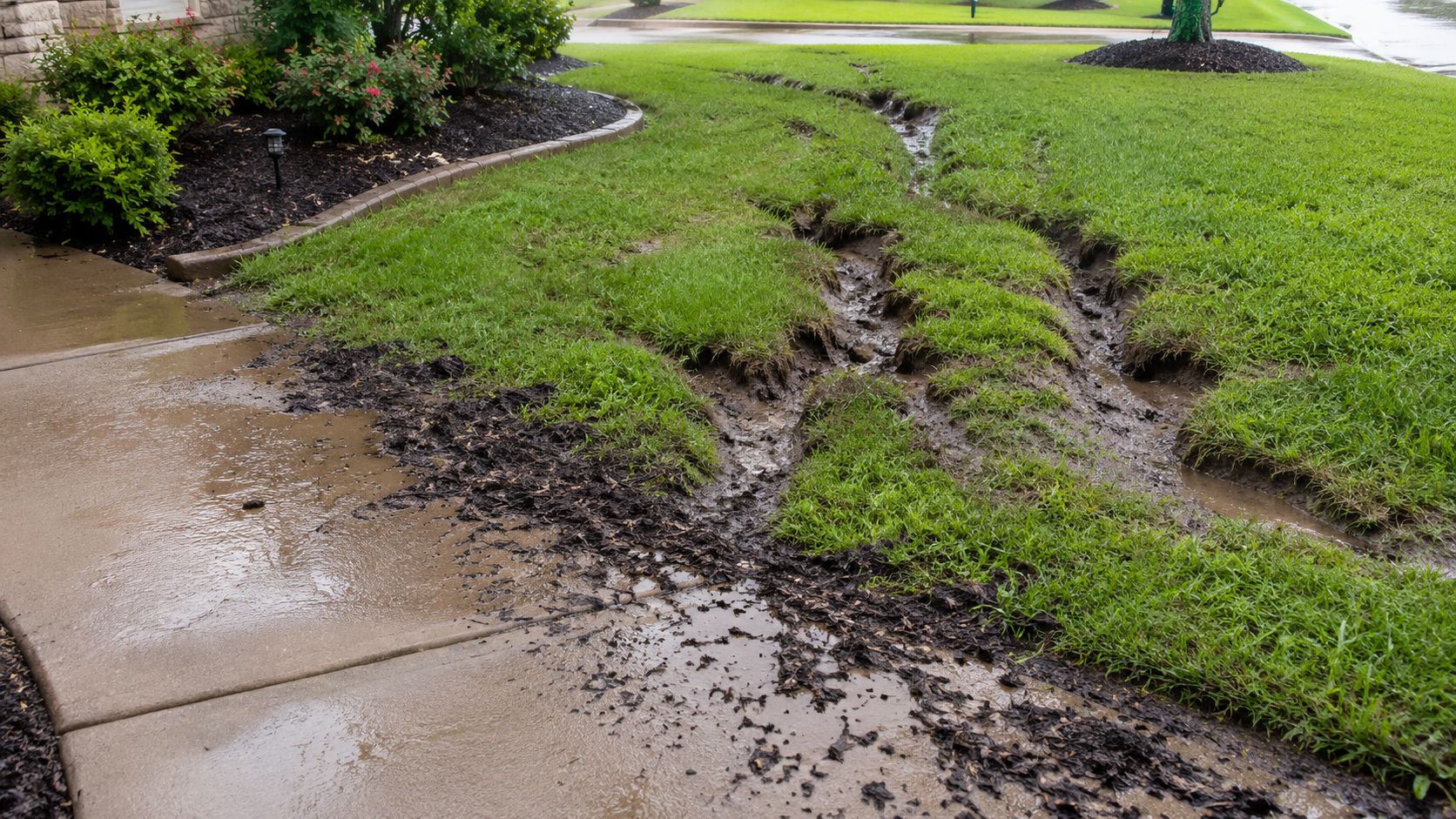
You walk outside after a hard North Texas rain and see the same mess again. Mulch in the sidewalk, muddy streaks across the lawn, a flower bed carved open at the bottom edge, and water sitting where it shouldn't be. If that keeps happening, the problem usually isn't just “too much rain.” It's that the yard is moving water faster than the soil, plants, and grading can handle.
In DFW, erosion control landscaping has to work through extremes. Clay soil seals up and sheds water when storms hit hard. Then long dry periods bake the surface, crack it, and make the next runoff event more destructive. A fix that looks good the week it's installed can fail by the next storm season if it doesn't slow water, protect bare soil, and hold up through maintenance.
Why Your Yard Is Washing Away and What It Costs You
Most homeowners first notice erosion as a cleanup problem. The bed edge collapses. Gravel migrates. Sod lifts. Soil ends up in the street or against the driveway. But erosion is soil being detached and carried away by water, and once that starts, the yard begins to lose the layer its outdoor area depends on.
What makes DFW yards vulnerable
North Texas gives you a rough combination. Heavy downpours deliver a lot of water fast. Clay-heavy soil often doesn't absorb that burst quickly enough. Many suburban lots also have builder grading, compacted subsoil, and concentrated discharge from downspouts. Put those together and the water starts cutting paths.
Freshly disturbed areas are the most fragile. That includes new beds, regraded side yards, utility trenches, new patios, pool construction zones, and bare slopes after tree removal. On disturbed sites, erosion can reach 100 to 500 tons per acre per year, which is about 100 times greater than cropland erosion and 2,000 times greater than natural background erosion, according to this erosion control plant guidance.
That's why newly planted areas often fail before plants root in. The danger is front-loaded.
Practical rule: The first storm after grading is often more important than the finished planting plan.
The costs most people don't see at first
Erosion strips away topsoil first, not just “dirt.” That means your plants lose the layer with the best structure for rooting and moisture retention. In clay soil, once that top layer goes, what's left often sheds water even more aggressively.
The visible damage also leads to secondary problems:
- Plant stress: Roots get exposed, crowns wash out, and young plants dry faster between rains.
- Drainage issues: Water cuts channels that train future runoff into the same destructive route.
- Hardscape undermining: Paver edges, stepping stones, and patio borders can lose support.
- Foundation risk: Repeated water concentration near the house can contribute to movement and moisture problems around the slab.
Why cosmetic fixes don't last
A lot of erosion repairs fail because they treat the symptom. Adding a little mulch over an active washout usually just gives the next storm something else to move. Re-seeding a slope without slowing runoff often produces a thin green layer that tears open at the first concentrated flow path.
Good erosion control landscaping doesn't start with plant selection. It starts with asking one question: Where is the water accelerating, and why is it allowed to stay fast?
Assessing Your Property's Erosion Hotspots
Before you buy fabric, rock, mulch, or plants, walk the property with a simple goal. Track water from the point where it lands or exits a downspout to the point where it leaves your lot or pools. If you can understand that path, you can usually predict where failure will happen.

What to look for on your walk-through
The best time to inspect is during light rain, right after a storm, and again when the ground has dried. Each moment shows something different. During rain, you see flow direction. After rain, you see deposition and damage. When dry, you can spot crusting, exposed roots, and old channels.
Use this field checklist:
- Downspout outlets: Look for splashing, bare soil, or a small trench forming where roof water discharges.
- Slope transitions: Check the bottom of slopes, especially where lawn meets bed, fence line, or patio edge.
- Bare zones: Any open soil patch is a weak point, especially on recently worked ground.
- Low spots: Standing water tells you where water is being trapped instead of guided out.
- Pathways and side yards: Foot traffic compacts soil and creates runoff lanes.
- Bed edging: If water is blowing out one low section of edging, that's usually a concentrated escape point.
Learn the three common erosion patterns
Not all erosion looks dramatic at first. A lot of expensive repairs start with subtle loss.
| Erosion type | What it looks like | What it usually means |
|---|---|---|
| Sheet erosion | Thin, broad soil loss with no obvious ditch | Water is moving across the surface evenly but too fast |
| Rill erosion | Small channels you can rake smooth | Runoff is beginning to concentrate |
| Gully erosion | Larger cuts that return after each rain | The yard needs grade correction or structural control |
Sheet erosion is easy to miss because it looks like the yard is just thinning out. Rills are your warning sign. Gullies mean the water has already claimed a route.
Walk the site from the top down, then from the outlet back uphill. You'll often notice a problem area on the return pass that you missed the first time.
Map the flow, not just the damage
A simple sketch helps more than people expect. Mark the house, downspouts, patio, fence gates, low corners, and every place where soil has moved. Then draw arrows showing runoff direction.
That sketch usually reveals one of three patterns:
- Water is concentrated too early, often from a downspout or hardscape edge.
- Water is accelerating on a slope because there's no interruption.
- Water is getting trapped, then overflowing in the weakest spot.
Once you know which of those is happening, you can stop guessing. That matters because erosion control landscaping works best when every part of the system has a job. One element slows water, another spreads it, another protects soil, and another establishes roots.
Immediate Fixes for Short-Term Stabilization
If soil is actively moving, the first job is to stabilize the surface before the next storm. This is not the time to chase a perfect finished look. You need temporary cover, flow reduction, and enough surface protection to keep the grade from getting worse while you plan the permanent repair.

Use mulch the right way
Mulch helps most when rain is hitting exposed soil directly. It softens impact, shades the soil surface, and buys time for roots to establish. But mulch only works if the water isn't already moving in a concentrated channel.
Use mulch for open beds, mild slopes, and newly planted areas where runoff is broad and shallow. Don't rely on loose mulch alone in a washout lane below a downspout or in a narrow side-yard drain path. In those areas, water will carry it away.
A practical DIY approach is to rake the area smooth, remove loose clods, and apply mulch evenly so the soil is covered rather than patched. If one edge always blows out, pin that zone with a blanket or convert it to rock and drainage instead of repeatedly replacing bark.
Blankets and matting for active slopes
On slopes and recently graded banks, erosion control blankets or jute matting are often the fastest upgrade from “loose cover” to actual stabilization. They hold seed and soil in place while the surface roots in. They also reduce the little rills that start after the first runoff event.
What makes them fail is poor contact with the soil. If the blanket bridges over bumps, water runs underneath and strips soil out of sight. Smooth the surface first, then secure the blanket tight to the grade.
If water can get under the blanket, the blanket becomes camouflage for erosion instead of prevention.
Temporary cover has to be dense enough
Short-term stabilization works only when the material is applied heavily enough to protect the ground. Guidance for temporary cover often specifies hydromulch at 2,000 lb./acre with seed, or 4,000 lb./acre for dry straw mulch, as noted in this erosion control FAQ. The takeaway for homeowners is simple. A light scattering of cover rarely performs like a real erosion control layer.
For small residential trouble spots, that principle still applies. Coverage matters. Thin, uneven application leaves bare gaps, and bare gaps become starting points for washouts.
Fast fixes that buy time
These are useful when you need immediate protection:
- Redirect downspouts: Move discharge away from bare slopes and bed edges.
- Install wattles or similar barriers on contour: They can slow sheet flow on mild to moderate slopes.
- Cover exposed soil quickly: Use mulch or matting before a storm window, not after.
- Protect outlets and splash zones: Add stone where water exits pipes or leaders.
- Keep drains open: If water can't enter the intended drain path, it will cut a new one.
If water is repeatedly crossing a lawn, bed, or side yard and you can't stabilize it with surface treatments alone, the issue is probably drainage design, not just cover. That's where a site-specific landscape drainage plan becomes more useful than another round of patching.
Long-Term Solutions Part 1 Reshaping the Land
After a North Texas cloudburst, the problem usually shows up fast. Water cuts a track through the side yard, mulch ends up in the lawn, and the same bare strip keeps widening with every storm. At that point, the fix is rarely another load of mulch or a few extra plants. The grade is telling water where to go, and right now it is choosing the wrong path.
Regrading before planting
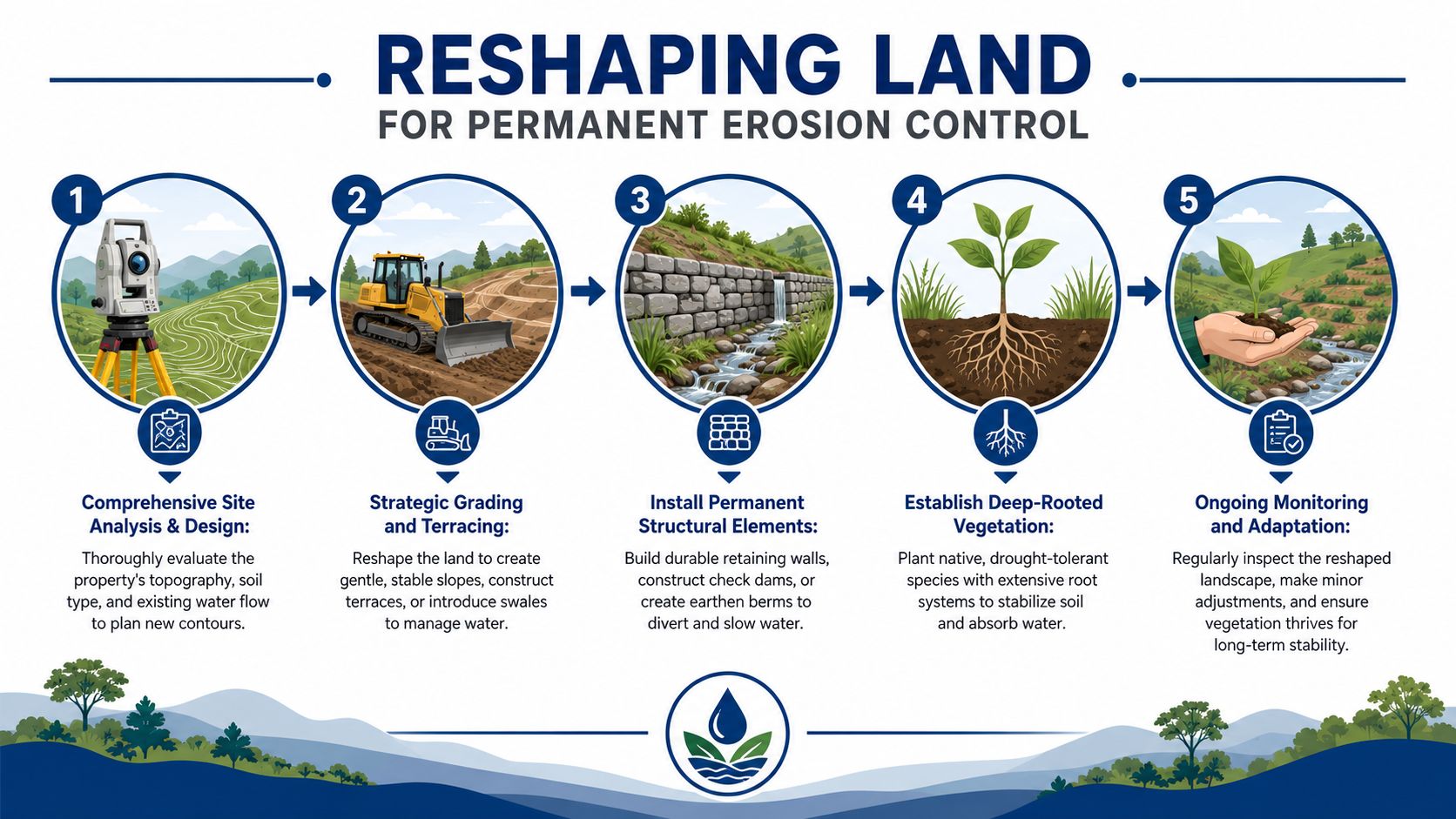
A common mistake on DFW properties is trying to plant through a drainage problem. Homeowners add groundcover, then more mulch, then larger shrubs, but the runoff pattern stays the same. If water is concentrating on bare soil, the dependable sequence is to regrade first, then install geotextile or biodegradable erosion fabric, and only then add plantings or structural checks, as outlined in this steep-slope erosion guidance.
That order matters. Planting into an active flow path usually means replacing plants after the next hard rain.
What grading actually does
Good grading on a residential lot is usually subtle. The job is not massive excavation. The job is shaping the ground so water spreads, slows, and reaches a stable outlet without cutting through soil.
That can mean correcting small low spots that hold water until they overflow. It can mean easing a sharp break in slope that keeps shedding mulch. It can mean redirecting runoff away from a fence line where clay soil has already started to channel.
On clay-heavy sites, restraint matters. Overwork the soil when it is wet and you can create a slick, compacted surface that sheds even more water. Work it too dry and it breaks into clods that do not knit back together well. Durable erosion control in DFW depends as much on timing and finish work as on the shape itself.
A well-shaped yard gives water a route without giving it speed.
Swales, terraces, and retaining structures
Once the flow path is clear, the right built feature depends on slope, available space, and how much runoff the yard receives during heavy storms.
Swales
A vegetated swale works well where runoff needs to cross a yard in a controlled way without turning into a trench. The best ones are broad and shallow, not narrow and deep. In North Texas, they also need enough fall to keep water moving during a storm, but not so much pitch that flow starts scouring the bottom.
Swales often solve the quiet erosion problems along side yards and rear fence lines. They also stay easier to maintain when the edges are simple enough to mow or trim cleanly.
Terraces
Terracing helps on long slopes that keep building runoff speed. Breaking one slope into smaller steps shortens the flow path and creates places where water can pause, soak in, or be redirected.
The trade-off is upkeep. If terrace edges settle, or if runoff is allowed to spill over one point instead of across the full edge, the system starts to fail at the weak spot. On clay soil, that kind of failure can happen quickly after one intense rain.
Retaining walls
A retaining wall fits sites where the grade change is too steep for planting alone, or where the yard does not have enough room for a gentler slope. Walls solve elevation problems. They do not solve drainage by themselves.
A wall should control grade. Drainage should control water.
I have seen plenty of walls that looked fine on day one and started bowing, staining, or washing out at the base later because water had nowhere to go. Backfill, drainage stone, outlet planning, and soil pressure matter just as much as the block or stone you see from the yard.
Why fabric and subgrade prep matter
The visible finish gets the attention. Long-term performance comes from what sits underneath.
On runoff-prone areas, geotextiles, erosion blankets, proper anchoring, and firm subgrade preparation help keep the surface from raveling apart during repeated storms. Manufacturers such as American Excelsior Company publish erosion blanket installation guidance that emphasizes trenching, close soil contact, and secure overlaps. Those details are not fussy extras. They are what keep water from getting under the material and lifting it during a downpour.
The same principle applies to reinforced systems like geocells. The exact build depends on slope, soil condition, runoff volume, and the surface finish above it. What matters for homeowners is the reason these systems work. They confine soil, spread loads, and protect weak subgrade from unraveling. Skip the prep work and the top layer starts moving, even if it looked solid right after installation.
Where professional design changes the outcome
Once grading, drainage, structural elements, and planting all have to work together, the job shifts from patching symptoms to building a system that holds up through drought, heavy rain, and seasonal soil movement. A coordinated plan for professional outdoor design and construction in DFW helps prevent the usual cycle of repair, washout, and repair again.
The best long-term results come from shaping runoff intentionally, protecting the soil surface, and making the finished system realistic to maintain year after year.
Long-Term Solutions Part 2 Using Plants and Hardscapes
After the land is shaped correctly, plants become the living layer that holds the system together. At this stage, many North Texas yards either stabilize beautifully or slide back into maintenance trouble. The difference is usually plant function, not flower color.
On erosion-prone sites, choose plants for rooting habit, spread, and drought tolerance, then build the look around that. In DFW, you want species that can handle summer stress but still establish enough root mass to knit the soil. Deep-rooted grasses and spreading groundcovers usually outperform thirsty, shallow-rooted ornamentals on difficult slopes.
Top erosion control plants for North Texas
| Plant Name | Type | Root System | Water Needs | Sun Exposure |
|---|---|---|---|---|
| Gulf muhly | Ornamental grass | Dense fibrous roots | Low once established | Full sun |
| Little bluestem | Native grass | Deep, soil-binding roots | Low once established | Full sun |
| Inland sea oats | Native grass | Spreading clumps, stabilizing roots | Moderate | Part sun to shade |
| Frogfruit | Groundcover | Spreading, mat-forming roots | Low to moderate | Sun to part shade |
| Liriope | Groundcover | Fibrous clumping roots | Moderate | Sun to shade |
| Asian jasmine | Groundcover | Dense surface-covering roots | Moderate | Part sun to shade |
| Texas sage | Shrub | Woody, stabilizing root system | Low once established | Full sun |
| Dwarf yaupon holly | Shrub | Dense root mass | Low to moderate | Sun to part shade |
This isn't a one-size-fits-all list. A shaded side yard near a downspout needs a different planting strategy than a baked west-facing slope above a patio. But the pattern holds. Dense cover and durable roots outperform sparse ornamental spacing on erosion-prone ground.
Plants that solve different problems
Use plants according to the type of stress:
- For open sunny slopes: Native grasses such as little bluestem and Gulf muhly give you root mass and flexible tops that handle runoff better than brittle annual color beds.
- For shaded drainage edges: Inland sea oats, liriope, and other spreading shade-tolerant plants help cover exposed soil where turf often thins.
- For bed faces and terrace edges: Groundcovers like frogfruit can act like a living mulch.
- For structure and anchoring: Shrubs belong on stable pockets, shelves, or terrace levels, not in the middle of an active washout.
Hardscapes that reduce erosion instead of causing it
Hardscape can help or hurt. Impermeable surfaces that dump water onto unprotected edges often create the very erosion they were supposed to clean up around. Better options are the ones that control where water lands and how fast it moves.
A few examples:
- Permeable pavers: Useful where you want usable space without increasing runoff concentration.
- Stone splash areas: Good below downspouts and outlets.
- Defined footpaths with stone or mulch: Helpful on slopes where repeated traffic strips vegetation.
- Edging with outlet planning: At low points, leave a deliberate escape path so water doesn't pond and burst through randomly.
The best planting plan in the yard will still fail if a walkway, roof drain, or patio edge sends concentrated water straight through it.
If you're already designing for water efficiency and heat tolerance, it's worth pairing erosion control measures with drought-tolerant landscaping ideas for Dallas-Fort Worth homeowners. In North Texas, the most durable outdoor systems usually solve both problems at the same time.
Maintaining Your System and Knowing When to Call a Pro
Most erosion failures in DFW don't happen because the original idea was completely wrong. They happen because the system wasn't maintained through the first storm cycles. New plantings stay too thin. Mulch washes and never gets reset. A drain inlet clogs with sediment. A small rill is ignored until it becomes a recurring cut.
What to inspect after every major storm
You don't need a formal checklist on a clipboard, but you do need a routine. Walk the property and look for changes, not just damage.
Focus on these points:
- Drainage entries and exits: Clear leaves, sediment, and mulch that block flow.
- Slope surfaces: Look for fresh channels, exposed fabric, or lifted blanket edges.
- Mulched beds: Reset displaced mulch before bare soil bakes and hardens.
- Plant establishment: Replace failed plants while the surrounding area is still stable.
- Hardscape edges: Watch for undermining near pavers, path borders, and wall toes.
The first season matters most. A new system has weak points until roots knit the soil and runoff patterns prove themselves.
Why maintenance matters more in North Texas
DFW weather doesn't test outdoor installations gently. A long dry period can weaken fresh plantings and shrink clay soils. Then a sharp downpour hits hard ground, and runoff moves quickly across the surface. That cycle exposes weak installation details fast.
Maintenance is what turns an installation into a system. If one part slips, the others have to carry more load. Once that happens, failure spreads. The drain clogs, the outlet bypasses, the bed edge opens, and now the repair is larger than the original issue.
When vegetation isn't enough
There's a point where homeowners should stop trying to solve erosion with more turf or more groundcover. For slopes greater than 50% (a 2:1 ratio), non-mowed plantings, terracing, or retaining walls are recommended, according to this slope erosion guidance. On grades that steep, relying on grass or simple surface cover alone is a common mistake.
That threshold matters because it clarifies the trade-off. Plants are part of the solution, but they are not always the structure.
Good reasons to call a professional
Bring in help when you see any of these conditions:
- Repeated washouts in the same path: That usually means grading or concentrated runoff needs correction.
- Soil loss near the house or hardscape: Erosion affecting structures carries greater risk.
- A slope that keeps failing after replanting: The root cause is probably runoff speed or poor grade.
- Collapsing bed edges or exposed roots after each storm: Surface cover alone isn't enough.
- Steep or inaccessible areas: These often need terracing, retaining, or engineered drainage.
Rosewood Group handles drainage, grading, planting, and hardscape work across DFW, which makes it one practical option when the fix needs to be coordinated rather than patched one piece at a time.
If your yard keeps washing out after every storm, it's time to fix the water path, not just replace the mulch. Rosewood Landscape Group works with DFW homeowners and property managers on drainage, grading, planting, and long-term stabilization built for North Texas conditions.
Related posts
8 Best Shrubs for North Texas Landscapes in 2026
Permeable Paver Installation: A DFW Homeowner’s Guide
Zoysia Grass Fungus: Identify, Treat & Prevent in 2026
How to Improve Soil Quality: Easy Ways to Improve Soil
Take All Root Rot: Diagnose & Treat Your Lawn