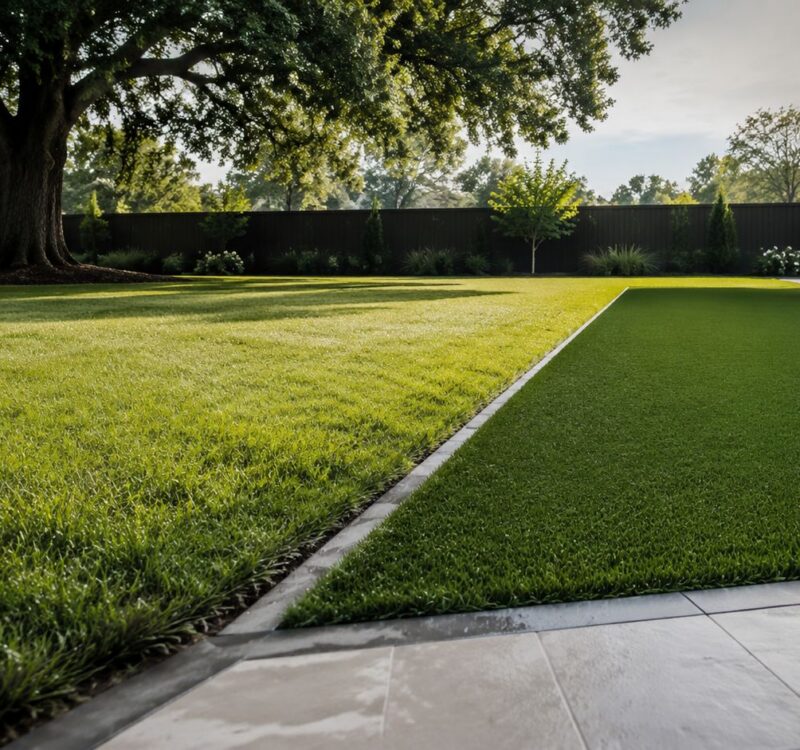
Artificial turf installation cost per square foot usually lands around $16 to $20 installed, with national benchmarks at $16.08 to $19.74 per square foot and similar market averages at $15 to $19 per square foot. That's the right starting point, but in Dallas-Fort Worth the actual price depends on your soil, drainage, heat exposure, access, and how much prep the yard needs before a single roll of turf goes down.
You're probably here because your lawn has turned into a recurring bill. Water it, mow it, feed it, treat it, patch it, then watch a North Texas summer burn it back down again. That cycle gets old fast, especially when large parts of the yard still look tired by August.
Artificial turf solves a different problem than sod. Sod asks you to keep managing nature. Turf asks you to invest upfront so the lawn looks finished and usable with far less ongoing work. For many DFW homeowners, that's the appeal. Not just green color, but fewer weekends spent trying to rescue grass that doesn't want to cooperate with heat, foot traffic, shade, dogs, or clay soil.
Tired of Your Thirsty Texas Lawn
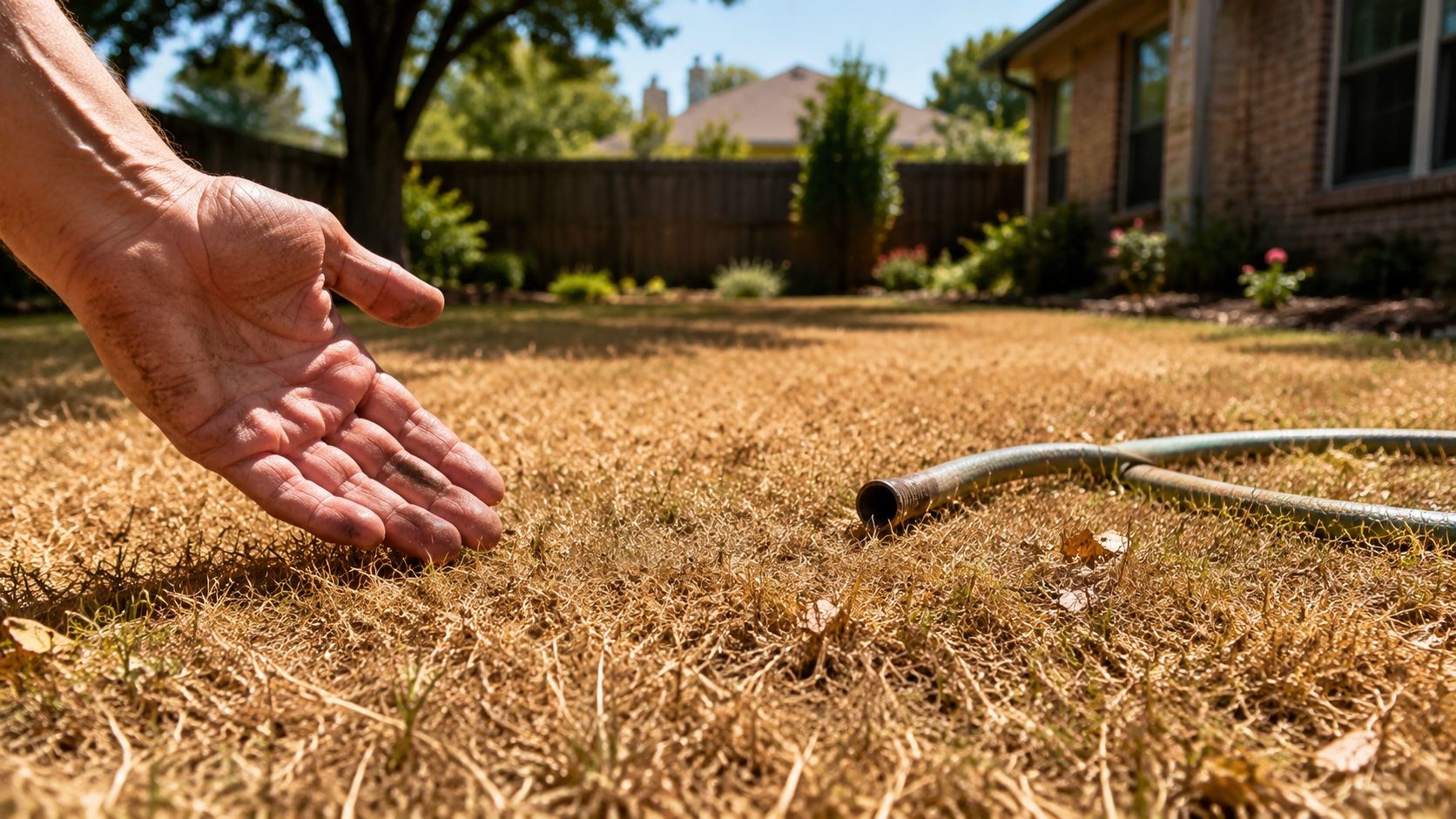
North Texas lawns take a beating. Long hot stretches, watering restrictions, heavy clay, and sudden downpours make it hard to keep grass consistent across an entire yard. One side dries out. Another side stays soggy. The dog run turns into mud. The strip by the patio gets worn down to dirt.
That's why artificial turf keeps coming up in real homeowner conversations. It isn't just about appearance. It's about ending the cycle of reseeding, resodding, mowing, edging, and chasing bare spots every season.
A lot of people begin with one question: what's the artificial turf installation cost per square foot? That's a fair question, but the mistake is treating the turf roll like the whole project. In DFW, the turf product matters, but the ground under it often matters more. Clay expansion, drainage planning, and base compaction are what separate a clean install from one that ripples, holds odor, or drains poorly after storms.
Why the baseline price isn't the whole answer
The national average gives you a budgeting reference. It does not tell you whether your backyard needs extra removal, edging, drainage correction, or access labor. A flat backyard with clean access is one kind of job. A narrow side yard behind a gate with poor slope is another.
If you're comparing turf with other low-water approaches, it also helps to look at drought-tolerant landscaping tips for Dallas-Fort Worth homeowners. In some yards, a mixed strategy works better than wall-to-wall turf.
Turf works best when the space has a clear purpose. Dog run, play zone, clean side yard, shaded patch where grass keeps failing, or a backyard people actually use.
What usually makes turf worth considering in DFW
- Heat-stressed grass: Natural lawns in North Texas often look strongest for only part of the year.
- High-use areas: Kids, pets, and backyard traffic wear out real grass faster than most homeowners expect.
- Mess around patios and pools: Mud, tracked dirt, and thin turf edges create constant cleanup.
- Water fatigue: Some homeowners don't want another season of irrigation tuning and lawn recovery.
For the right property, turf isn't a cosmetic upgrade. It's a practical one.
The National Average Artificial Turf Cost
A realistic baseline for artificial turf installation cost per square foot is the national installed average, not the price of the material alone. Homewyse's May 2026 artificial lawn installation benchmark estimated $16.08 to $19.74 per square foot, and the same verified benchmark notes LawnStarter reported a very similar $15 to $19 per square foot average including materials and labor.
That number surprises homeowners who have only priced turf rolls online. The reason is simple. Installation includes much more than the visible grass layer. A professional quote usually bundles demolition, grading, aggregate base, compaction, cutting, seaming, fastening, cleanup, and finish work.
What that installed number usually includes
When a contractor prices a full turf job, they're not just charging for green surface area. They're pricing the work required to build a stable, drainable, durable system.
Here are the line items most homeowners are paying for:
- Surface removal: Existing grass, weeds, and debris have to come out before base work starts.
- Excavation and grading: The crew adjusts the subgrade so the finished surface drains correctly.
- Base construction: A compacted aggregate base supports the turf and helps prevent soft spots.
- Turf installation: Rolls are cut, fit, seamed, secured, and brushed.
- Perimeter detailing: Edging and transitions around beds, patios, fences, and walkways add labor.
The same Homewyse-based verified data also notes that grass removal adds $0.88 to $1.84 per square foot and edging can add $2 to $11.50 per linear foot. Those two items alone explain why a quote can move quickly once the yard has curves, borders, old lawn to strip out, or awkward transitions.
Why homeowners get confused by low online prices
Some pricing you'll see online is really a material-only number or a stripped-down installation figure for a very simple job. That's not the same as a complete residential install in a real backyard.
Budget rule: If a quote sounds cheap, check whether it includes removal, base prep, drainage correction, infill, seams, and edge restraint.
A verified budget example helps. The same Homewyse-based data says a 500-square-foot project commonly lands around $7,400 to $9,350 installed. That's a useful reference point because it reflects a mid-range national benchmark, not a bare-material estimate.
For DFW homeowners, that baseline is helpful. It gives you a realistic starting budget before local conditions start pushing the number up or down.
Decoding the Line Items on Your Turf Quote
Most turf quotes look simple on the front end and complicated once you read the details. That's normal. A professional install has multiple layers, and each one affects how the finished lawn handles rain, heat, traffic, and time.
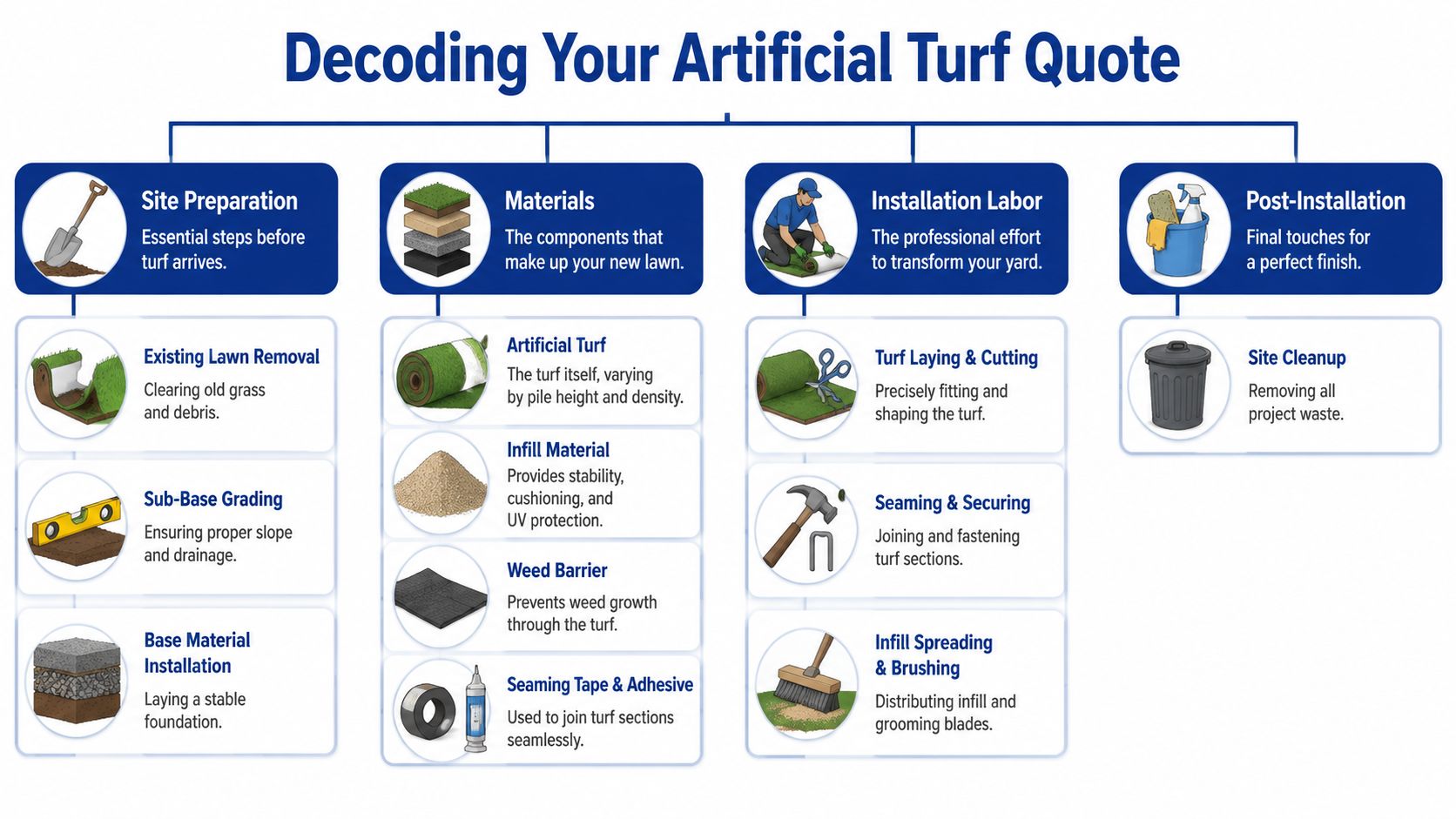
A useful cost model comes from this pricing breakdown of turf materials and installation labor. It separates artificial grass and materials at roughly $4.50 to $7.00 per square foot from labor and installation at $4 to $13 per square foot, for a combined installed range of about $8.50 to $20 per square foot. That labor spread is the important part. It tells you the site can be easy, or it can be a lot of work.
Site preparation
Cheap jobs usually cut corners on the preparation. The yard has to be stripped, graded, and built back correctly before the turf goes down.
Some prep work is straightforward. Some isn't. If the soil is uneven, access is tight, or drainage is poor, labor rises because the crew has to solve those issues first.
Key prep items usually include:
- Existing lawn removal: Old grass and roots can't stay in place under a long-term installation.
- Subgrade shaping: The crew establishes proper slope so surface water moves where it should.
- Base installation and compaction: This supports the turf and keeps the surface from feeling spongy or shifting underfoot.
- Weed barrier and separation layers: Used where the site calls for them.
Materials that change the quote
Not all turf products are built for the same use. A decorative front yard, a pet zone, and a putting surface need different performance characteristics.
The quote often changes based on:
- Turf face weight and density: Heavier, more durable products usually cost more.
- Pile height: Taller isn't always better. In high-use areas, the right balance matters more than a plush look.
- Backing and drainage: Important in DFW, where summer storms can dump water fast.
- Infill selection: Helps support blades, improve feel, and influence how the turf performs over time.
- Edge restraint and transitions: Concrete borders, steel edging, paver interfaces, and bed edges all add detail work.
A clean seam is one of the first things experienced buyers look for. If the crew doesn't respect seam direction and layout, the lawn never looks right no matter how nice the turf is.
Labor is where craftsmanship shows
A homeowner can compare samples in five minutes. It takes much longer to judge installation quality, and that's where projects either hold up or disappoint.
Labor covers the hard parts:
- Precise layout: Rolls need to be oriented correctly so the grain looks consistent.
- Cutting and fitting: Curves, corners, tree rings, and patio edges take time.
- Seaming and fastening: This determines whether the lawn reads as one field or several pieces.
- Infill spreading and grooming: Done right, the surface stands up better and looks more natural.
The smartest move is to ask for a line-item scope, not just a total. A well-scoped quote tells you what's being removed, how the base is built, how edges are finished, and what the crew does after installation. If you want a good reference for how detailed exterior construction planning should look, this guide on how a professional landscape build process works for Dallas homeowners and businesses is worth reviewing.
How Project Size and DFW Conditions Adjust Costs
Project size changes turf pricing more than most homeowners expect. So do local site conditions. Two backyards can measure similarly and still price very differently if one has good access and stable grade while the other has drainage trouble, expansive clay, and tight gate clearance.
A verified size guide from InstallArtificial's 2026 turf cost breakdown shows the scale effect clearly. Projects under 500 square feet can run around $20 per square foot, while a 1,000-square-foot job averages about $12.4 per square foot. That's why small pet runs and narrow side yards often feel expensive on a per-foot basis.
Why larger installs usually price better
Some costs don't scale in a perfectly linear way. Mobilization, cutting around edges, bringing in materials, and setting the base happen whether the project is modest or broad. On a larger continuous lawn, those fixed efforts get spread across more square footage.
That usually favors:
- Large backyard conversions
- HOA common areas
- Commercial amenity zones
- Wide open side-by-side lawn sections
A small broken-up layout often costs more per square foot because the crew spends more time trimming, fitting, and handling transitions.
DFW conditions that raise or lower the quote
North Texas adds its own complications, and clay soil is near the top of the list. Clay expands and contracts. It also drains inconsistently if the grade is off. That means base prep can't be casual.
The local conditions that matter most are:
- Clay-heavy subsoil: Requires disciplined grading and compaction so the surface stays stable.
- Fast storm runoff: Turf needs a base and slope that handle heavy rain without trapping water.
- Summer heat: Product selection and installation quality matter more when the surface is exposed to intense sun.
- Backyard access: A simple install becomes slower and more expensive if material has to move through a narrow side gate by hand.
- Shade patterns and use patterns: Areas under trees or beside structures may need a different approach than full-sun open lawn.
In DFW, drainage is rarely a side issue. It's part of the core installation plan.
Timing can also influence the practical side of a project. Cooler months often make scheduling easier and keep the yard disruption more manageable. If you're planning a broader renovation, why the offseason is the best time to start your landscape renovation in Texas offers a useful way to think about sequencing.
Sample Artificial Turf Project Budgets for DFW Homes
Homeowners usually want one thing after hearing ranges and variables. They want to know what a real project might look like on paper. The table below gives budget examples for common residential scenarios in DFW using the verified project-type ranges available.
The biggest point to understand is that application matters. A basic lawn or dog run doesn't price the same way as a putting green. This artificial grass cost calculator guide lists lawn and dog grass installation at $4.00 to $8.00 per square foot and putting greens at $8.50 to $12.50 per square foot, which helps explain why specialty work can sit in a different bracket.
Estimated Artificial Turf Installation Costs in DFW 2026
| Project Type | Typical Size (Sq. Ft.) | Estimated Cost Range |
|---|---|---|
| Small patio turf or dog run | 250 | $1,000 to $2,000 |
| Typical backyard lawn area | 750 | $3,000 to $6,000 |
| Larger residential lawn zone | 1,500 | $6,000 to $12,000 |
| Backyard putting green | Scope varies | Higher than standard lawn turf on a per-square-foot basis |
These examples are useful for early budgeting, but they don't override the site-specific factors discussed earlier. A compact, clean, rectangular area is usually simpler to price than a yard with curved beds, multiple gates, tree roots, and elevation changes.
How to use the table without misleading yourself
Treat these examples as screening numbers, not contract pricing.
A homeowner should ask:
- Is this a standard lawn area or a specialty surface?
- Will the crew need to remove failing grass or old ground covering material first?
- Are there lots of edges, curves, or built-in features?
- Does the area need drainage correction before installation?
Putting greens deserve special caution. They may look like “just turf,” but they often require more precise grading and a more exact finish. If the sub-base isn't consistent, the surface won't perform the way the owner expects.
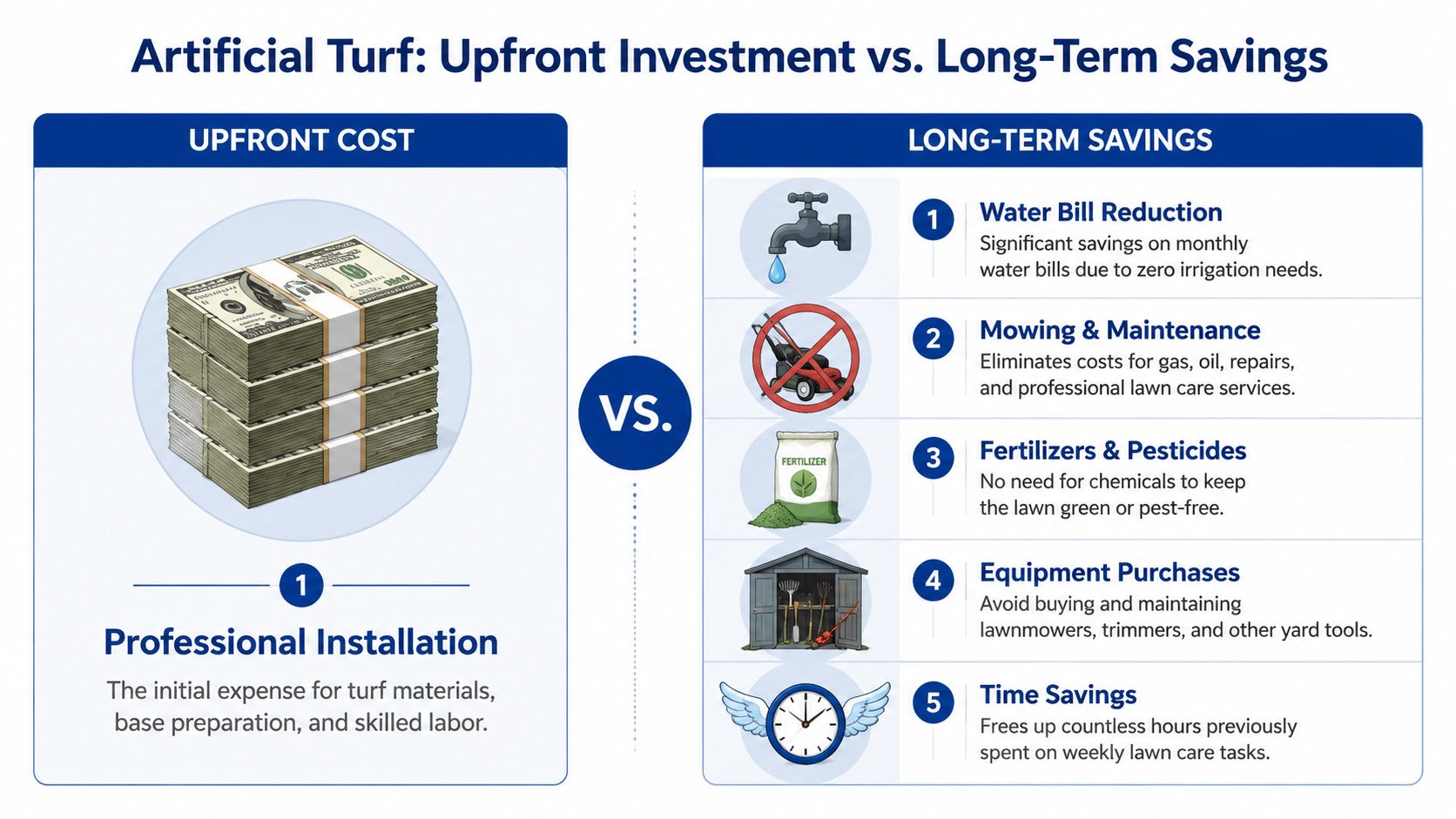
Comparing Upfront Cost to Long-Term Savings
Artificial turf is expensive upfront. That's the honest answer. But the better question isn't just what it costs to install. It's what it costs to own the space over time.
A natural lawn in North Texas keeps billing you. Water, mowing, edging, fertilizing, weed control, seasonal repair, and occasional rework after heat or traffic damage don't stop. Turf changes that equation. You accept a larger initial expense in exchange for a yard that doesn't demand the same recurring cycle of inputs.
Where homeowners usually feel the savings
The long-term value usually shows up in everyday categories:
- Water use: Turf removes the need to irrigate that section like a traditional lawn.
- Routine maintenance: No mowing, edging, fertilizing, or reseeding for the turf area.
- Cleanup and usability: Less mud around patios, pet areas, and play zones.
- Appearance through summer: The space stays visually consistent without the same seasonal drop-off.
For many DFW households, time matters as much as direct expense. The lawn stops competing with weekends.
Why low first cost can be expensive later
The danger is buying turf by sticker price alone. A lower bid can work if the scope is still solid. But a low bid that skips base prep, seam quality, or drainage planning often creates the exact problems homeowners hoped to avoid.
A verified warning from this 2026 turf pricing page discussing low-cost installs and lifespan risk is that installation can be as low as $4 to $8 per square foot in some markets, but poor prep or uneven seams can reduce lifespan. That tracks with what experienced project managers see in the field. When the base is weak, the surface tells on it later.
Cheap turf isn't always the problem. Cheap preparation usually is.
That's especially true in Texas heat. The hotter and harder the environment, the less forgiveness there is for shortcuts. A properly prepared base, good drainage, and careful seam work protect the investment better than chasing the cheapest visible product.
If the goal is long-term value, the smartest comparison isn't turf versus nothing. It's professional turf versus years of repeated spending on a lawn that keeps failing in the same spots.
Get a Precise Quote for Your DFW Property
National averages help. Sample budgets help. Neither one can tell you exactly what your yard will cost.
The only reliable way to price a turf project is to inspect the site and evaluate the things that drive labor and material scope. Grade. Drainage. Clay movement. Access. Existing lawn condition. Edges. Shade. Intended use. A dog run, a family lawn, and a visual accent area might all use turf, but they don't get built the same way.
What a real quote should include
Ask for a quote that clearly identifies the work, not just the total.
A useful proposal should show:
- Removal and prep scope: What gets taken out, and how the site is shaped.
- Base approach: How the contractor plans to build a stable foundation.
- Product selection: Which turf is being installed and why it fits the use.
- Edge and seam treatment: How transitions and joints will be handled.
- Cleanup and finish work: What happens after the turf is secured and brushed.
That level of detail protects you from comparing one full system to another contractor's partial number.
Quick answers to common final questions
Does turf hold up in Texas heat
Yes, when the product and installation are suited to the site. Heat makes quality prep and product choice more important.
Is artificial turf good for dogs
It can be. Pet areas need drainage, practical cleaning access, and the right layout.
Does turf need maintenance
Yes, but far less than natural grass. It still needs periodic cleaning, grooming, and inspection.
Can I finance a turf project
Some contractors offer financing for qualified projects, which can make a larger installation easier to stage within a household budget.
If you want a firm number instead of a broad range, the next step is simple. Have the site evaluated by a contractor who understands North Texas conditions and can price the actual scope instead of guessing from square footage alone.
If you're ready to price a turf project for your home or commercial property, Rosewood Landscape Group can inspect the site, identify key cost drivers, and provide a customized quote for your DFW property. Financing options are available for qualified projects, which can make a long-term lawn upgrade easier to plan.
Related posts
8 Best Shrubs for North Texas Landscapes in 2026
Permeable Paver Installation: A DFW Homeowner’s Guide
Zoysia Grass Fungus: Identify, Treat & Prevent in 2026
How to Improve Soil Quality: Easy Ways to Improve Soil
Take All Root Rot: Diagnose & Treat Your Lawn